In contemporary popular culture, the imagery of ancient gods is undergoing massive transformations. Often, the entertainment industry opts for simplification: deities become superheroes, technologically advanced aliens, or mortal humans within whom «avatars» (like «Moon Knight») or reincarnations of ancient souls (like «The Mighty Johnsons» or «New Gods») suddenly awaken. This approach strips myth of its primary ontological characteristic—continuity.
This visual exploration focuses on a different cultural phenomenon: series where ancient gods are «original.» They have not lost their memory, nor have they died or been reincarnated into human forms. These are the very same ancient Greek gods that people worshipped thousands of years ago, yet they are forced to exist within the realities of the 21st century.
Contents: Introduction Ch. 1. Mimicry and Street Style Ch. 2. Sacred Geography Conclusion Bibliography Image Sources
INTRODUCTION
According to Mircea Eliade’s concept of dividing the world into the «sacred» and the «profane, ” the sacred always seeks to manifest itself through a sharp break from the mundane. In traditional culture, this phenomenon, called hierophany, required monumental temples, inaccessible statues, and strict rituals separating the divine from the everyday. However, in modern fiction, the gods perform the opposite maneuver—visual mimicry. Instead of overwhelming humans with majesty, immortal entities dissolve into the urban environment. The gods borrow the current dress codes of power and subcultures.
The research hypothesis posits that the representation of original gods and monsters is built upon visual oxymorons. Mighty entities are contained within mundane realities—their nature is repackaged into the trivial shells of modern culture.
Semioticsian Roland Barthes, building upon Ferdinand de Saussure’s ideas about the sign—which consists of the signifier and the signified—developed the concept of the modern myth as a secondary sign system in his 1957 work, Mythologies. According to Saussure, the connection between an object’s form and its direct meaning forms the primary sign. Barthes demonstrated that the myth takes this pre-existing sign, empties it of its initial meaning, and transforms it into a pure form for a new meaning. What is merely a sign at the first level becomes the signifier for the myth at the second level. For instance, at the first level, a skyscraper is simply a tall building constructed for spatial efficiency. At the second level, it functions as the signifier for the myth of technological progress, the triumph of capitalism, and the conquest of nature.
Myths in the modern age cease to be fictional tales and become secondary meanings imposed by the content creator.
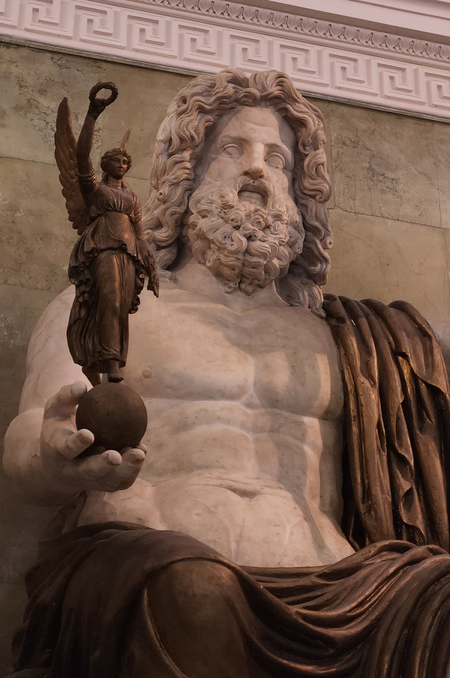
The choice of the ancient Greek pantheon as the core of this research is predicated on its unique status within the visual sphere. Ancient mythology constitutes a foundational cultural code of Western civilization, possessing exceptionally rigid and recognizable iconography. The sculpture of the Classical and Hellenistic periods, Renaissance painting, and academic art have shaped the archetypal visual image of the Olympians for centuries: marble whiteness, idealized anatomical proportions, the draping of togas, and specific attributes (thunderbolt, trident, laurel wreath).
It is this quintessential recognizability that makes the Greek gods a suitable subject for semiotic experimentation. For any viewer to perceive the visual alterations in the gods’ likenesses, the original mythological image must be deeply entrenched in the broad public consciousness. Furthermore, unlike many other mythologies, the Olympian pantheon is inherently anthropomorphic.
The serial format shifts the focus from mythological heroism to the routine and everyday existence of immortal beings. This gives the creators more opportunity to fully flesh out the characters, allowing costume designers and directors to build complex visual drama through mundane details.
CHAPTER 1. MIMICRY AND STREET STYLE: GODS AMONG US
This chapter analyzes the visual trope of divine descent. The gods do not mask themselves; instead, they adapt their representation to fit current capitalist and social hierarchies.
Clothing and the overall appearance of characters play a significant role in visual media. The audience subconsciously assigns characteristics to a character based on their visual presentation.
Instead of classical ancient armor and a helmet, Ares’s visual code in Percy Jackson is radicalized through the aesthetic of rebellious fashion. Ares wears a heavy black leather biker jacket and rides a motorcycle. At the first level of perception, the leather jacket is merely clothing, and the motorcycle is just transportation for quick movement, nothing more.
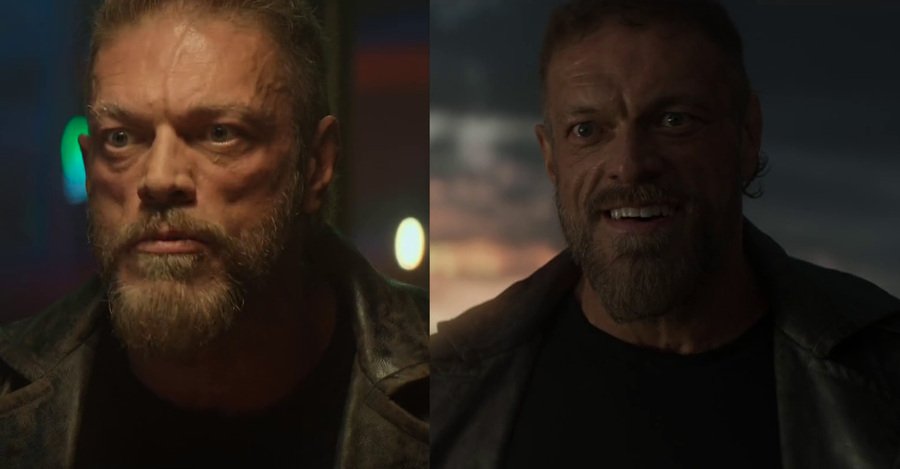
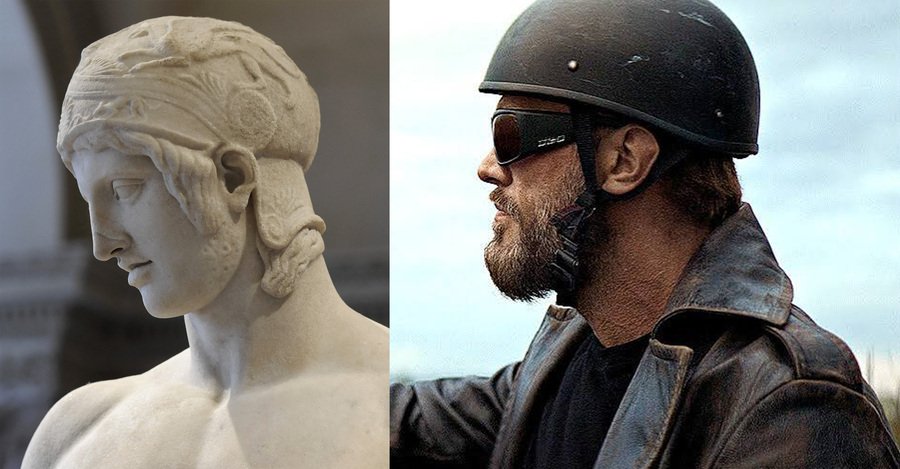
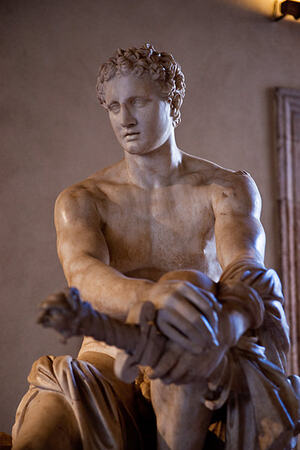
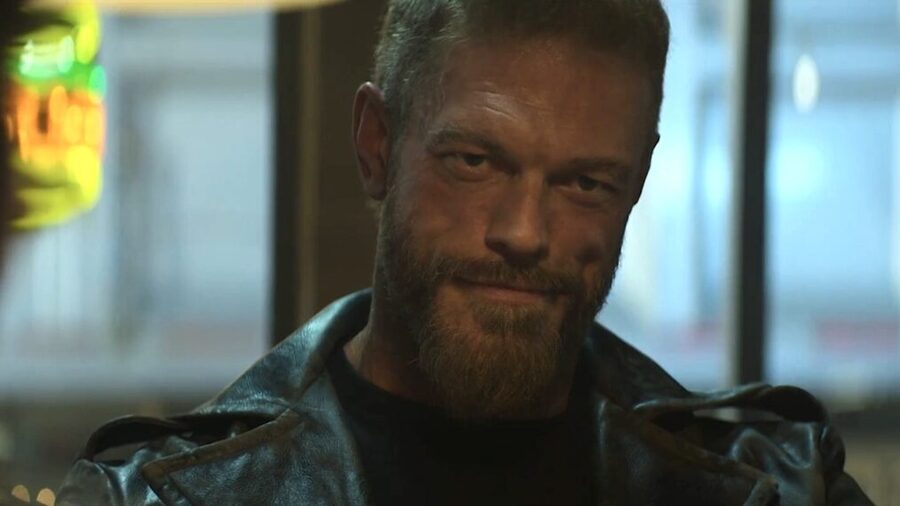
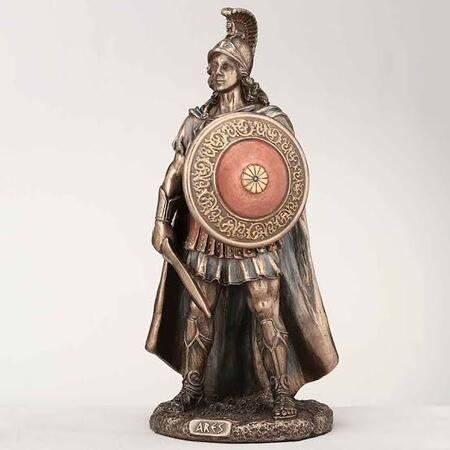
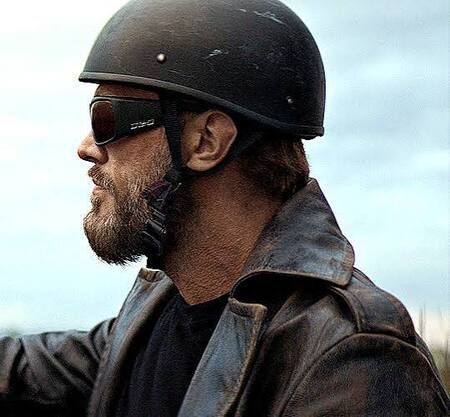
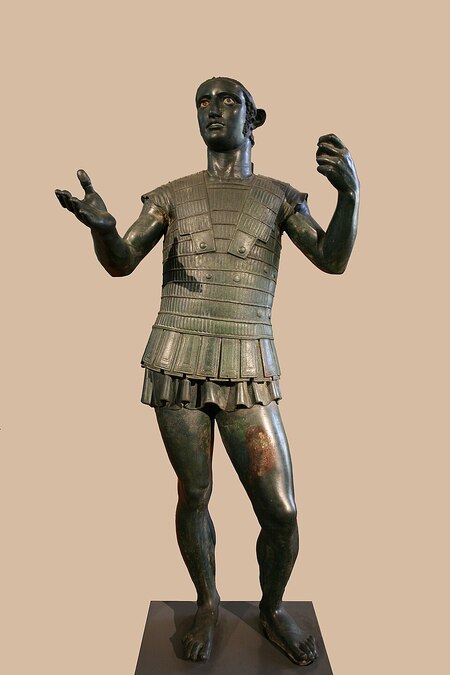
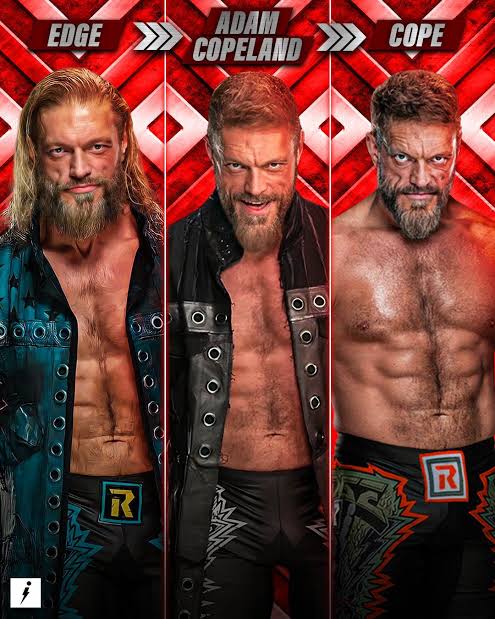
Costume designers, conversely, exploit a second level of perception by referencing the stereotype of «intimidating and menacing bikers.» The leather jacket functions as a modern equivalent of armor, and the roar of the motorcycle engine replaces the clatter of war chariots on the battlefield.

Even the choice of actor suggests the character’s danger—the role of Ares was played by American wrestler Adam Copeland.
Poseidon in «Percy Jackson» looks like a tanned fisherman with scars on his hands. In the series, he wears a light linen beach shirt. Today, the sea is no longer the threat it was in antiquity, and this portrayal of the god of the seas reflects that. The texture of the fabric and the blue-green palette serve as a chromatic reminder of his true nature.
Zeus in «Percy Jackson» wears severe, Wall Street-style business suits, which, according to Roland Barthes' concept presented in the monograph «The System of Fashion,» is read as a sign of absolute power.
In a modern interpretation of «Chaos,» the god of wine, ecstasy, and madness is deconstructed through the contemporary archetype of the privileged «nepo baby» and the carefree party-goer. Instead of raw natural elements (ivy, grapevines, and leopard skins), his wardrobe embodies the maximalism and pop art aesthetic of the 1970s and 1990s.
Since Dionysus was not always an immortal god, he is close to human nature and the human world as a whole. In his search for the meaning of life—something the other gods never considered—Dionysus undergoes an arc of psychological development, which is reinforced by his outward appearance. His visual code evolves from garish vibrancy to more restrained monochrome silhouettes.
Thus, the contemporary depiction of mythological characters is built upon an aesthetic of contrast. The original gods no longer overwhelm the viewer with monumental scale—they exert influence through recognizable social markers, transforming everyday attire and interiors into a new form of divine grandeur.
CHAPTER 2. SACRED GEOGRAPHY: THE SPACE AND ARCHITECTURE OF DIVINE POWER
In classical mythology, the abodes of the gods—the peak of Olympus, the underwater palaces, or the dark Tartarus—were separated from the human world by an insurmountable natural boundary. However, in modern television series, this sacred geography undergoes a process of urbanization and capitalist reinterpretation. Space ceases to be mere background and becomes a primary instrument of visual mimicry: architecture, landscape, and interior design transmit the new social status of the ancient pantheon.
The events of the series «Chaos» take place in an alternate modern Mediterranean setting. Zeus lives on Olympus with his wife Hera, but instead of majestic colonnades and amphitheaters, the viewer sees perfectly manicured emerald lawns, bushes, open swimming pools, and panoramic terraces. The staff resembles employees of an elite golf club. Zeus and Hera exist within a sterile, isolated ecosystem that in modern culture is strongly associated with old money, class segregation, and the leisure of the ultra-rich elite.
According to Roland Barthes' formula, the aesthetic of a private country club—on a first level, it functions as a space for sporting recreation and relaxation—becomes a signifier on a second level for the myth of divine unattainability and the disconnect between power and the real problems of mortals.