Introduction
Alexander Nikolaevich Samokhvalov (1894–1971) holds a significant place in the history of Soviet art, primarily as an artist who created a recognizable visual archetype of the Soviet woman—the worker, the athlete, the metro builder. His «Girl in a T-Shirt» (1932) received a gold medal at the International Exhibition in Paris in 1937 and is often regarded as an iconic image of the era. However, behind this exemplary work lies a longer body of his work, in which the same image—the «builder of a new life”—takes on varying plastic and semantic meanings.The relevance of this study stems from the fact that Samokhvalov’s female figures are most often analyzed as illustrations of Soviet ideology, while their visual structure—composition, angle, figure modeling, the role of attributes, and pictorial texture—remains insufficiently researched. Yet, it is these formal choices that shape a specific type of corporeality, which shifts throughout the 1928–1970 period.
This study focuses on six works by Samokhvalov, created between 1928 and 1970: «Conductor» (1928), «Woman with a File» (1929), «Girl in a T-shirt» (1932), «Girl with a Ball» (1933), «Metro Construction Site with a Drill» (1937), and «Girl with a Flower» (1970).
Research Goal: to trace how the balance between monumental and lyrical qualities in Samokhvalov’s female figures evolved between 1928 and 1970, and to determine the visual devices that convey this dynamic.
Hypothesis
The female figure in Samokhvalov’s work is not a static illustration of an ideological formula, but rather a dynamic visual structure. Between 1928 and 1970, the emphasis in these depictions shifts from the heroine’s productive function to her internal, lyrical subjectivity.It is suggested that in the works of the late 1920s and 1930s, the female figure is primarily constructed as a monumental image of labor and sport: characterized by an enlarged scale, frontality, resemblance to classical statuary, and the use of tools of production as attributes. In the later piece, «Girl with a Flower» (1970), the same monumental foundation is retained, but it is softened and individualized: the flower replaces the drill bit, grace replaces athleticism, and a «resolute posture» coexists with «tenderness and charm.»
In other words, the evolution of the female image in Samokhvalov’s work does not follow a path of abandoning monumentality, but rather a path of humanizing it.
Research Methodology
The work employs a comparative visual analysis of six pieces using unified parameters. This method involves sequentially describing each piece, followed by a correlation of the gathered data.The material is examined in chronological order; however, within each chapter, the pieces are grouped not only by date but also by the type of imagery. For each piece, a visual description (composition, color, details) is provided first, followed by an analysis of the female figure. The study concludes by comparing the parameters across the works to identify shifts that have occurred.
Navigation
- Introduction
- 1928–1929
- 1932–1937
- 1970
- Conclusion
- References
Chapter 1. 1928–1929
Historical Context
The late 1920s marked a period of fundamental restructuring for Soviet society, driven by the focus on industrialization and collectivization. Starting in 1928, drastic changes occurred in the socio-economic sphere—changes the state deliberately leveraged to forge a «New Man» with a transformed consciousness. Simultaneously, the ideological construct of the «New Woman"—a working, conscious participant in communist construction, freed from «domestic servitude"—became firmly established as a visual canon.
«Conductor»
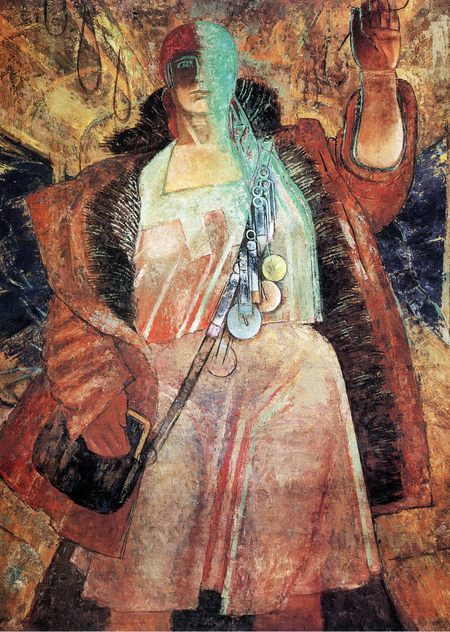
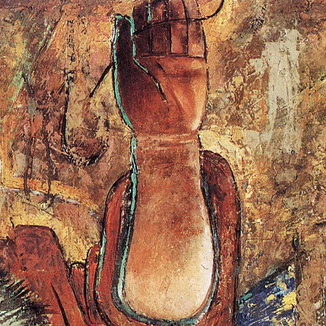
«Conductor,» 1928, A. N. Samokhvalov.
Artwork Description
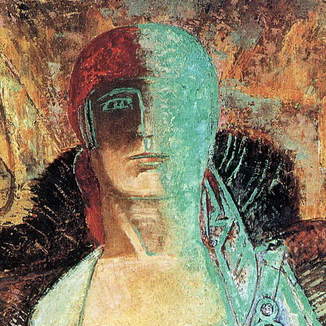
The composition is built upon a stark discrepancy between the figure’s scale and the canvas size. The woman occupies almost the entire space, and her figure appears constrained within the frame. Self-portraiture places the heroine at the center and structures the image as if the viewer is looking up at her from below. This angle transforms an ordinary tram worker into a colossal vision that dominates the viewer. The researchers push the figure’s proportions toward archaic stone sculptures, and the heroine herself gazes down at the viewer with cool indifference.The painting is dominated by blue, red, and yellow. Half of the face is illuminated by the greenish-blue light of an electric flash, and this radiance spills across the heroine’s chest, echoing in the contours of her open palm. The figure does not dissolve into the environment but reigns over the dynamic space amidst the roar of the passing tram. The painting’s texture deliberately imitates a fresco: the brushwork is flat, and only isolated parts of the image gain volume.
Analysis of the female figure
The heroine’s gesture—a raised hand with an open palm—operates on multiple levels simultaneously. On a practical level, it is an energetic signal that directs the tram’s movement. On a symbolic level, it is the hand of Nemesis, and the entire image reads as one of compelling and punitive power. Samkhov himself explained the concept plainly: he wanted the viewer to feel how an ordinary worker controls the formidable and terrifying power of electricity, which in the past was subservient only to Zeus the Thunderer and Elijah the Prophet. His formulation of the heroine’s greatness is also telling: if Athena were to encounter her in her chariot, it would be Athena who would be surprised, not the conductor. What is important here is that the conductor is not simply equal to the goddess—she is calmer and more assured than her, because she acts not within a myth, but within the reality of an electric tram.
However, this monumentality also has a flip side that researchers have noted: the female figure achieves this synthesis at the cost of masculinization. Samkhov does not depict feminine bodies, but rather statues of ancient gods, and in «The Conductor,» corporeality is almost entirely subordinated to function and symbol. The figure lacks customary feminine curves—she is powerful, colossal, and stone-like. This is less a portrait of a specific woman and more a visual formula for a new social type: the worker as the bearer of power over machinery, and through it—over space and time. The artist strives to elevate the image to the level of an epochal symbol, employing the language of monumental painting, and in this sense, «The Conductor» is the first in Samkhov’s series of heroines where the female body becomes a carrier of an idea rather than an object of adoration.
«Woman with a Rasp»
Artwork Description
Analysis of the Female Figure
Chapter 2. 1932–1937
Historical Context
«Girl in a T-shirt»
Artwork Description
Analysis of the Female Figure
«Girl with a Ball»