Navigation
1. Concept 2. Historical Gothic: Architectural Features 3. Assassin’s Creed Unity: Reconstruction 4. Hogwarts Legacy: Stylization 5. Bloodborne: Reimagining 6. Comparison of Three Approaches 7. Conclusion and Findings 8. Bibliography and Image Sources
Concept
Gothic architecture, which developed in Western Europe during the 12th–16th centuries, has become one of the most recognizable architectural styles. Its characteristic elements—pointed arches, ribbed vaults, flying buttresses, buttresses, tall towers, and stained glass windows—created a distinct spatial system characterized by verticality, structural complexity, and the expressiveness of its forms.Initially, Gothic architecture was closely tied to the religious beliefs of medieval society. However, over time, its elements began to be used beyond ecclesiastical construction and subsequently received new interpretations in architecture, literature, cinema, and video games.In modern video games, Gothic architecture often serves as the foundation for creating fantastical cities, castles, cathedrals, and other structures. In this context, historical architectural elements are not merely copied; they are adapted to suit the artistic and spatial demands of the virtual world.
What is particularly interesting is that in video games, architecture ceases to be merely a visual backdrop. Players can independently explore the space, move through buildings, and interact with architectural elements. Consequently, historical forms take on new functions that are not always related to their original purpose.
The choice of this theme stems from an interest in how the architectural heritage of the past continues to exist and evolve within modern digital culture. This research will allow for an examination of video games as a space for reinterpreting historical architecture.
Key question: how do the forms and functions of Gothic architecture transform when transposed into the virtual space of video games?
In medieval architecture, many characteristic elements of Gothic style had specific structural functions. For example, flying buttresses and buttresses were used to counteract the outward thrust of vaults. In video games, the need for such structures is often absent, yet developers continue to reproduce them for visual expressiveness and spatial organization.
Hypothesis: In video games, Gothic architecture is used not only for historical stylization.
Its characteristic elements are reinterpreted to create various artistic effects and to organize the game space.
Historical Gothic: Architectural Features
What is Gothic architecture?
Gothic is an architectural style that originated in Northern France in the mid-12th century and spread throughout Europe during the 13th–16th centuries.
Gothic succeeded the Romanesque style. Its development was connected to the refinement of structural engineering, the growth of medieval cities, and the importance of the Christian Church in European society.
The characteristics of Gothic were most fully manifested in the architecture of cathedrals, although the style was also used in the construction of castles, town halls, palaces, and other structures.
The defining characteristic of Gothic architecture is the aspiration to create tall, spacious, and well-lit buildings. To achieve this, architects utilized a structural system that allowed them to reduce the massiveness of walls while increasing window sizes. Unlike Romanesque architecture, which features predominantly heavy walls, small window openings, and massive forms, Gothic architecture strove for verticality, lightness, and spatial expressiveness. The church of the Abbey of Saint-Denis, near Paris, is considered a crucial early monument of Gothic architecture; its choir was rebuilt between 1140 and 1144 under the guidance of Abbot Suger.
Gothic is not defined by a single element, but by a combination of characteristic structural and compositional solutions.
Characteristic elements of Gothic architecture include
Pointed arch—an arch with a sharpened apex. It is used in window and door openings, arcades, and vaults. It allows for the creation of varied opening proportions and emphasizes the verticality of the structure.Ribbed vault—a vault featuring a system of projecting stone ribs, called ribs. These ribs organize the geometry of the vaulting and participate in load distribution.Flying buttress—an exterior supporting arch that transfers the thrust of a high vault to an external support.Buttress—a vertical support projecting from the wall that absorbs horizontal forces and increases the stability of the structure.Verticality—the characteristic prevalence of elongated proportions, tall towers, spires, narrow windows, and vertical articulation of the facade.Stained glass and large windows—essential elements of the Gothic interior. Thanks to the development of the structural system, it became possible to install expansive glazed surfaces that fill the space with colored light.Architectural decoration—complex stone carving, tracery in window frames, sculptures, pinnacles, and ornamental details.
These elements form an interconnected architectural system. It is their combination that allows one to distinguish historical Gothic from later stylizations.
Gothic (12th–16th Centuries)
Gothic is an architectural style that emerged in Northern France in the mid-12th century and subsequently spread across Europe. It succeeded the Romanesque style and achieved its greatest development in the construction of cathedrals, monasteries, castles, and public buildings.
The evolution of Gothic was driven by advancements in construction technologies and the ambition to create taller, more spacious, and better-lit structures. One of the earliest Gothic monuments was the Abbey Church of Saint-Denis in France, which was remodeled in the 12th century.
Chartres Cathedral (France, 12th–13th centuries)
Chartres Cathedral is one of the most renowned examples of French Gothic architecture. The main body of the current building was constructed following the fire of 1194.
The cathedral is characterized by its high rib vaults, pointed arches, developed system of flying buttresses, and large stained-glass windows. A distinctive feature of the facade is the presence of two towers, each topped with a spire of a different shape and dating.
The principal architectural characteristic is the combination of a monumental vertical composition with an abundance of stained glass, which fills the interior with colored light.
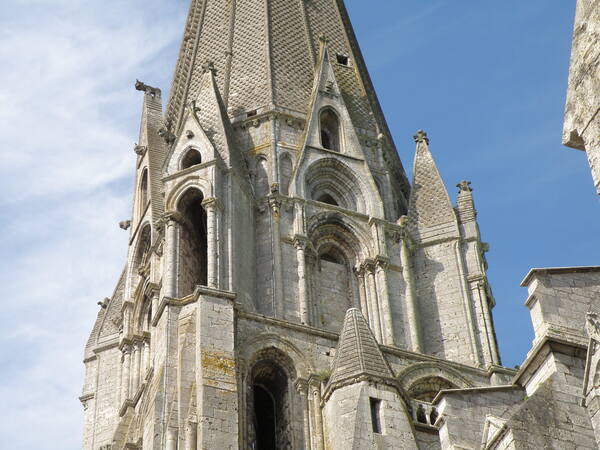
Южная башня (XII век)
Северная башня (XVI век)
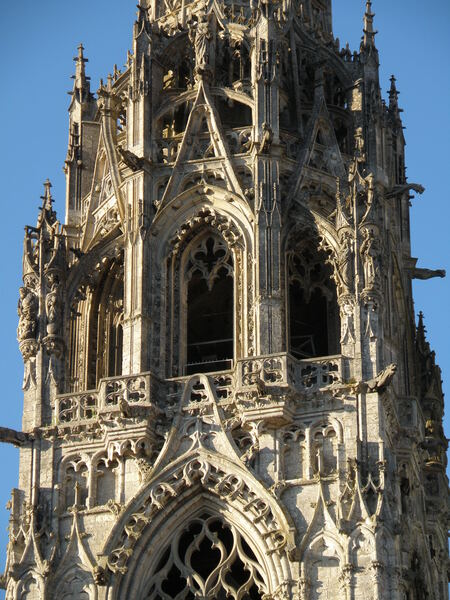
The South Tower is executed in the style of Early Gothic. It is characterized by strict geometric forms, restrained decoration, and a tall octagonal stone spire.The North Tower—its spire was rebuilt in the style of Late Flamboyant Gothic. It features intricate openwork carving, an abundance of decorative elements, and a more refined silhouette.The main feature is that the two towers of the Chartres Cathedral reflect different stages of Gothic development, ranging from the rigid forms of the early period to the decorative complexity of the later one.
Amiens Cathedral (France, 13th Century)
Amiens Cathedral is one of the largest and most expressive monuments of mature French Gothic architecture. Its construction began in 1220.
The cathedral is distinguished by its high ribbed vaults, pointed arches, elaborate system of flying buttresses and buttresses. The main façade is adorned with three portals, sculptures, and a large rose window.
The defining feature is the height of the central nave (approximately 42 meters) and the elegant proportions, which create a sense of vertical aspiration and monumentality.
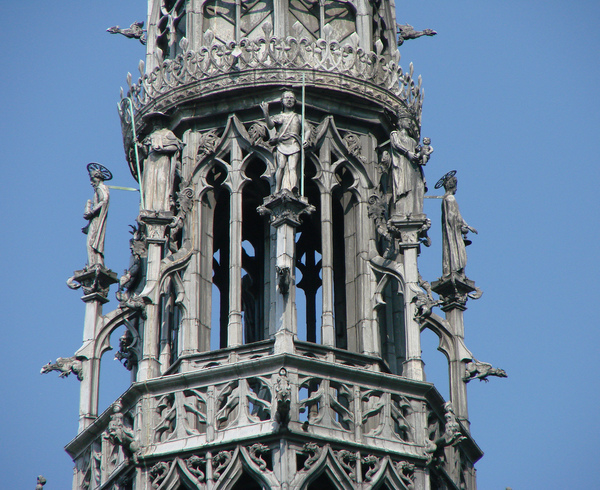
Скульптуры шпиля
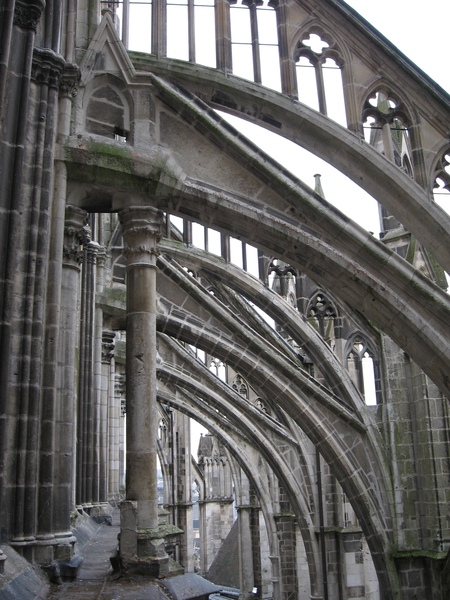
Аркбутаны
Sculptures on the spire serve as part of the decorative and symbolic ornamentation of Gothic architecture. Figures of saints and religious characters emphasize the cathedral’s spiritual purpose, while intricate stonework enhances the structure’s verticality and expressiveness.
Flying buttresses are external stone semicircular arches that transfer the thrust of the vaults to the buttresses. They allowed for the construction of taller walls with larger windows while simultaneously forming the characteristic tracery appearance of Gothic cathedrals.
Neo-Gothic (18th–19th Centuries)
Midland Grand Hotel (1868–1876)
Neo-Gothic is an architectural style that originated in Great Britain during the 18th century and gained widespread popularity across Europe and America in the 19th century.
Neo-Gothic is based on the revival of medieval Gothic forms. Architects reintroduce pointed arches, towers, spires, stained glass, and decorative stone carving.
The main difference from medieval Gothic is that the historical forms are now intentionally reproduced in new buildings, including universities, parliaments, residential buildings, and train stations. Furthermore, modern materials and construction techniques for that era can be utilized.