Scale Illusion: The Evolution of Technologies for Creating Large Spaces in Film
The visual study focuses on the development of technologies used by cinematographers to create massive spaces—from fantastical cities and architectural structures to entire fictional worlds.
Using examples from films across different eras, it examines how picturesque backdrops, optical illusions, miniature models, computer graphics, and virtual soundstages enable the creation of a sense of space far exceeding the real dimensions of the set design.
Particular attention is given to how perspective, lighting, camera movement, and the combination of various technologies influence the viewer’s perception of scale.
Research Concept
Cinema, since its inception, has striven to transcend the physical boundaries of the film set. On screen, giant structures, endless cities, fantastic planets, and spaces have appeared—creations that would be technically impossible or economically unwarranted to build at full scale. Yet, for the viewer, these spaces must appear convincing and be perceived as a unified reality.To achieve this, filmmakers have developed various methods for creating spatial illusion. Painted backdrops and perspective imagery allowed for the visual continuation of real interiors. Optical techniques merged objects shot under different conditions. Miniature models replaced enormous architectural structures, and later, computer graphics enabled the creation of entire cities and landscapes in a digital environment.The primary focus of this study is not solely on technological development, but also on how the image of a small physical object or an artificially constructed environment transforms into a convincing, large-scale space on screen.Several characteristic examples from the history of cinema are examined for this purpose. Among these are «Black Narcissus» (1947), «Blade Runner» (1982), The Lord of the Rings trilogy (2001–2003), «Avatar» (2009), and the series «The Mandalorian» (since 2019). These works represent different stages of technological evolution and allow for a comparison of spatial illusion creation methods.The study analyzes not the plots of the films, but specific visual solutions: the construction of set design, methods of using perspective, the characteristics of miniature shooting, digital modeling, and the integration of various image elements. Production stills, schematics, set photography, film clips, and materials demonstrating the creation process of visual effects are of particular importance.The selection of material is based on two principles. The first is historical progression, which allows us to trace the development of technological capabilities. The second is the visual clarity of comparison, enabling a juxtaposition of the final image with the physical model, painted background, or digital scene used to create it.The structure of the research is based on a technological principle. Each chapter is dedicated to a specific method of space formation: painted
Categories
- Research Concept
- Origins of Spatial Illusion: Painted Scenography and Matte Painting
- Optical Effects: Perspective and Space Blending
- Miniature Models: Creating Giant Cities and Structures
- Combined Technologies: Interaction Between Physical Models and Digital Graphics
- Digital Worlds: Computer Modeling of Large-Scale Spaces
- Virtual Production: LED Screens and Real-Time Environments
- Comparative Analysis of Scale Creation Technologies
- Conclusion
- Bibliography
- Image Sources
Chapter 1. Origins of Spatial Illusion
When the drawn world becomes reality
Even before the advent of digital technologies, cinematographers learned to create on-screen spaces that did not exist in front of the camera. Artists enhanced real sets with depictions of architecture, landscapes, and entire cities, using perspective, light, and painterly techniques. One of the most crucial methods was the matte painting technique—the process of painting in elements of an image to merge live-action footage with artificially created environments.
How Matte Painting Works
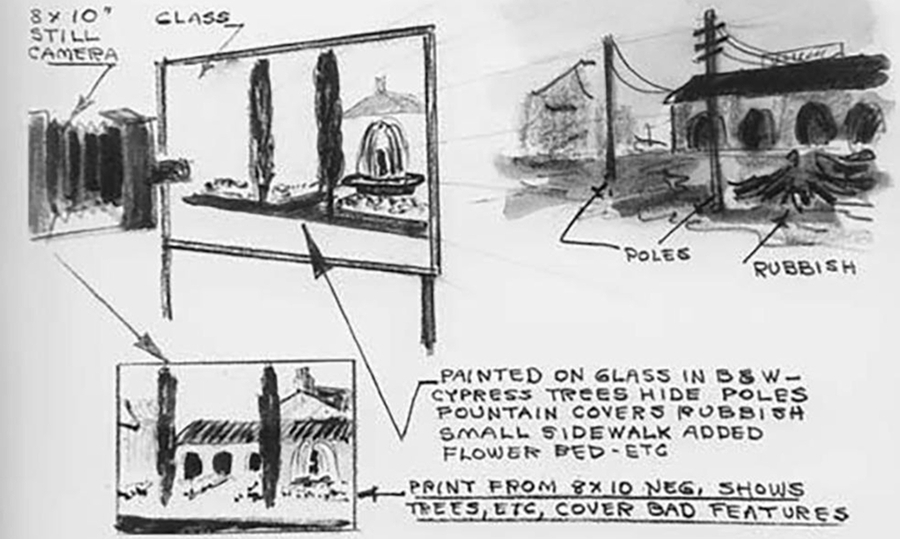
Real and illustrated in one frameA traditional matte painting is based on merging filmed space with a painted image. The artist creates missing elements of the environment—for example, high mountains, architectural structures, or distant buildings.One of the early methods involved applying the image onto glass placed between the camera and the real object. With precise perspective matching, the painted elements were perceived as an extension of the actual space.Thus, scale was achieved not by constructing an enormous set, but by integrating several visual layers into a single frame.
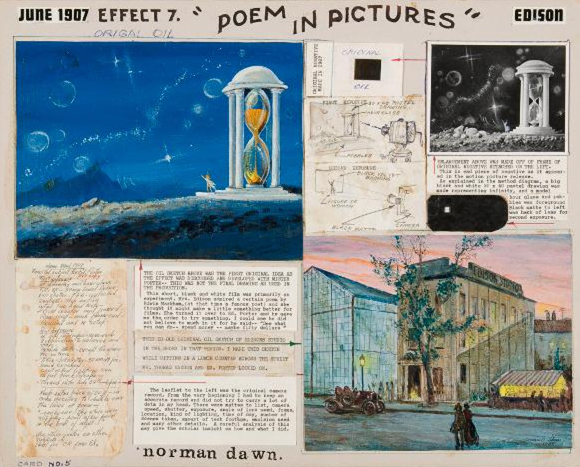
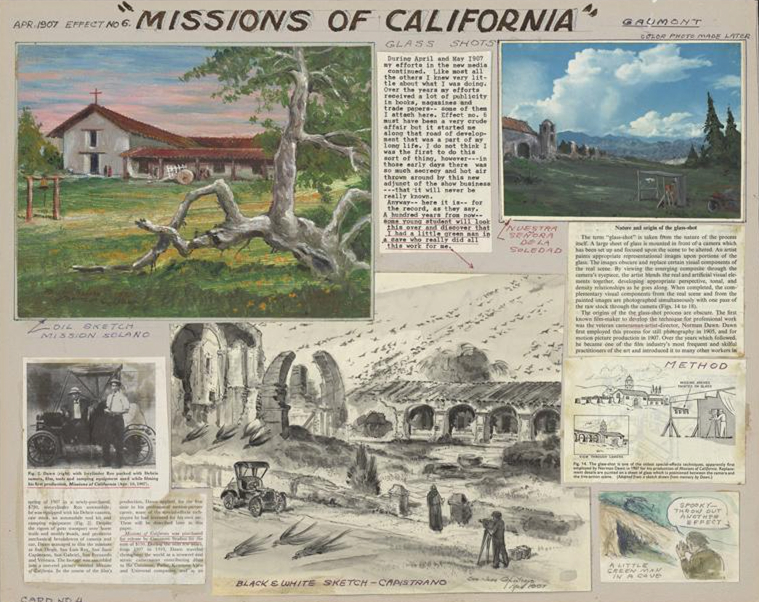
Norman Downe and early sketches, 1907
- Space Augmented by Painting
One of the pioneers in using pictorial inpainting in cinema was the American cinematographer Norman Downe. While working on the film «California Missions» (1907), he used images on glass to visually restore damaged architectural structures.
The inpainted elements covered damaged sections of buildings, creating the impression of cohesive architecture.
This example is significant to the history of cinematic space: the camera captured not only the existing reality but also an image specifically created to augment it.
The visual veracity of the space began to depend not only on what was in front of the camera, but also on what the artist could add to the frame.