
Introduction
In a furniture catalog, the impression of an interior is created not only by sofas, tables, and cabinets, but also by the surrounding objects: books, tableware, clothing, plants, and children’s toys. These items suggest who lives in the room, what they do, and how they spend their leisure time. Through such details, the advertising space gains a sense of everyday life.
This research is dedicated to how IKEA creates the image of a cozy home and connects it to the values of its audience. Using catalogs and advertising campaigns, it examines how visual techniques and text help the brand connect with people’s daily needs.
Material Selection Principle
The research is based on images from Swedish IKEA catalogs dating from the 1970s–1990s, which are available in the digital archive of the IKEA Museum [1]. Selecting a single national version allows for a comparison of how domestic life is depicted within a shared cultural context.Materials from the 1950s–1960s are used to explain the premises of this approach, while later catalogs, interior photographs, and advertising campaigns are used to analyze its continuation and evolution.
Rubrication Principle
The research is structured thematically. It begins by examining the connection between the advertising image of the home and the values of the audience. Next, catalog examples are analyzed to explore ways of creating comfort through communication, familiar activities, personal belongings, and the traces of their use. The research insertions help link individual observations to the history of domestic life.
Principle of Selecting and Analyzing Textual Sources
The textual sources were selected based on their connection to the depiction of daily life and advertising positioning. The works of Rebecca Carrara and Marie Kronqvist help explore the catalog as a means of shaping perceptions of home and domestic habits. The psychographic typology of WorkLine Group, outlined by Margarita Vasilieva, is used to interpret engagement with audience values. Materials from the IKEA Museum and publications on advertising campaigns serve to clarify the dates, authorship, and context of the images.The researchers' conclusions are compared with specific visual examples, and materials from the brand itself are considered as a reflection of its own perception of its history and advertising.
Key Question
How do everyday details create a sense of cozy home living in IKEA catalogs from the 1970s–1990s, and how does this approach manifest in the brand’s later advertising?
Hypothesis
A sense of comfort emerges from the connection between objects and the anticipated activities of the residents. A book next to an armchair, toys beside a sofa, or dishes on a table allow the viewer to mentally continue the scene and imagine how the furniture is being used.
Who is the image of a cozy home addressed to?
Advertising can persuade through practical utility, the promise of pleasure, social status, or the ability to express individuality. The choice of approach is tied to the audience: it is crucial for companies to understand who they are creating the product for and what consumer desires they are connecting it to in their advertisements.

One way to describe these differences is through the psychographic typology of the WorkLine Group, presented by Margarita Vasilieva in the article «Psychotypes and Their Speech—in Advertising and Life» [2]. She identifies six consumer types: the average person, the intelligentsia, the independent, the hedonist, the careerist, and the imitator.For this research, the «average person» type is particularly important—this is a consumer oriented toward stability, material well-being, and home environment. Family, friends, and social interaction are also significant for this type.
Home begins with connection
Source: ikeamuseum.com
A man and a woman are seated facing each other, holding cups. The man is shown from behind in the foreground; the woman is sitting on a sofa, with her legs drawn up. A low table connects their spaces within a shared area.The feeling of domestic comfort is composed of specific details. Books and records fill the shelf, a model sailboat stands nearby, and there is dishware and flowers on the table. These objects suggest the residents' interests and pastimes, while their relaxed postures indicate that the furniture is used comfortably and casually.When comparing the scene to the chosen typology, this represents an appeal to the values of home and connection. The advertising promise is expressed through a familiar situation: being able to relax with a loved one over a cup of coffee. The furniture gains meaning within this everyday scenario.
Comfort through a familiar activity
Source: ikeamuseum.com
In the previous image, two cups connected the living room to coffee conversation. Here, a ball of yarn plays the same role. A woman sits on the sofa with her legs crossed; next to her lies a ball of yarn from which a thread extends to her knitting needles. The yellow knitting stands out against the dark shirt and white upholstery. The eye easily traces the connection between the heroine’s hands and the space where she is situated.This detail helps convey the sofa’s comfort. There is enough room on the seat both to cross one’s legs and to knit. Even if the buyer doesn’t knit themselves, they recognize the desire to get comfortable and engage in something personal.
The Catalog as a Guide to Life
Rebecca Karrai compared IKEA catalogs to editions of the Swedish guide God Bostad («Good Housing») from 1954, 1960, and 1964 [3]. The official guidance defined the requirements for comfortable and hygienic housing. The catalog offered the buyer options for arranging their living space.The official recommendations favored individual beds that could be placed side-by-side—they were easier to move and keep clean. IKEA addressed these requirements while simultaneously offering solutions for various buyer habits.
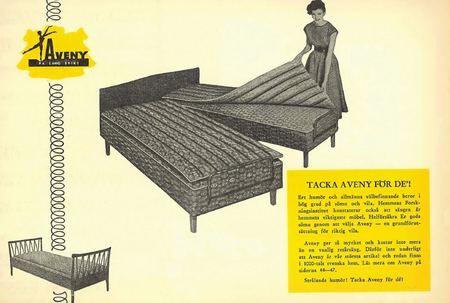
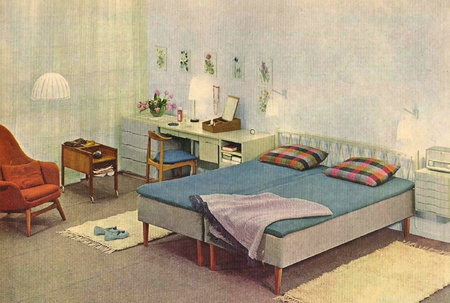
Source: IKEA Catalog, 1961. Illustrations 5 and 6 from Carrai, pp. 40–41.
In the 1961 bedroom, beside the bed, there is an armchair, a side table, and a vanity with a mirror. Slippers, magazines, and vials suggest the occupants' daily activities. The photograph presents a complete routine for using the room—it’s a space for reading, relaxing, and getting ready in the morning.The catalog becomes a visual guide, conveying the concept of a comfortable life through the arrangement of furniture and everyday objects.
Custom Employment Opportunities
Source: ikeamuseum.com
A man is lying on a mattress with his legs extended, holding an open magazine on his knees. Across from him, a girl is sitting with her legs crossed, holding headphones. Both are in the same living room, yet each is engaged in their own activity. Their postures suggest that the TAJT can accommodate both lying down with a magazine and sitting while leaning against a soft bolster.
Closer to the camera, a third, unoccupied mattress is visible. Its upholstery, mounting hardware, and backrest shape are clearly discernible. Behind it, people are seen already relaxing on similar mattresses. The photo allows the viewer to simultaneously examine the product and envision themselves occupying one of the available spots.