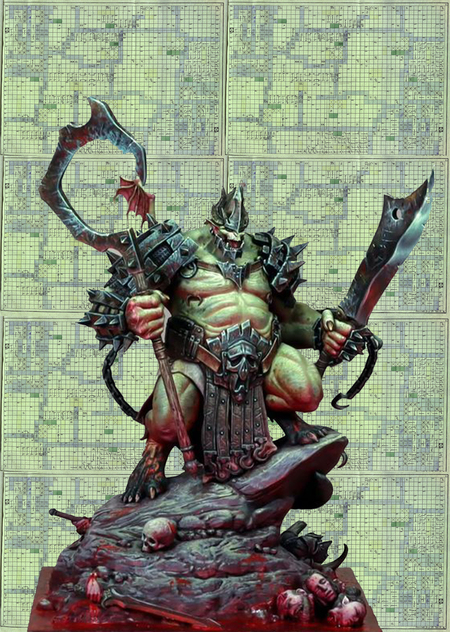
Concept.
The evolution of wargames presents a significant scientific and cultural interest, as it demonstrates the radical transformation of utilitarian practice into a massive entertainment industry. The relevance of this topic stems from the fact that today, a «Wargame» is primarily a hobby of collecting and painting miniature figures, rather than the game itself. Studying the shift toward smaller-scale «Skirmish» formats allows us to understand current trends in consumer behavior, where large, expensive armies are being replaced by the intimate uniqueness of each individual character, making the hobby more accessible and personalized.
How did the paradigm shift occur from the utilitarian modeling of «Kriegsspiel» to aesthetic collecting, and how did the «Skirmish» format facilitate the further democratization and individualization of this hobby?
Hypothesis.
The transformation of wargaming into a collectible hobby has become possible by shifting the focus from the gameplay mechanics to the aesthetics and materiality of the miniatures. The further popularization of the «Skirmish» format is a logical response to the high barriers to entry associated with large-scale wargames.
Moving away from massed, faceless armies in favor of small groups of unique characters reduces financial, time, and cognitive load, while simultaneously deepening the player’s emotional investment and enhancing their creativity.
Research Sectioning Principle:
1. Concept 2. Origin Story: The creation of wargames as a utilitarian simulation tool, where the miniatures held no aesthetic value. 3. Transition from Tactics to Material Aspects: Games Workshop shifted the focus from the gameplay to ownership, assembly, painting, and collector status. 4. Shift from Expensive Armies to Small Squads: The industry and players moved toward smaller formats, which combine a low barrier to entry with high uniqueness for each warrior. 5. Conclusion 6. Sources
Source Analysis
[1] — Matthew B. Caffrey Jr., «On Wargaming» The source was selected as a foundational text on military history, establishing the basis for this study. It provides the classic definition of wargaming as conflict simulation and describes the evolution from utilitarian Prussian Kriegspiel, where miniatures held no aesthetic value. Furthermore, Caffrey explains the reasons for the high barrier to entry in miniature wargames, which substantiates the relevance of «Skirmish.»[2] — Russell Belk, «Collecting in a Consumer Society» This work was chosen to provide psychological and sociological grounding for the collecting phenomenon. It incorporates the concept of the «extended self, ” which explains why acquiring and modifying objects provides emotional satisfaction and expands one’s identity. The idea of controlling a „small world“ through a collection is also utilized, helping to explain why in „Skirmish, ” the uniqueness and detailing of each individual character are more valuable than an impersonal mass army.[3] — John Fiske, „The Cultural Economy of Fandom“ This source is used to analyze the social dynamics within the wargaming community. From Fiske’s work, the concept of „cultural capital“ is taken to demonstrate that knowledge of the world’s lore, rare miniatures, and painting skill become currency for status. His thesis on the inclusive nature of fan collecting is also applied, where the scope of the collection represents its value—a characteristic of the era of large Games Workshop armies.[4] — M. Meriläinen, Y. Stenros, K. Heljakka, „More Than Wargaming“ This is a key contemporary study that directly proves the shift in paradigm. The term „miniaturing pastime“ is drawn from the article, justifying that tabletop play takes a secondary role. The authors show that players' focus shifts to creation and painting, as well as to the public display of their work, which proves the transformation of wargaming into a collecting hobby.
The history of its inception and market penetration.
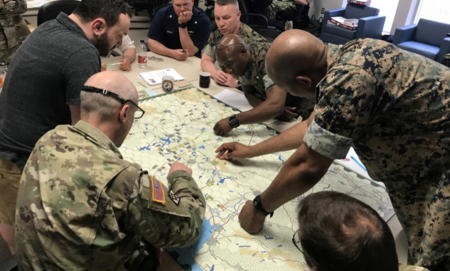
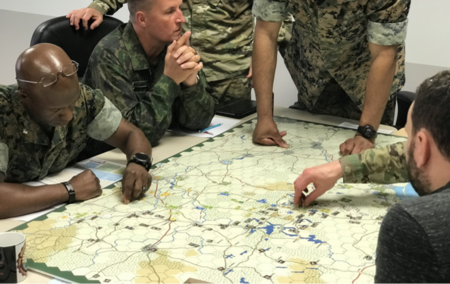
Conducting a military exercise at the US Marine Corps College (2019)
The fundamental definition of wargaming is provided by retired U.S. Air Force Colonel Matthew B. Caffrey Jr. In his work, «On Wargaming, ” he characterizes the game as a dynamic model of conflict: „…our working definition of 'wargame' will be any multitsided simulation of armed conflict in which the decisions of the participants influence the outcome.“ [1, p. 5]. This definition places sole emphasis on simulation, decision-making, and its consequences.
Kriegsspiel (1824)
The origins of this approach date back to the 19th-century Prussian Kriegsspiel. As Caffrey notes, the tools used for such simulations (maps, terrain models, figurines) were used exclusively to represent battlefield realities and to train command staff: «Terrain tables (on which the landscape is modeled) and miniatures were used in the earliest constructive game… Maps, charts, and print are almost as old as terrain tables; the original map wargames used topographical maps and naval charts» [1, p. 271]. Within Kriegsspiel and similar systems, the miniatures were strictly utilitarian. They denoted battalions, supply lines, and topography. The goal of these games was to develop the participants' skills and support decision-making: «Decision-support wargames tend to develop the skills of their participants…» [1, p. 272]. The player acted as a general, and the figurines were impersonal resources that held no value outside the gaming table.
Wargame unit for the Napoleonic Wars era, using paper figures instead of plastic or metal miniatures (2015).
Gradually, interest in military themes permeated the civilian sector: «Until that enthusiasm withered with growing casualty counts, games on military subjects sold well in several Western countries. Some of these were simple games decorated with military images or depicting military subjects» [1, p. 43]. However, the mass market entry in the United States occurred not due to miniatures, but because of board games with abstract components.
Later, the mass market opted for simple board games (with cardboard tokens and boards) instead of miniatures.
Herbert Wells plays a tabletop wargame with miniature soldiers according to the rules of his book Little Wars (1913).
Firstly, this was connected to the implementation of a hexagonal grid, which ensured more realistic movement while maintaining mechanical simplicity: «In 1959 he saw a picture of a RAND wargame in Life magazine. The game’s map, he saw, had a hexagonal grid; he immediately realized that the 'hex' grid allowed more realistic movement than a chess-like square grid, while keeping movement simple» [1, p. 78]. Secondly, and this is most important, was the high barrier to entry for miniature games: «However, in the United States board or print wargames soon overtook miniatures in numbers of participants. It is easy to see why. To start a miniatures-based wargame, an individual needs to purchase miniatures and paint them; buy and read a rule book appropriate to the era of the miniatures purchased; build a playing surface like a model railroad layout; often, buy and read a second book with descriptions of the battles of the era; and then, finally, play» [1, p. 83].
Excerpt from a game session of the board wargame Idro (2006)
Thus, during its nascent stages and initial mass-market debut, wargames evolved through simplification and mechanical simulation. Possessing components offered no aesthetic pleasure; assembling and painting miniatures was perceived as an excessive and costly barrier. This situation set the stage for a radical revolution, which was later executed by Games Workshop, transforming the physical medium (the miniature) from a supporting tool into the primary object of consumption and collecting.
Shifting from tactics to material aspects.
Classic wargaming represented a conflict model. Players derived pleasure from solving tactical problems, and the miniatures or tokens were secondary. However, with the arrival of Games Workshop on the market, the tangible medium itself—the highly detailed miniature—became the main product.
Board game with miniatures based on homemade rules for Hannibal at the Gates (2018)
To describe this shift, researchers Mikko Meriläinen, Jaakko Stenross, and Katriina Heljakka introduce the term «miniaturing pastime, ” which is much broader than the narrow concept of „wargaming.“ They emphasize that viewing this phenomenon merely as a game is fundamentally incorrect: „Earlier research… has shown that even when the focus is on gaming, miniaturing should not be understood simply as gaming. Instead, it is a collection of interlinked practices that are better characterized as a pastime or a hobby“ [4, p. 7].
For a large segment of the audience, tabletop play takes a secondary role. The primary sources of enjoyment become the purchase, assembly, painting, and collecting: „…many reported that their focus had shifted from the anticipation of play to enjoying the crafting of the miniatures. Some had even stopped playing altogether or had played very seldom in the first place“ [4, p. 10]. The culmination of this material focus is the phenomenon of accumulating unpainted miniatures, which clearly demonstrates that the act of acquisition and possession has become more important to many players than the match itself.
This shift is directly linked to social motivation and consumer psychology. «…the process of actively, selectively, and passionately acquiring and possessing things removed from ordinary use and perceived as part of a set of non-identical objects or experiences» [2, p. 67]. By possessing an interconnected set of objects (for example, an army of a certain faction), the collector gains control over a «little world»: «collectors who possess an interrelated set of objects control a „little world“» [2, p. 70]. Furthermore, the act of buying itself evokes positive emotions and expands the buyer’s self: «…when we buy something the purchase makes us feel better, more secure, and in some way enlarges our personality» [2, p. 78].
In the context of the wargaming community, this translates into the accumulation of cultural capital, as described by John Fiske. Knowing the lore, rare limited-edition miniatures, and painting skill become the primary markers of status: «In fandom as in the official culture, the accumulation of knowledge is fundamental to the accumulation of cultural capital…» [3, p. 42]. Furthermore, fan collecting often takes on an inclusive nature, where value is determined by the scale and completeness of the collection: «Collecting is also important in fan culture, but it tends to be inclusive rather than exclusive: the emphasis is not so much upon acquiring a few good (and thus expensive) objects as upon accumulating as many as possible…» [3, p. 44].Finally, the material aspect of the hobby takes the form of public display. Painted miniatures cease to be tools for gameplay and become objects of aesthetic admiration. Players showcase their work for all to see: «Many of our respondents reported putting up their miniatures for show in glass cabinets… Taking photographs of the miniatures… sharing them online…» [4, p. 9]. Recognition of one’s miniature painting skill by peers becomes a reward in itself.
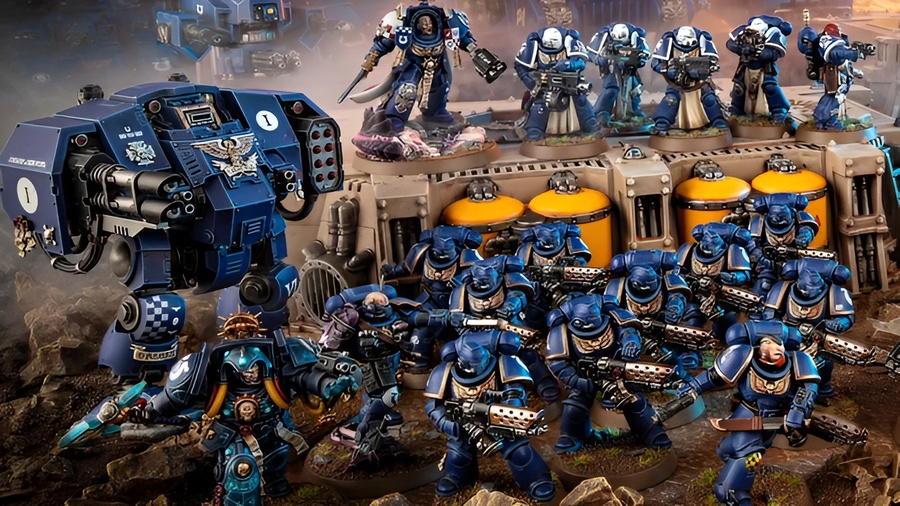
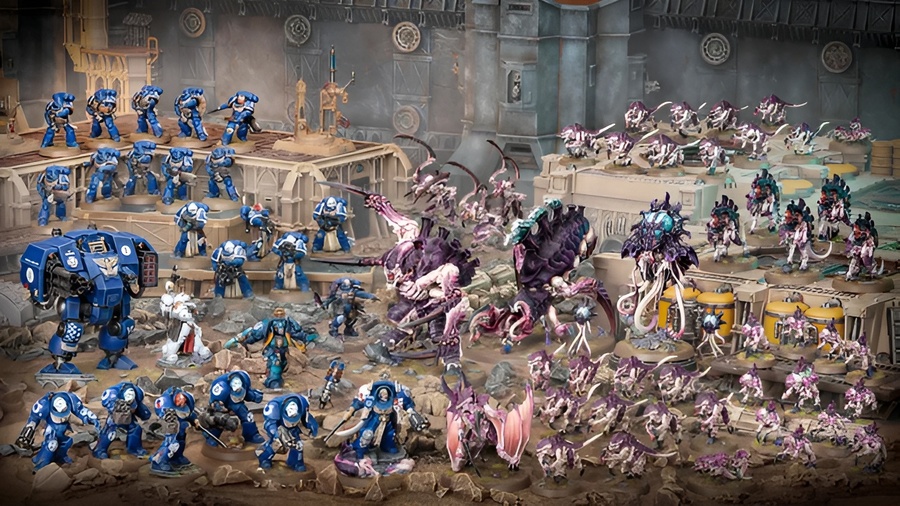
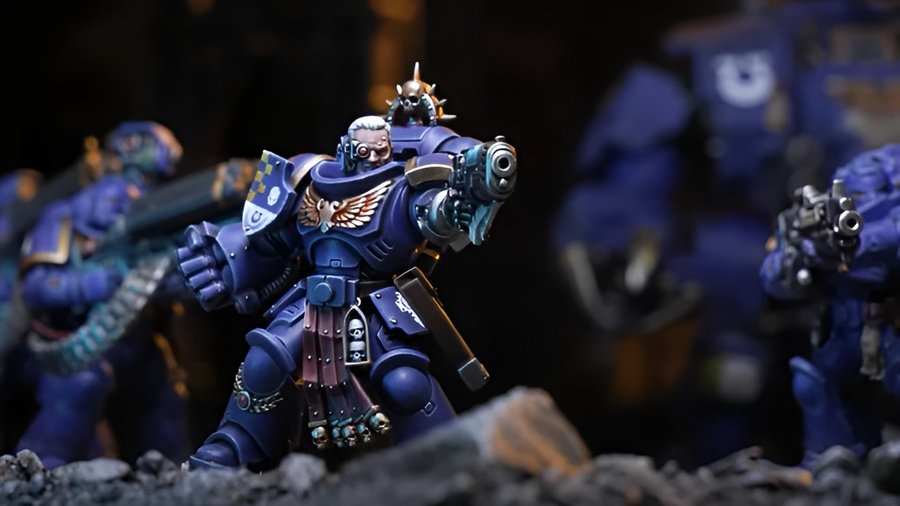
Warhammer 40,000 Army (2023)
Thus, Games Workshop shifted the focus from tactical modeling to the aesthetics of ownership. The game transformed into a comprehensive hobby where assembly and painting dominate the gameplay, and the collection becomes a marker of status and an extension of the owner’s personality. However, it was this very model—which demands enormous time and financial investment to create a «miniature world”—that created a high barrier to entry, inevitably pushing the industry to seek new, more accessible formats.
The transition from large armies to small units.