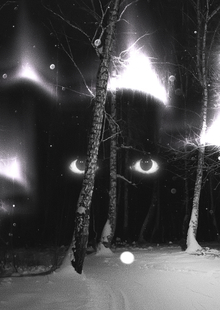
In 1978, the Karpinski Geological Institute expedition on the island of Graham Bell (Franz-Yosif Archipelagic) drilled a deep well. At a depth of just over a mile and a half, the storms suddenly failed, resulting in the fall of pressure in the highway and the depressurization of the convoy. The bottomed telesonade showed a vast subterranean cube body with smooth walls. It was based on a monolithic plate containing four complex, non-euclidic geometry objects, the shape of which caused visual dissonance and failed to be described. Their material, a homogeneous dark gray substrate, completely absorbed the light of the searchlights and displayed abnormal hardness, leaving no trace of the diamond incisor.

Within 24 hours, all the ground equipment went out of service due to a series of electrical overloads. The seismometers recorded a non-manufacturous resonance, the source of which was in the area of the cavity. A special research station, code-named «LIRA» (Rezonance Anomaly Research Laboratory), was urgently established to study the phenomenon on the ground.
The material submitted is part of the declassified phonographic archive of the LIRA station established during the implementation of the Chronorazonance Project. The scientific concept of the laboratory is that of the artificial origin of the entities found. Their morphology and observed interaction with energy did not match any known technological pattern. This led to the formulation of a radical hypothesis: these artifacts are not a relic of the past, but a deliberate message from the future. We were supposed to have a sort of acoustic «capsula», whose activation mechanism is based on the principles of resonance. Access to the contents required not a static study, but a communication protocol that used its own object language — a system based on frequencies, time intervals and interference patterns.
The lab’s hardware complex has been modified to deal with acoustic emancipations of objects. The main method was a resonant application: background sound signals, spontaneously emitted by objects, were recorded, cleaned up by noise, reinforced and retransmitted through specialized sound radiators mounted on a drilling column. The response fluctuations were recorded in seismic and hydroacoustic sensor arrays, converted into an auditory range and documented into a magnetic tape.