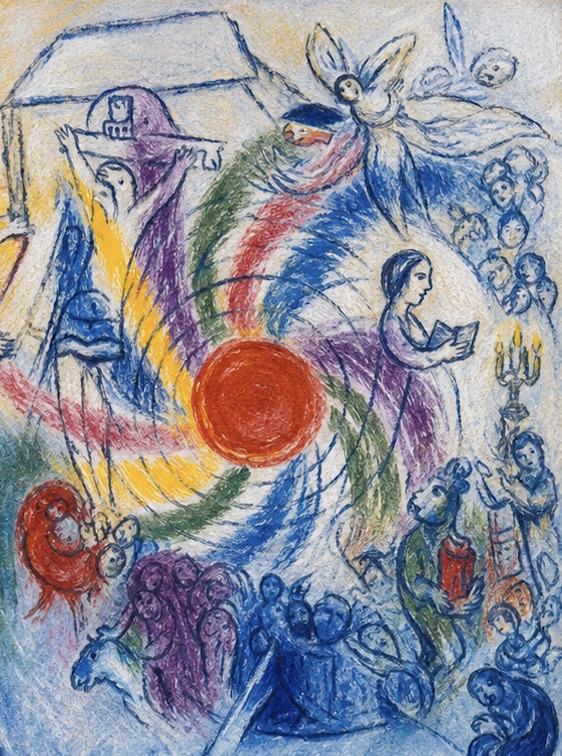
Biblical narratives have remained one of the most significant themes in world art throughout many centuries. Artists of various eras addressed the same stories, yet rendered them in their own unique way each time. The creation of man, the Fall of Adam and Eve, the Great Flood, Abraham’s sacrifice, and the story of Moses repeatedly appeared in painting, evolving alongside artistic traditions and worldviews. Furthermore, biblical events were not merely illustrated—they were reinterpreted: through composition, color, symbols, and character imagery, artists conveyed their personal perspectives on these occurrences.The works of Marc Chagall hold a special place among such pieces. The biblical theme accompanied the artist throughout a significant portion of his creative life and became central to his art. By drawing from the Old Testament, Chagall created unconventional, symbolic compositions where real and fantastic imagery coexisted. His characters might float in the air, space defied conventional laws of perspective, and color served to convey the mood and emotional substance of the scene.The selection of this theme stems from an interest in how Marc Chagall depicted well-known Old Testament stories and the visual solutions he employed to convey their meaning. It is particularly fascinating to examine the interplay between biblical narration and his individual artistic language in his works. This research allows us to trace which events the artist emphasizes, how he portrays the relationships between characters, and how he transforms familiar religious subjects into autonomous artistic expressions.For this visual study, selected works by Marc Chagall dedicated to the most renowned events of the Old Testament were chosen. The primary focus is on pieces where the specific rendering of characters, space, color, and biblical symbolism can be traced. The materials include works from different biblical cycles of the artist, encompassing both graphic illustrations and painted compositions. This selection permits an examination of how the same artistic techniques manifest across different mediums and when depicting varied events.
However, the research focuses exclusively on the creativity of Marc Chagall, without a detailed comparison to the works of other artists.
The structure of this research follows the chronological sequence of the Old Testament and is divided into three chapters. The first chapter, «The Creation of the World and the Fall of Man, ” is dedicated to images depicting the creation of humanity, Adam and Eve in the Garden of Eden, and their subsequent expulsion from paradise. It examines how Chagall portrays the first people, the paradisiacal space, and the transition from harmony to the violation of the divine prohibition.The second chapter, „Stories of the Old Testament Patriarchs, ” includes works dedicated to Noah’s Ark and the Great Flood, Abraham’s sacrifice, as well as Jacob’s dream and the ladder to heaven. The focus here is on the methods used to depict divine intervention, human trials, and humanity’s interaction with higher powers.The third chapter, „The Story of Moses, ” analyzes three events: God’s appearance to Moses in the burning bush, the crossing of the Red Sea, and the reception of the Tablets of the Covenant. Analyzing these works allows us to trace how Chagall depicts miracles, the presence of the divine, and the figure of the prophet acting as a mediator between God and the people.The primary methodology of this study is visual analysis of the artworks. Each chapter examines composition, color schemes, the arrangement and plasticity of figures, the character of the space, symbolic details, and the ways in which the emotional state of the characters is conveyed. Special attention is paid to the extent to which the imagery aligns with the biblical narrative and what details Chagall modifies, adds, or emphasizes.The theoretical foundation of the research consists of art historical publications dedicated to the work of Marc Chagall, his biblical cycles, and the peculiarities of his artistic language. The Old Testament text is used as a primary source, enabling a comparison between the content of the biblical stories and their visual interpretations. For supplementary materials, preference is given to museum publications, exhibition catalogs, and scholarly research containing information about the creation of the works and an analysis of their artistic characteristics. While textual sources are used to clarify context, the primary focus remains on the images themselves.
Key research question: What visual means did Marc Chagall use to convey the content of Old Testament narratives, and how did the characteristics of his artistic language influence the depiction of biblical events?
Research Hypothesis: It is posited that Marc Chagall conveys Old Testament narratives not through the literal depiction of events, but through color, composition, and symbolic imagery. Furthermore, the visual solutions depend on the content of each specific story: scenes of the creation of the world and paradise feature images of unity between humanity and nature; stories of the patriarchs emphasize the interaction between humanity and divine forces; and narratives about Moses highlight the contrast between the human and the divine through the scale of figures, light, and color. Therefore, it is assumed that each of the three thematic cycles possesses unique visual characteristics that can be identified and compared during the analysis of the works.
Chapter 1. The Creation of the World and the Fall from Grace
The story of humanity’s creation and its expulsion from paradise holds a special place within Marc Chagall’s biblical cycle. The early chapters of the Book of Genesis describe the appearance of Adam and Eve, their life in the Garden of Eden, the breaking of the divine commandment, and their subsequent banishment. These events are united by a central theme: the transformation of humanity’s relationship with the surrounding world—from an initial unity with nature to its loss.Chagall references these narratives in three works: «The Creation of Man, ” „Paradise, ” and „The Expulsion of Adam and Eve from Paradise.“ Each painting is dedicated to a distinct stage of this biblical history, yet it is not limited to a literal depiction of events. The artist interweaves different episodes, employs unusual spatial solutions, and imbues familiar figures with added meaning. Comparing these works reveals how the position of the human figure, the nature of movement, and the organization of the surrounding space evolve.
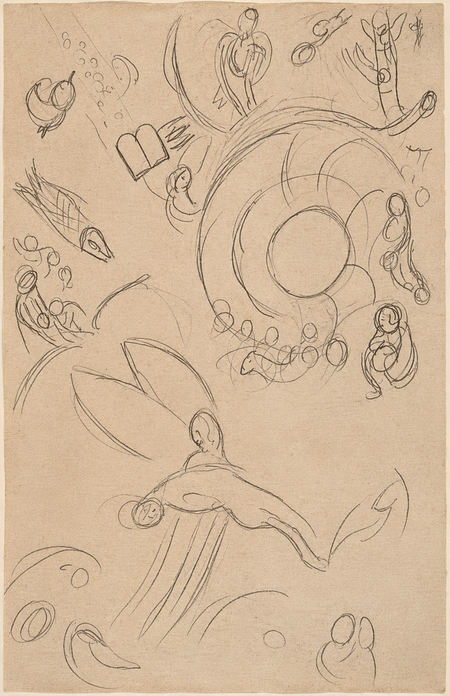
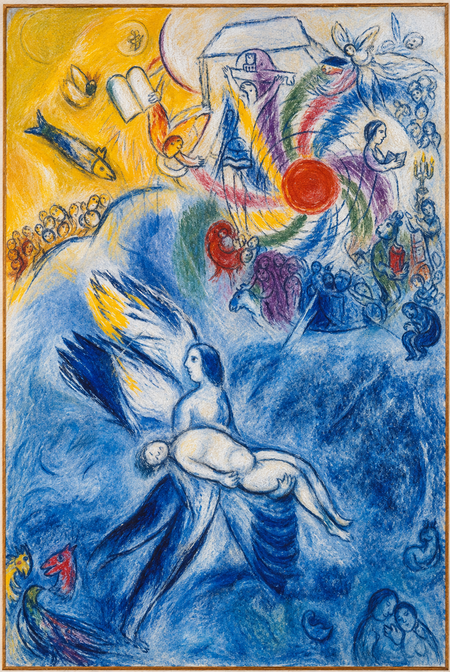
Marc Chagall. «The Creation of Man, ” 1956–1958. Canvas, oil.
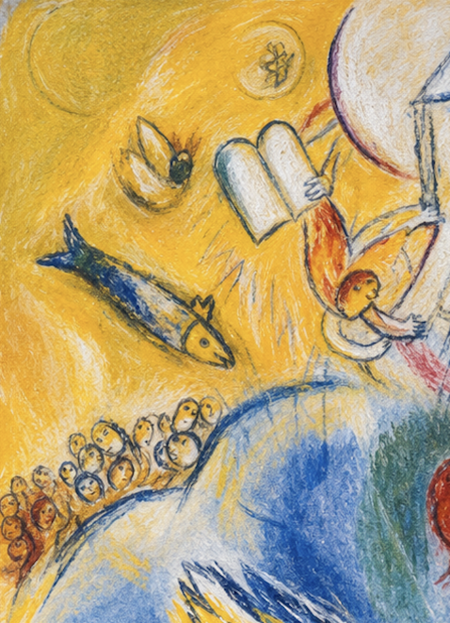
In the painting «The Creation of Man,» Chagall addresses the appearance of the first human, yet he eschews a literal depiction of the biblical episode. Instead of creating Adam from earthly dust, the artist portrays an angel carrying the human figure in its hands. Adam is depicted nude, with closed eyes and a relaxed body. He performs no actions and is entirely dependent on the angel supporting him.The positioning of the figures dictates the perception of the entire scene. Adam’s body is stretched horizontally, while the angel’s figure forms a diagonal extending through the lower part of the composition. This evokes an impression of fluid motion, as if the human has not yet established a place in the world. His closed eyes and motionless posture underscore a state between nonexistence and awakening.The majority of the lower space is occupied by blue and light blue hues. The figures almost dissolve into the surrounding color, and the absence of a distinct horizon line renders the space ambiguous. It is impossible to establish a specific setting here—the angel and Adam seem to float outside of the earthly realm. The color unites them and creates a serene atmosphere appropriate to the moment of life’s emergence.The upper section of the painting differs significantly in its structure. It is filled with numerous figures, events, and symbols associated with biblical history. Here appear images related to the history of the Jewish people, as well as motifs of suffering and religious revelation. Among these is the depiction of the crucified Christ—an image Chagall repeatedly used in his work, linking it, in part, to the theme of the Jewish people’s suffering. Consequently, one composition unites events separated by vast stretches of time. While only the first man is appearing below, the history of humanity is already unfolding above. Chagall does not structure these events chronologically; rather, he presents them simultaneously.
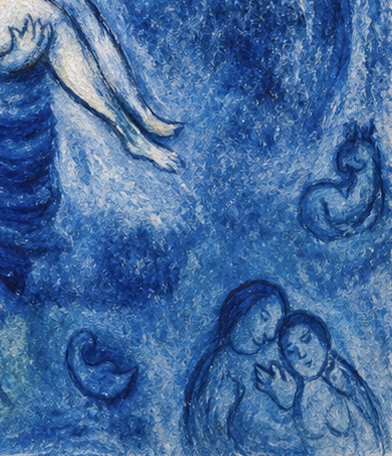
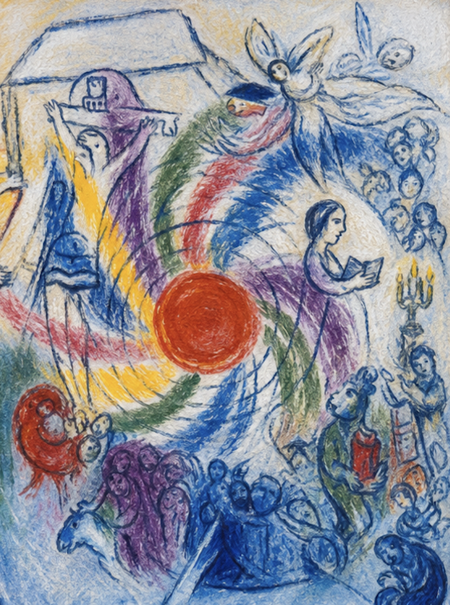
Marc Chagall. «The Creation of Man,» 1956–1958. Canvas, oil.
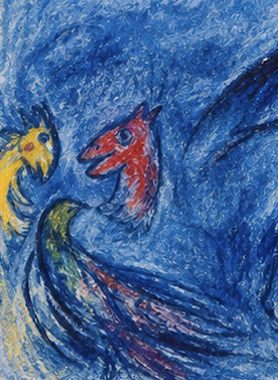
The division of the painting is emphasized by color. The cool, relatively uniform lower section contrasts with the more saturated upper space, where yellow, red, and other bright color spots appear. The density of the imagery also differs: in the lower part, attention is focused on two large figures, while the upper part features numerous small characters forming a complex composition.
Scale also helps establish thematic accents. The angel with Adam is significantly larger than most of the figures in the upper section. Despite the abundance of additional events, the appearance of humankind remains the central theme of the work. Simultaneously, its juxtaposition with other biblical figures allows the creation of Adam to be perceived as the beginning of a story that will continue far beyond the depicted moment.
Thus, in «The Creation of Man,» Chagall depicts not so much the physical process of creating the first human as his emergence before the face of future history. The calmness of the lower section contrasts with the event-rich upper space. Through scale, color, and compositional division, the artist connects the beginning of human life with its subsequent trials.
Marc Chagall. «Paradise,» 1961. Canvas, oil.
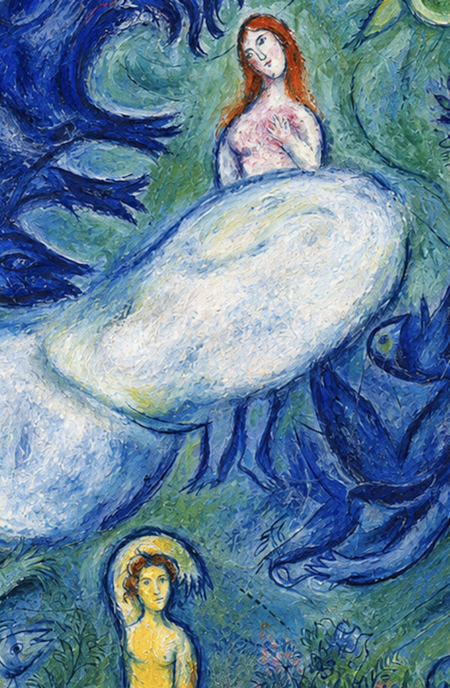
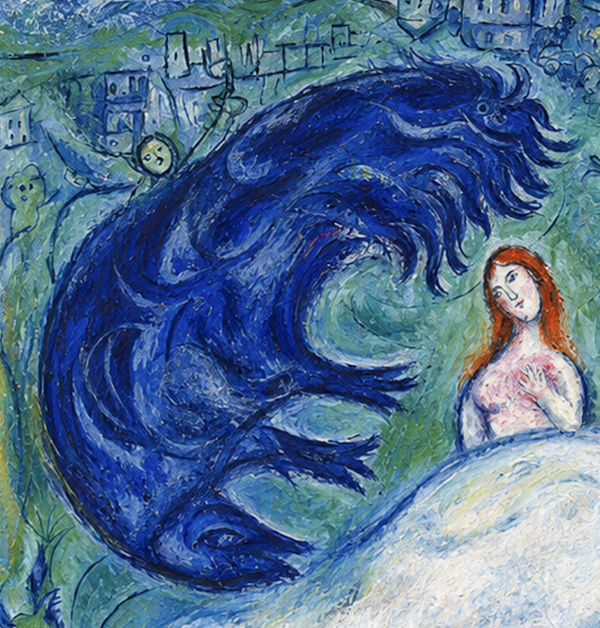
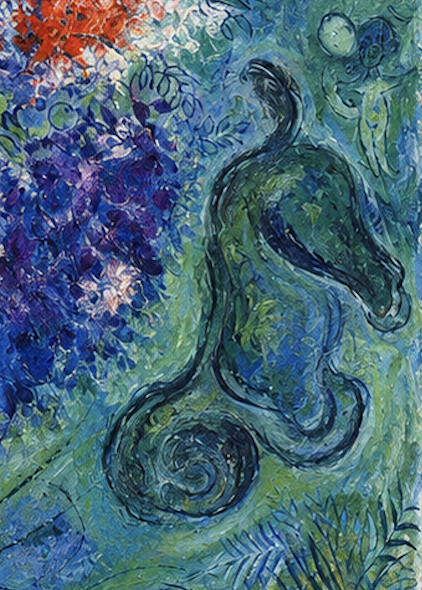
The painting «Paradise» is dedicated to the lives of the first humans in the Garden of Eden and the events preceding the Fall. Unlike the previous work, where Adam was situated in an indeterminate space, here humanity exists among plants, animals, and other living creatures.The composition is built as a diptych, consisting of two connected parts. On the left, the creation of Eve is depicted; on the right, the temptation of the first humans. This division allows Chagall to unify sequential events within a single work without turning them into a conventional narrative illustration.In the left section, the focus is on the figures of Adam and Eve. Their bodies are placed close to one another, and individual lines and silhouettes visually intersect. The characters are perceived as a single entity, which echoes the biblical narrative of Eve being created from Adam’s rib. Rather than detailing the process itself, the artist conveys the connection between the first humans through the plasticity of their bodies.The figures do not possess pronounced anatomical accuracy. Their contours are fluid, sometimes elongated, and their placement in space does not always adhere to the laws of physical equilibrium. This brings the human bodies into close relation with the surrounding botanical forms. Humanity is not set against nature; rather, it becomes a part of it.
Marc Chagall. «Paradise, ” 1961. Canvas, oil.
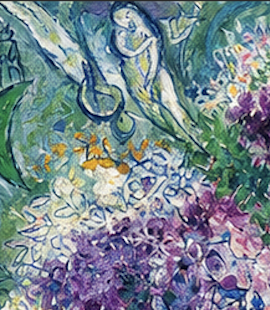
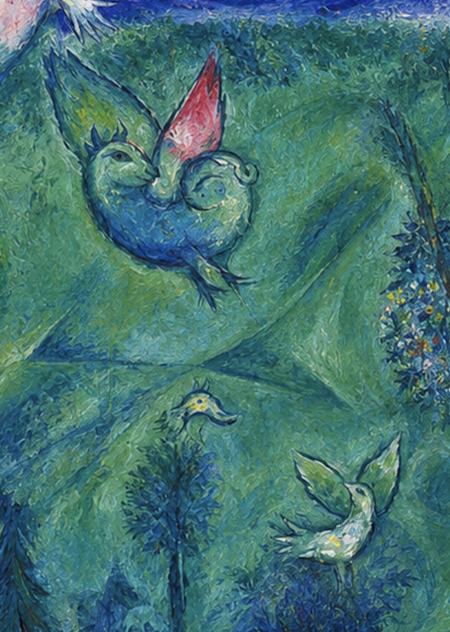
The right panel of the diptych is dedicated to temptation. Motifs of the forbidden fruit and the serpent appear, relating to the violation of divine prohibition. However, Chagall does not depict the Fall as a separate tragic scene. It exists within the same vibrant, life-filled space as the creation of Eve.In both parts of the painting, animals take up a significant portion of the space. Their figures are positioned near people, amidst trees and other elements of the garden. Some creatures are depicted in unusual poses, and their sizes do not always correspond to real proportions. Because of this, paradise is perceived not as a specific natural landscape, but as a fantastical world where all life forms coexist.The color palette unites the two parts of the diptych. Predominantly, green, blue, and azure tones prevail, transitioning from the plants to the human figures and the surrounding space. The green color connects the image to vegetation and life, while the blue hues lend it a sense of lightness. Scattered warm accents diversify the composition without disrupting its overall tranquil character.It is notable that there are almost no distinct visual boundaries between humans and nature. Botanical forms intersect with the figures, animals are situated on different planes, and individual elements seem to continue one another. As a result, the viewer’s gaze moves freely across the surface of the painting, without lingering on a single compositional center.
Marc Chagall. «Paradise, ” 1961. Canvas, oil.
The unification of Eve’s creation and the temptation lends the work a dual nature. On one hand, it depicts a world where humanity still exists in harmony with nature. On the other, the composition already contains the event that will lead to the loss of that state.
Shagal does not juxtapose the two parts of the diptych with a sharp change in color or space. The temptation does not invade paradise as something visually foreign, but rather becomes part of its depiction. This allows the fall from grace to be perceived not as a sudden destruction of the world, but as an event whose possibility already exists within the original harmony.
In «Paradise,» the relationship between humanity and the surrounding world becomes the central theme of the image. This is revealed through the closeness of the figures, the continuity of the lines, and the overall color environment. Furthermore, the diptych allows both states to be shown simultaneously—the emergence of human unity and the approach of its disruption.
Marc Chagall. «The Expulsion of Adam and Eve from Paradise, ” 1961. Canvas, oil.
In the painting «The Expulsion of Adam and Eve from Paradise, ” Chagall portrays the consequences of violating a divine prohibition. According to the third chapter of the Book of Genesis, after tasting the forbidden fruit, the first humans become aware of their nakedness and lose the ability to remain in the Garden of Eden. However, for Chagall, the expulsion does not devolve into a scene of purely human suffering. It affects the entire surrounding world, which seems to come alive along with Adam and Eve.The composition is built on the intersection of two main directions. The horizontal line of the river cuts through the paradise garden, while the vertical line of the glowing tree in the left portion of the painting anchors the space. Against the green background, numerous figures of animals, birds, and fantastic creatures are placed. Their arrangement creates the impression of disorder that has engulfed what was once a harmonious world.Some birds are depicted upside down, while others have goat heads. Winged fish emerge from the river, and certain creatures seem to lose their familiar orientation in space. These unusual images convey the consequences of the Fall through the alteration of the very structure of the surrounding world. Nature remains recognizable, but it no longer adheres to the former order.
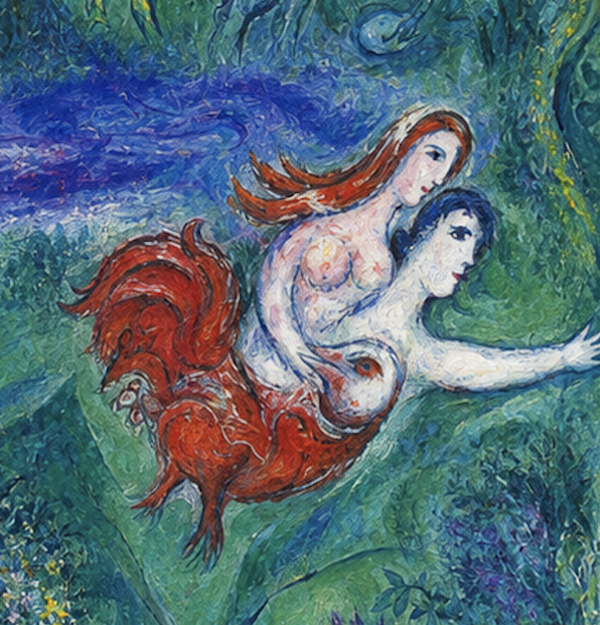
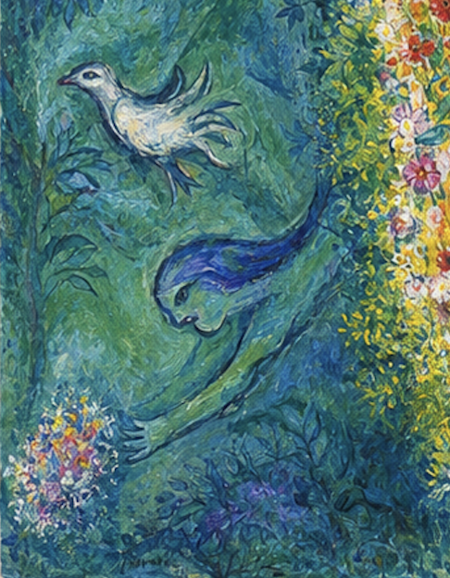
Marc Chagall. «The Expulsion of Adam and Eve from Paradise,» 1961. Canvas, oil.
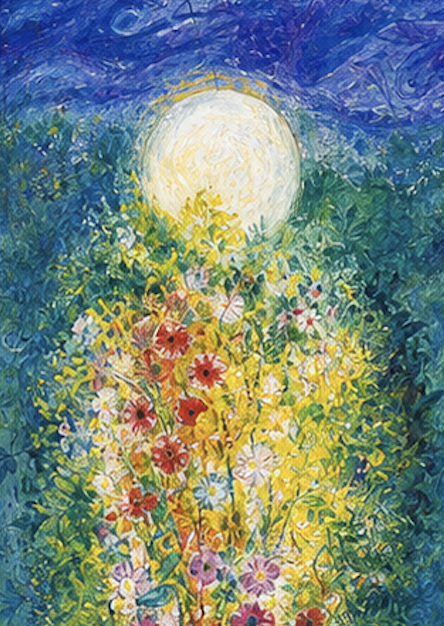
In the upper center, an angel directs Adam and Eve away from paradise. Its gesture sets the direction of movement toward the right edge of the painting. The first couple is positioned on the back of a large red rooster, which seems to carry them beyond the frame. The rooster becomes one of the painting’s main color accents. Its red form stands out sharply against the green tones of the garden. Furthermore, the bird’s significance is not limited to anxiety or danger. Traditionally, the rooster is associated with vital energy and fertility, lending an additional layer of meaning to the scene. Adam and Eve are leaving paradise, but simultaneously heading toward earthly life.This duality distinguishes the painting from an image of exile as an ultimate catastrophe. The first people do not fall to the ground, nor do they appear completely broken. On the contrary, their movement resembles flight. Chagall transforms punishment into the beginning of a new stage in human history.A small scene of motherhood in the lower right part of the painting supports this interpretation. It references the continuation of the human race after exile, linking the loss of paradise with the emergence of future generations. This detail does not directly relate to the moment described in the Book of Genesis, but it helps reveal the artist’s perspective on what is happening.It is also interesting that the paradise garden does not lose its vibrancy. Green still predominates in the composition; the plants, animals, and water remain. The change is conveyed not through the destruction of the familiar world, but through the disruption of its inner balance. If in «Paradise» the figures existed in a relatively tranquil environment, here almost every element is involved in motion.Thus, exile, in Chagall’s work, carries two meanings. On one hand, the overturned animals, scattering birds, and the angel’s guiding gesture signify the breakdown of the original order. On the other hand, the red rooster, the movement beyond the canvas, and the image of motherhood connect the event to the continuation of life. The artist presents the fall from grace not only as the loss of paradise but also as the beginning of humanity’s independent story.
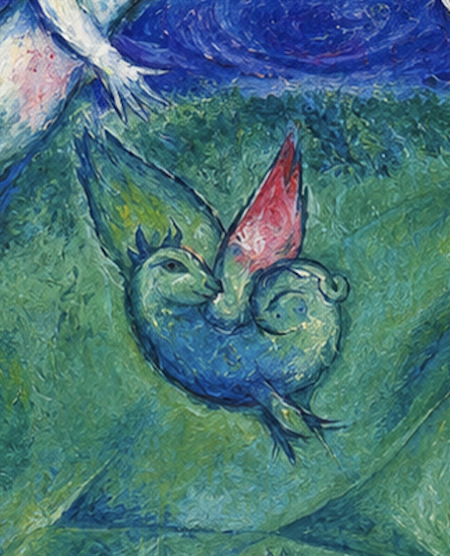
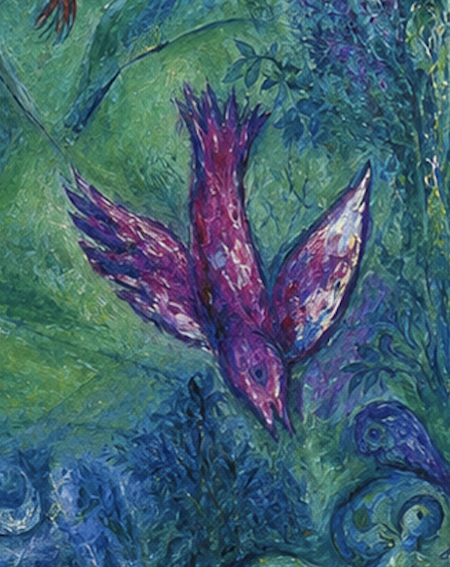
Marc Chagall. «The Expulsion of Adam and Eve from Paradise, ” 1961. Canvas, oil.
In the three works examined, Marc Chagall depicts different stages of early human existence, altering the manner of their representation according to the subject of the biblical event. In «The Creation of Man, ” Adam is still and held by an angel, and the composition’s division into two levels connects his emergence with the future history of humanity. In „Paradise, ” the first people become part of a unified natural space, where smooth lines and the close placement of figures underscore their connection to the surrounding world. In „The Expulsion of Adam and Eve from Paradise, ” tranquility gives way to active movement, but the destruction of the former harmony does not signify the end of life. This comparison shows that Chagall conveys the development of biblical history primarily through the changing posture of the human figures and the character of the surrounding space. The artist moves from the motionless Adam carried by an angel to the unified figures of the first people in paradise, and then to their swift movement beyond the garden. Furthermore, the Fall is not depicted solely as a tragedy. The final painting features symbols of the continuation of life, which makes the expulsion not only the conclusion of idyllic existence but also the beginning of a new phase in human history.
Chapter 2. Stories of the Old Testament Patriarchs
Biblical narratives of Noah and Abraham explore the relationship between humanity and God, the tests of faith, and the possibility of salvation. Unlike creation myths, where humanity simply appears to begin interacting with the natural world, here the heroes confront divine decisions that dictate their own fate and the lives of others.
In Mark Chagall’s biblical cycle, these events receive diverse visual interpretations. The paintings «Noah’s Ark» and «Noah and the Rainbow» examine two phases of the same story: salvation during the Great Flood and the covenant established between God and humanity. «The Sacrifice of Isaac» delves into a more personal trial, wherein Abraham must choose between his love for his son and obedience to divine will.
Marc Chagall. «The Ark of Noah, ” 1961–1966. Canvas, oil.
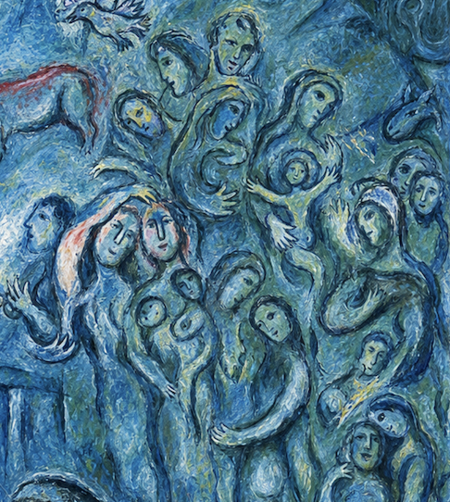
The story of Noah’s Ark is described in chapters six through nine of the Book of Genesis. According to the biblical narrative, God decides to destroy corrupt humanity with a global flood, but spares the righteous Noah, his family, and representatives of the animal kingdom. To ensure their survival, Noah builds an ark, which becomes the only safe space amid the catastrophe.
In the painting «Noah’s Ark,» Marc Chagall primarily addresses the theme of preserving life. Instead of providing a detailed depiction of a ship battling immense waves, the artist focuses on the space filled with people and animals. This shifts the viewer’s attention from the scale of the disaster to those who managed to be saved.
The painting’s composition is built around a large gathering of figures unified by circular lines. Humans and animals are placed closely together; their silhouettes intersect and partially overlap. This choice creates a feeling of a tight, confined space—a space where life is concentrated. Furthermore, Chagall does not attempt to sequentially illustrate the internal structure of the ship. The ark’s space is conveyed conditionally, through the arrangement of the characters and their interaction.
The lack of a clear division between human and animal figures plays a crucial role. They exist in a single space, with almost no perceived hierarchy between them. This emphasizes that the salvation pertains not only to humanity but to the entire living world. The ark thus becomes a kind of model of a world where diverse creatures are bound by a shared fate.
Marc Chagall. «Noah’s Ark, ” 1961–1966. Canvas, oil.
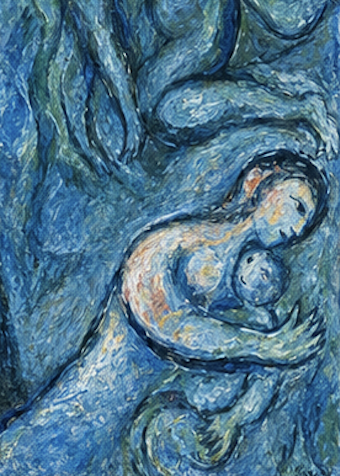
The use of rounded shapes is particularly noticeable. The lines of the figures and the surrounding space guide the viewer’s gaze in a circle, returning it to the central part of the composition. Unlike straight lines, which might emphasize the ship’s structure, the curved outlines create the impression of a protected space. The figures seem gathered within a single shell. The painting’s color scheme also supports this feeling. The work is dominated by blue, azure, and greenish hues. They unite the characters and the surrounding space, making the boundaries between them less apparent. The cool palette may evoke the water surrounding the ark, yet in the image, it does not create a sense of an exclusively hostile environment. Individual, lighter, and warmer color spots highlight the figures against the overall background. Because of this, the composition does not devolve into a uniform mass but preserves many independent characters and details. Simultaneously, no figure is perceived as completely isolated from the others.It is interesting that Chagall barely depicts the immediate threat of doom. The painting does not need to show enormous waves, ruined cities, or people trying to escape. The scale of the catastrophe is conveyed indirectly—through the very existence of a closed space where the surviving creatures are gathered.This approach changes the emotional content of the narrative. Instead of portraying the fear of the flood, the artist focuses on the possibility of salvation. The cramped nature of the ark does not appear exclusively frightening because it simultaneously creates a sense of intimacy and protection. Compared to the works in the first chapter, one can note a similarity to the painting «Paradise.» In both works, humans and animals are unified by a shared space, and color helps convey their connection. However, in «Paradise,» this unity exists naturally, whereas in «Noah’s Ark,» it becomes a necessary condition for survival.Thus, Chagall depicts the ark not so much as a specific structure, but as a space for preserving life. Through the rounded composition, the close proximity of the figures, and the unified cool palette, the artist emphasizes the interconnectedness of all living beings in the face of shared danger.
Marc Chagall. «Noah and the Rainbow, ” 1961–1966. Canvas, oil.