Concept
What one consumes, another under no circumstances can eat [1]
However, each individual satisfies their need for food separately; a communal meal transforms a personal need into an event that people share. Around the shared table, the guests, the assigned seating, and who has the authority to direct the proceedings are all important—thus, specific customs and rules emerge around the feast.From this arises a contradiction that forms the basis of the visual research: the shared meal assumes that people temporarily form a group, yet participation in that group presents each individual with contrasting possibilities. A person may sit at the shared table but not be considered «one of us»; heroes may be invited to the table, but there is no guarantee they will attend. The structure of the meal is built from everyday decisions, and most of them are perceived as unconditional rules. These become especially noticeable when the accustomed system is broken—such as refusing a dish, being unwilling to sit at the table, or stopping a conversation. Such unfamiliar actions expose the fracture in patterns and highlight for the viewer the demands and discrepancies in expectations between one character and another.
In cinema, this concept has a visible form: in the book Film Art: An Introduction, David Bordwell and Kristin Thompson link mise-en-scène with the organization of action in front of the camera. [2]
Regarding dining scenes, this allows us to examine people and objects as a representation of the relationships depicted in the film. Significance is gained from who appears in the same shot, the distance separating the characters, and how the editing allows us to contrast the space before the meal with the space afterward, once the established order is disrupted. The sequence of shots, which illustrates the shifting relationships, becomes the unit of analysis for this visual study.
The research question centers on the composition and editing of meal scenes—how they illustrate the distribution of power among the characters and what role the disruption of order plays in the film’s conflict.
The working hypothesis suggests that the place at the table denotes a person’s position within the group, but their capacity to influence events unfolds during the meal. Thus, two opportunities may align or diverge; in such cases, power is revealed through the established seating arrangement and the potential to alter the conditions under which the people gathered.
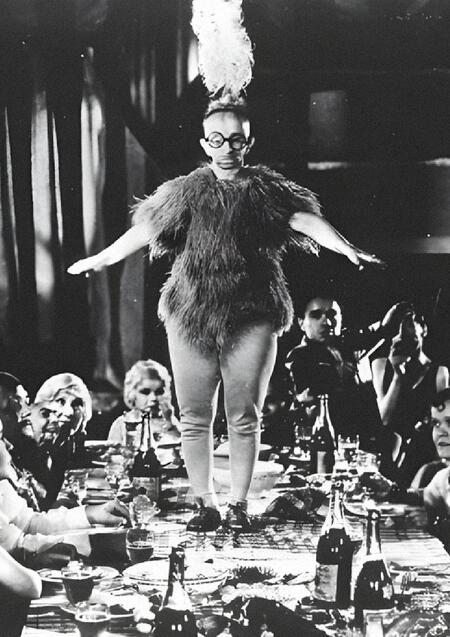
The study material comprised five American films released between 1925 and 1936: Charles Chaplin’s The Gold Rush, William Welman’s Enemy of the State, Tod Browning’s Freaks, Frank Capra’s It Happened One Night, and Gregory La Cava’s My Servant Godfrey.
These films share a domestic situation that occupies a different place in the narrative development. In a comedy, the breaking of rules at the table allows for a commentary on mismatches in status and initiative; in a gangster film, the home meal is examined as an expression of private violence; and in a horror film, the communal table becomes a site of conflict over who has the authority to admit another person to the group or reject its norms. This genre difference is crucial because it helps explain why a similar spatial situation carries different implications across these films.
The investigation compares three aspects of the common order: access to the table, the right to set the rules, and the ability to interrupt the meal. This correlation will allow us to test in which instances cinema presents hierarchy as a familiar aspect of everyday life, and in which it elevates it to a subject of conflict. The meal itself is interesting from the perspective of a situation where interpersonal relationships can be observed on the scale of a single table and a few minutes of screen time.
Plan
- Concept
- Chapter 1. Nobody Came
- Chapter 2. Who Teaches Breakfast Here?
- Chapter 3. Family Business on the Table
- Chapter 4. One of Us
- Chapter 5. Who Will Change the Order?
- Conclusion
Chapter 1. No One Ever Came
You can set the table on your own, but to be the host of the evening, you need guests. The New Year’s episode of «Gold Rush» is built around the contrast between two actions: the dinner is ready, but no guests are forthcoming. The diligent character invites Georgia and her friends from the saloon for a New Year’s dinner. The cabin isn’t even his—he is watching over someone else’s home, and he earns the money for the chicken and small gifts by shoveling snow [4]. He does everything that is up to him; the only thing outside his control is whether the guests will arrive.
The film «The Gold Rush» (directed by Charlie Chaplin, 1925)
The protagonist distributes gifts among the guests, placing them in the seats where the invitees will sit. This initially establishes a relationship between people who have not yet appeared on screen. The diligent host knows in advance where the guests will sit—this is his initiative as the host—but the wait stretches on for a long time, and the empty seats signify the very possibility of people appearing in the frame.
The film «The Gold Rush» (directed by Charles Chaplin, 1925)
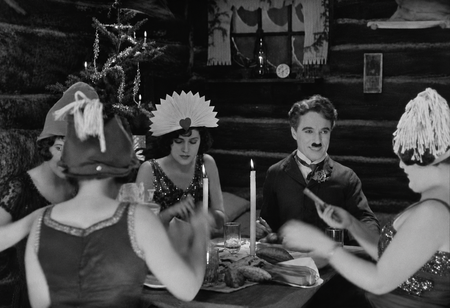
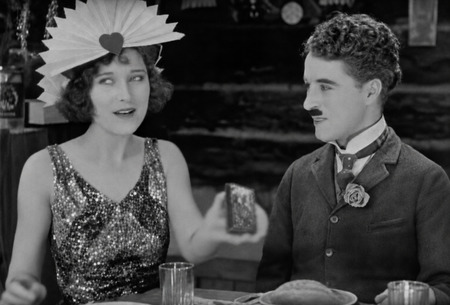
The film «The Gold Rush» (directed by Charlie Chaplin, 1925)
The main character falls asleep while waiting; in his dream, he sees himself giving out gifts, joking around, and then placing two buns on forks and making them dance [4]. The tabletop momentarily transforms into a stage, the food items become props, and the guests turn into an audience. Thus, the host’s initiative is expressed in the way he captivates the table.
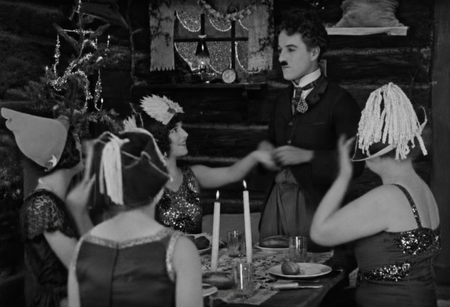
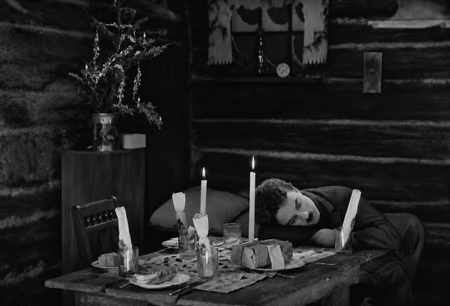
The film «The Gold Rush» (dir. Charlie Chaplin, 1925)
The film «The Gold Rush» (dir. Charlie Chaplin, 1925)
The celebration did take place, just somewhere else. The earnest seeker steps outside and stops by the illuminated windows of a saloon, where a New Year’s song is sung at midnight [4]. The window begins to function as a frame within the frame: on one side, we see a crowded hall, and on the other—a solitary person.I would draw a parallel to a cabin—it had space for guests, but there were no people inside, whereas the saloon has no space, but it is crowded with people.Through the carefully constructed frame, the director conveys the protagonist’s isolation by juxtaposing two spaces.
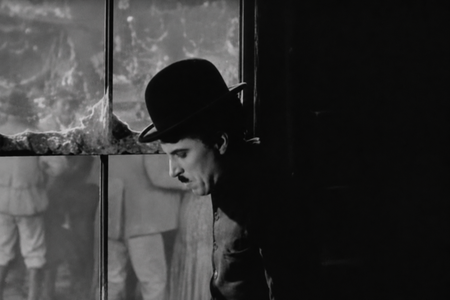
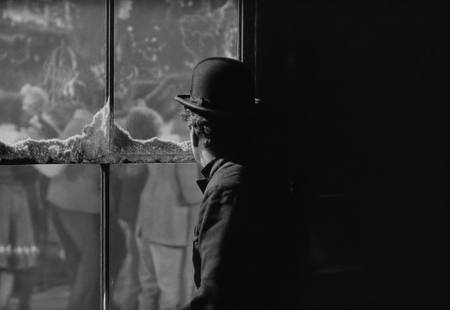
The film «The Gold Rush» (directed by Charlie Chaplin, 1925)
After midnight, Georgia recalls the invitation and leads her group to the cabin to mock the host, but the cabin is empty. The guest still finds themselves in front of the table, only this time the host is gone. The meticulous place setting clearly shows the effort put into it. The group and the host are separated by time and space on two occasions, so no one ever sits at this table in this interpretation.
The film «The Gold Rush» (directed by Charlie Chaplin, 1925)
This episode leads to the first observation of the entire study. The host controls everything on the table and even who sits where, but the feast only begins when the guests accept the invitation. It turns out that the simplest boundary of power at the table is the consent of others to attend.
Chapter 2. Who’s Teaching Breakfast Here
In the film Enemy of the State, there are two tables, and at each one, someone attempts to teach Tom Powers how to behave. At the family dinner, his older brother Mike, who has returned from the war, acts as the instructor. At the hotel breakfast, it is Kitty, who lives with him. Both lessons conclude with the entire table ceasing to exist as a space for communal eating. Richard Maltby also calls the film a family melodrama about the collision of two worlds inhabited by the second generation of immigrants [7]. The kitchen table is precisely where these worlds meet face-to-face.
1.1 Barrel instead of a festive dish
The film «The Public Enemy» (directed by William Wellman, 1931)
Dinner is hosted to celebrate Mike’s return. Tom and Matt bring a large barrel of beer to the table and place it in the center of the feast, where the main course is customarily set during celebrations. In the years of Prohibition, beer was the commodity that sustained Tom’s income. Thus, the condition for the evening is subtly set: to drink the beer is to accept where it came from.The composition of the shot is arranged so that the barrel stands between the seated figures, preventing them from seeing each other. It turns out that the object meant to unite the table physically divides it into two halves.
The film «The Public Enemy» (dir. William Wellman, 1931)
Mike stands up, accusing his brother of how he earns his living, and throws a barrel. This is three consecutive violations of order: the refusal of hospitality, stepping out of the shared level of the seated guests, and finally, removing the very center of the table. Mike is right, but he is the one who destroys the celebration—Maltsby observes that despite Mike’s moral correctness, he «destroys every opportunity for family harmony» [7]. Tom counters that his brother’s hands are not clean either: he killed in the war as well (the dispute over who has the right to judge at this table remains unresolved). The father, who could settle this, appears in the film only once [7]. The place of the head of the family is empty, and both brothers lay claim to it: one by the power of money, the other by the power of law. The mother remains seated between them.