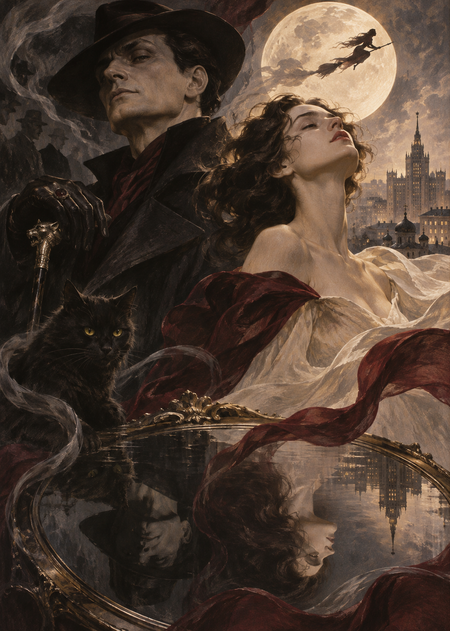
// Visual study based on illustrations by Nadia Rusheva, Gennadiy Kalinovsky, Andrei Kharshek, Nikolai Korolev, and Pavel Lekhovich for M.A. Bugalkov’s novel «The Master and Margarita» //
Navigation Menu
- Introduction — Relevance and Research Concept — Research Question — Hypothesis and Research Goal — Illustration Chronology (1968–2013)
- Part 1. Evolution of the Voland Visual Image
- Part 2. Evolution of the Margarita Visual Image
- Part 3. Comparative Visual Analysis
- Conclusion
- Sources — Bibliography — Illustration Sources
Concept
Mikhail Bulgakov’s novel «The Master and Margarita» has repeatedly served as a subject for artistic interpretations. Although the literary characteristics of the characters remained unchanged, the depictions of Woland and Margarita in the illustrations by different artists acquired new nuances: their appearance, emotional expressiveness, and interaction with their surroundings all evolved.
It is particularly interesting to trace how the visual embodiment of these characters has evolved over several decades—from the concise graphics by Nadia Rusheva created in 1968 to the illustrations by Pavel Lekhovich in 2013.
Voland, embodying the supernatural, was depicted at times as a conventional demonic figure, at other times as a mysterious man, and still others as an authoritative character with distinct human features. Margarita, conversely, could present herself as a romantic heroine, a free witch, a tragic woman, or a character straddling the boundary between two worlds.
The differences between the images reveal how artistic language influences the interpretation of a literary image. The study examines the works in chronological order of creation. However, this is not about proven lineage between artists, but rather about the evolution of how the same characters are interpreted.
// Research Question: How have the visual portrayals of Voland and Margarita evolved across illustrations by different artists from 1968 to 2013, and what changes in their portraiture, plasticity, color, and composition reflect varying understandings of their human and supernatural natures?
// Hypothesis: The illustrations under consideration demonstrate a transition from conventional, symbolic imagery to more concrete interpretations—those that are psychologically and narratively developed. Meanwhile, Voldemort’s character gradually acquires more distinct human traits, and Margarita’s portrayal reveals her inner state and transformation through a wider array of visual representations.
// Objective: To trace the evolution of visual representations of two characters across the works of five artists and identify the core characteristics of each interpretation.
// Research Method: Chronological and comparative visual analysis, with a focus on portraiture, silhouette, gesture, color, composition, and space.
Chronology of Illustrations: 1. 1968 — N. Rushaeva 2. 1985 — G. Kalinovsky 3. 1987–1990 — A. Kharschak 4. 2007–2008 — N. Korolev 5. 2013 — P. Lekhovich
Part 1. How the visual image of Voland evolved.
I. Nadezhda Rusheva, 1968. Voland as a demonic symbol.
One of the early visual interpretations of Voland belongs to Nadezhda Rusheva, who created a series of drawings for the novel in 1968. In her work, Voland is not portrayed as a realistic portrait of a specific person. The artist uses a concise line, an expressive silhouette, and a minimal number of details.
In the drawing «Voland, ” the overall form of the figure is particularly important. The conventional depiction, the characteristic silhouette, and the facial features evoke associations with traditional images of Mephistopheles. The character’s human appearance here is linked to his demonic nature.
It is fundamentally important that Rusheva does not attempt to give Voldemort the illusion of material presence. On the plane of the paper, his figure appears as a graphic sign, almost independent of the surrounding space.
In the drawing «Voland’s Eye, ” the focus shifts even more strongly from the human form to a distinct symbolic element. The eye can be interpreted as an expression of Voland’s ability to observe, understand, and foresee events.
«Voland’s Eye»
Thus, the supernatural nature of the character is conveyed through a rejection of realistic detail. Voland in Rusheva’s work is primarily a symbol of mysterious, otherworldly power. The artist emphasizes not his individuality, but his belonging to a different realm. This serves as the starting point for comparison with subsequent interpretations.
II. Gennady Kalinovsky 1985. Voland as a participant in human reality.
In Gennadiy Kalinovsky’s illustrations, the figure of Voland takes on a different meaning. While Rushev primarily focuses on the character’s autonomous presence, Kalinovsky depicts him within a complex system of human relationships and fantastic events.
In the scene at Patriarch’s Ponds, Woland becomes part of a recognizable Moscow landscape. He interacts with Berlioz and Ivan Bezdomny, fits in among other figures, and outwardly maintains the appearance of an ordinary man.
However, the tense graphic style, color contrasts, and the depiction of the surrounding environment create a feeling of the unusual nature of the event.
Voland is no longer presented as an isolated demonic symbol. He becomes a character whose presence alters the perception of familiar reality.
This is particularly evident in the scene of the chess game. The action itself is linked to intellectual confrontation, calculation, and control over events. Voland is perceived less as an embodiment of an external threat and more as a being capable of managing a complex system of occurrences.
Compared to Rusheva, Kalinovsky gives increasing importance to plot and space. Voldand’s demonic essence is revealed not only through his external characteristics but also through his relationships with the surrounding world.
The main shift in the character: Voland ceases to be primarily a graphic symbol of the supernatural and becomes an active character who conceals his unusual nature within everyday human life.