Navigation Menu
Research Concept
Chapter 1. The Formation of the Image of Soviet Reality
Chapter 2. The Image of the New Person
Chapter 3. The Theme of Abundance in Soviet Painting
Chapter 4. The Construction and Reflection of the New World
Bibliography
Image References
Research Concept
Painting in the 1930s was influenced and controlled by the Soviet regime. In its endeavor to disseminate the image of the new Soviet citizen and a flourishing state, the authorities controlled and censored the artists' work.
There was encouragement to depict themes of abundance, erudition, stability, and a vision of a bright future in the artwork.
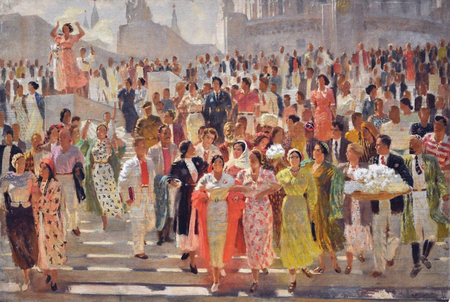
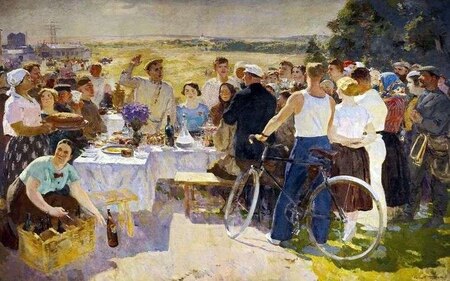
Samkhov A. N. «Cotton.» 1939; Gerasimov S. V. «Kolkhoz Holiday.» 1937
I am particularly interested in how artists depicted reality in their work during periods of massive national change. Therefore, for my visual research, I chose the theme of Soviet painting in the second half of the 1930s, a period where idealization and scenes of everyday life, alongside major social events, were frequently encountered.
Research Objective
The objective of this research was to study the image of Soviet reality from 1935–1939 as conveyed by artists of that era, and to examine how these authors rendered that reality through the subject matter they infused into their paintings.
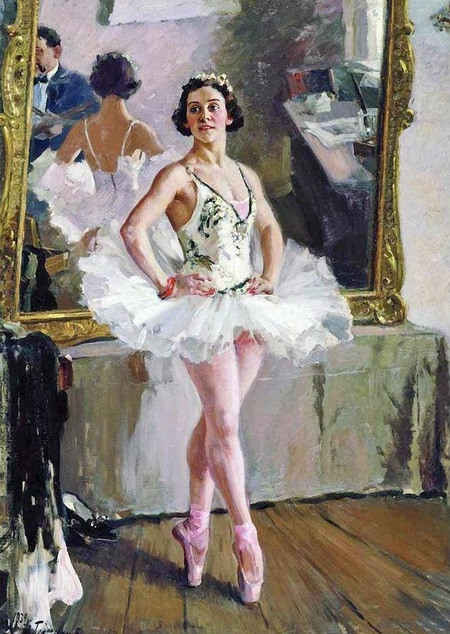
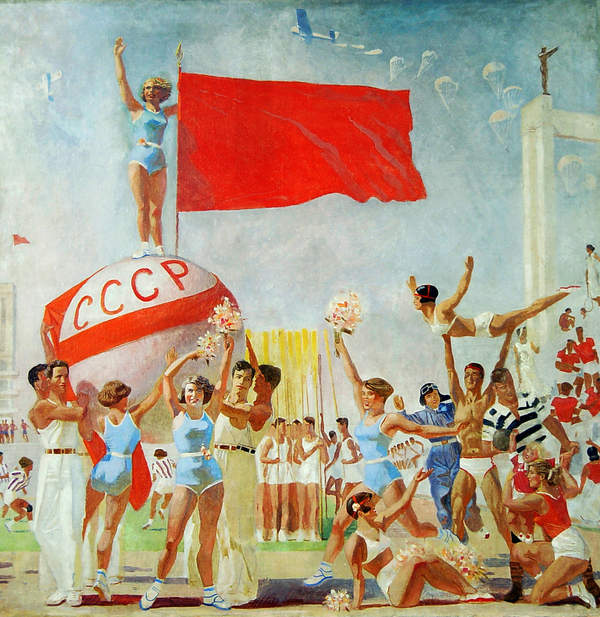
Gerasimov A. M. «Portrait of O. V. Lepeshinskaya.» 1939; Samokhvalov A. N. «Soviet Physical Culture.» 1935
The research period selected is from 1935 to 1939. By this time, socialist realism had established itself as the primary official artistic direction. Painting from this period reflected an idealized image of Soviet society and, naturally, the state.
Based on my research topic, I am focusing on paintings that convey various aspects of Soviet society, created in the second half of the 1930s. This timeframe allows me to examine both the characteristic works from that period, which were produced under strict governmental regulation, and to see the other side—how artists managed to preserve their approach to depicting reality.
Therefore, in the first chapter, I will examine the historical context crucial for understanding the circumstances under which these works were created. I will then analyze the main thematic narratives found in the paintings: the image of the Soviet person, the ideas of abundance and universal well-being, and the construction of a new world.
Plastov A. A. «Trojka.» 1937
The question of how artists reflected reality while maintaining personal motives will run throughout the entire study.
For this research, I am utilizing scholarly publications, the primary criterion for selection of which is their direct relevance to the chosen historical context, period, or artwork. As the research progresses, I aim to examine the topic from the perspective of various scholars and incorporate my own observations and commentary on the authors' work.
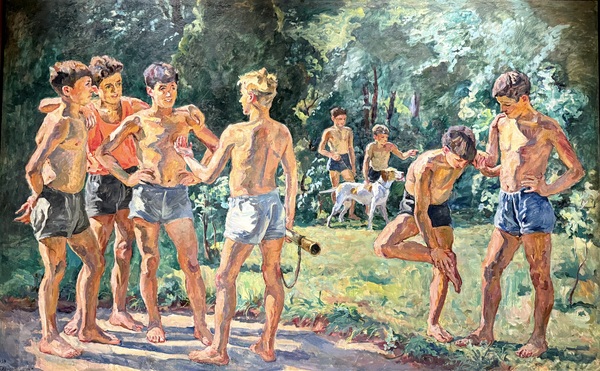
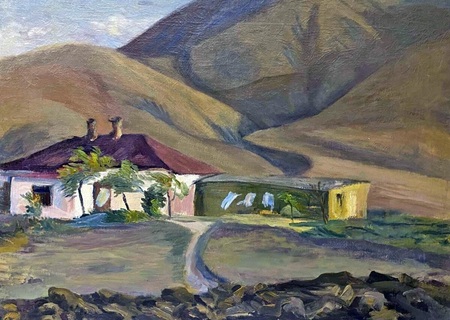
P. P. Konchalovsky. «Morning of Spanish Pioneers in a Summer Camp.» 1939; Kozulina T. S. «Crimea. Cozies.» 1937
Research Question
How did artists portray Soviet reality between 1935–1939, balancing official narratives of the new society with their personal views of the world around them?Research Hypothesis
I hypothesize that under conditions of strict censorship, artists were able to represent approved themes through the lens of their own vision. Therefore, the works from that era may vary in the mood and feeling they evoke in the viewer.Chapter 1. How the Image of Soviet Reality Was Formed
Art Under State Control
Soviet art of the 1930s was strictly regulated by the authorities. One of the phases in forming the new artistic policy was the Central Committee of the RCP (b) resolution, «On the Party’s Policy in the Field of Artistic Literature, ” from June 18, 1925, which marked the state’s desire to influence cultural development.The next significant development was the Central Committee of the VKP (b) decree «On the Restructuring of Literary and Artistic Organizations» from April 23, 1932, which changed the system of creative associations, contributed to strengthening state control and censorship, and limited artistic experimentation by artists [1].
Gerasimov, A. M. «I. V. Stalin and K. E. Voroshilov in the Kremlin.» 1938
The principles of Socialist Realism were embraced—creating works accessible to the mass audience and reflecting the idealized image of the Soviet state.
The image of a new person—physically developed, educated, and morally perfected—was formed and read within the motifs of the paintings. The motif of light became a symbol, a characteristic of a new, radiant world.
In their works, the artists depicted the construction of this world. They focused on industrial and urban landscapes. This occurred not only due to state commissions to document achievements but also from the artists' own desire to capture the nation’s industrialization. Even everyday scenes of human life were imbued with new significance, romance, lyricism, and optimism.
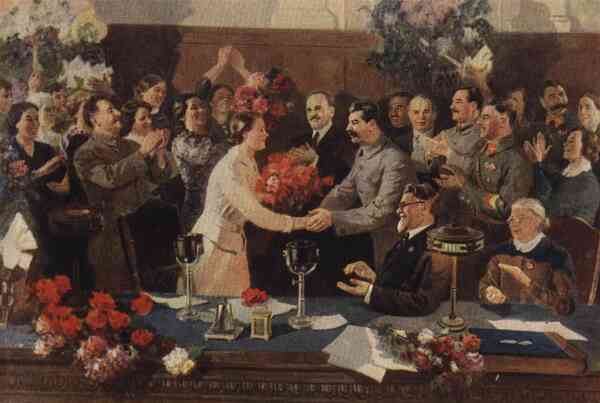
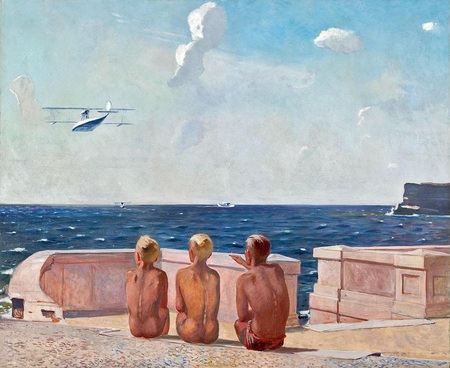
Vasily Prokofievich Efanov. «Unforgettable Meeting (Party and Government Leaders at the Presidium of the All-Union Conference of Wives of Producers and Engineers and Technical Workers of Heavy Industry in the Kremlin).» 1936–1937; Alexander Alexandrovich Deineka. «Future Pilots.» 1938
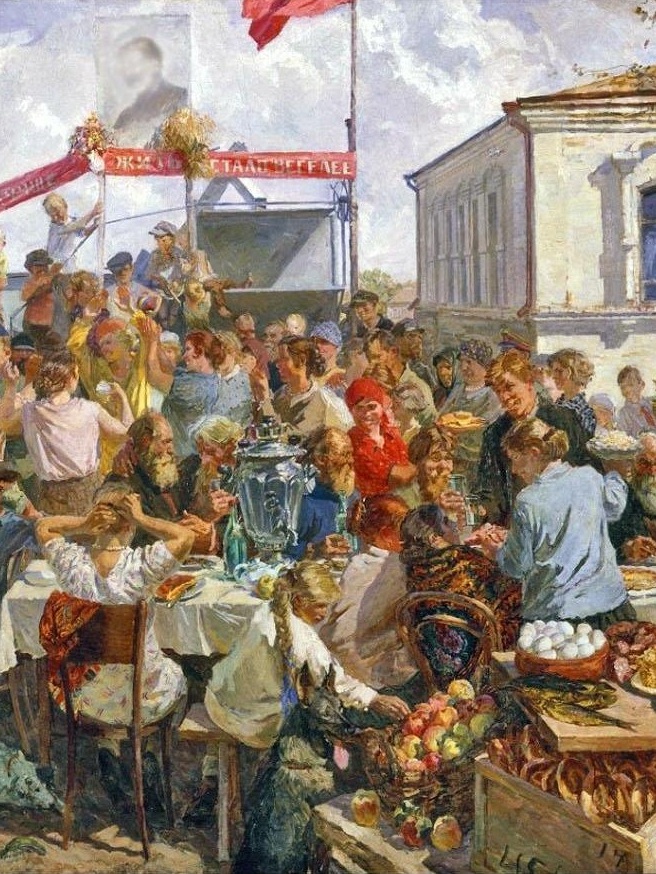
One of the primary motifs of official art was universal prosperity and abundance. Artists depicted rich harvests, overflowing markets, and festive life.
However, these images were often idealized and did not always reflect real-life conditions.
Mashkov I. I. «Pumpkins on an Embroidered Tablecloth.» 1939
However, adherence to state-approved themes did not always signify an artist’s renunciation of their own worldview. For instance, in the article by V.V. Voskresenskaya, the work «Peach Gathering» by M. Saryan is mentioned. The painting features detailed figures of people and the fruit of a tree. Here, the artist’s personal perception of the world might have aligned with the officially endorsed theme [2].