Concept
Teleportation holds a special place in science fiction: it allows for the traversal of distances that would otherwise require colossal expenditures of time, transportation, and physical effort. Yet, on screen, teleportation rarely appears as a neutral technical operation. A person vanishing in a beam of light, passing through a glowing threshold, decomposing into particles, or suddenly reappearing elsewhere evoke a range of feelings—from confidence in the technology’s perfection to anxiety over the integrity of the transported individual.
Behind the spectacular effect lie fundamental questions: what exactly is being transported, is the original matter preserved, can a person survive the dismantling of their own body, and does he remain himself upon arrival at the destination point?
The selection of a topic is driven by the fact that science fiction not only invents transport devices but also creates visual representations of invisible or hypothetical processes. The viewer must grasp what happened to the character within seconds, even if the mechanism is complex or entirely unexplained. Therefore, the device’s form, color, the nature of its glow, the manner in which the body vanishes, the depiction of the space «between» two points, and the characteristics of materialization all become part of the technological narrative. Studying these images allows us to uncover what perceptions of matter, information, and human identity are being cemented in mass culture.The scientific perspective is necessary for conceptual accuracy, but not for judging works on a simple «possible—impossible» scale. Contemporary science does not possess the technology to teleport a person using the methods described in science fiction. Consequently, the work will differentiate between scientific hypotheses, the rules of the fictional world, and artistic decisions. This approach will explain the underlying concepts of the screen image without presenting the fictional premise as an existing technology.
The materials will consist of films, television series, and video games where teleportation plays a significant and visually represented role. Preference will be given to scenes that allow for an examination not only of the result of the transport but also of its stages: device preparation, entry or initiation of the transfer, disappearance, any intermediate state, and arrival at the destination. Works are selected based on three criteria. The first is the distinction of the proposed mechanisms: the main body will feature examples of object dematerialization followed by reconstruction, as well as examples of transfer through a portal or a spacetime passage. The second is the expressiveness of the visual solution: the form of the device, the nature of the transition boundary, lighting, color, editing, sound, and the depiction of the body must offer material for comparison. The third is the diversity of the works: priority will be given to standalone franchises and different screen formats so that the study is not confined to the history of a single fictional world.
The unit of analysis will be a specific scene or gameplay episode, not just the work as a whole. For each example, the title, year, episode number or game location name (if necessary), and the sequence of key frames will be recorded. If a work does not explain the mechanism of teleportation, this will be stated directly: a light effect alone does not allow one to conclude that an object is disassembled into particles, nor does a visible portal guarantee that the transition occurs without material transformation.
The work progresses from a conceptual foundation to an analysis and comparison of works. Following the conception is the section «Teleportation as a Scientific and Fictional Concept.» This section will clarify how the term is used in the research, how the physical displacement of an object differs from transmitting information about it for subsequent reconstruction, and what questions arise when discussing space-time transitions. It also examines the limitations of fictional models: the necessity of providing a sufficiently complete description of the object, transmitting the data, ensuring the building material, and maintaining the integrity of the result. These questions serve as the framework for the analysis, not as an assertion of the technical feasibility of such a process.
The section «Analysis of Teleportation Models in Science Fiction» is divided into two main subsections. The first is dedicated to object dematerialization, transmission, and reconstruction. The focus here is on depicting the disappearance of a body, the role of the technical apparatus, methods for showing the object’s restoration, and the consequences of error. The second is dedicated to space-time portals. Here, the appearance of the entrance, the properties of its surface, the nature of the space on the other side, the possibility of seeing the destination, and the character’s actions when crossing the boundary are explored. If a work incorporates features of both models, it is considered a transitional case rather than being artificially assigned to only one subsection.
The subsequent section—“Comparative Visual Analysis”—is organized not by individual works, but by recurring imaging techniques. Devices and portals, the disappearance and reappearance of characters, the display or concealment of the transit itself, the maintenance of the apparent integrity of the body, as well as the use of editing and sound are compared. This structure allows for the identification of both the differences between the models and the shared visual conventions of science fiction. In the conclusion, the findings of the comparison are linked to how the works represent matter, information, consciousness, and identity.
Textual sources will be utilized according to their intended purpose. Scientific and educational publications will help clarify physical concepts and define the boundaries of justifiable claims. The video by Dmitry Pobedinsky on teleportation [8] will serve as the initial reference point for framing questions. His explanations will be cross-referenced with relevant scientific studies as necessary. Special attention is paid to the distinction between a hypothetical model and technology whose existence is experimentally confirmed.
To describe fantastic mechanisms, the works themselves hold paramount importance—the imagery, the dialogue, and the narrative consequences of teleportation’s use. Official descriptions, creators' materials, and interviews help clarify the intent, but they do not substitute for the analysis of a specific scene. Studies in film language and visual culture will be employed to examine shot composition, editing, special effects, and methods of guiding viewer perception.
When working with sources, it is necessary to distinguish between three levels of claims: what is directly shown, how the event is explained within the work, and what conclusion can be drawn from this data. This is particularly critical where the technology is presented visually but its inner workings remain undefined.
The core research question is: How do the visual modes of depicting teleportation help the viewer understand the presumed mechanism of transit, and what ideas does this formation create regarding the preservation of an object or person?
The research hypothesis is that different models of teleportation gravitate toward distinct visual solutions. Dematerialization and reassembly are often depicted as a technological processing of the body: its gradual disappearance, transformation, and restoration make the possibility of failure apparent. The portal, conversely, typically emphasizes the continuity of motion: the character enters the passage and exits it, remaining visibly whole. However, these patterns are not absolute. Science fiction may employ the image of a passage for a mechanism related to matter transformation, or show disappearance without explaining what happened to the object. By comparing the screen image with the rules of the fictional world, we can determine when the visual solution reveals the principle of teleportation and when it conceals it—and what questions regarding the preservation of human identity arise as a result.
Teleportation as a Scientific and Fictional Concept
Teleportation in science fiction is usually described as moving a person or object from one point to another without traversing the conventional path between them. However, the similar result—disappearance in one location and reappearance in another—can imply different processes. The object might be transformed, transmitted, and reconstructed; only information might reach the destination to create a new instance; or it might pass through some imagined connection between distant regions of space. To study this effectively, it is important to differentiate these models: the effect shown on screen informs the viewer of the relocation, but it does not always reveal what precisely happened to the object’s matter.
In Dmitry Pobedinsky’s video on teleportation [8], two primary hypothetical approaches to human transport are examined: object reconstruction based on transmitted data and traversing a spacetime passage. The first approach suggests that at the point of departure, a description of the object’s structure must be obtained, sent to the receiving point, where the object is then reconstructed from available matter. In this scenario, information—not the original body—is transmitted across the distance. This distinguishes it from fictional transporters, which, according to the rules of some narratives, convert matter into a transferable stream and then reassemble it. In both cases, the screen might display a similar vanishing and reappearing effect, although the in-world explanations differ. Therefore, when analyzing a work, one must determine whether it discusses the transfer of original matter, assembly from different material, or if the mechanism remains undefined.Reconstructing a human from a description faces difficulties right at the problem-setting level. It is insufficient to transmit just the general shape of the body or the location of its organs; restoring a functional organism requires knowledge of tissue structure, cellular condition, and numerous interconnected processes. The more precise the intended copy, the more difficult it is to obtain, preserve, and transmit the necessary data, and subsequently reproduce it without significant errors. The numerical estimates for data volume and assembly time presented in the video help illustrate the scale of the challenge, but they depend on the chosen descriptive accuracy, the communication channel’s capabilities, and the assumed restoration technology. They cannot be considered established parameters for future teleportation. Furthermore, transmitting data over a distance would not be instantaneous: a standard signal propagates at a finite speed, limited by the speed of light in a vacuum.
Approximate value of the speed of light in a vacuum
The speed of light was first estimated using the delays of Jupiter’s moon Io’s eclipses, and later measured in a laboratory: light was sent to a distant mirror, and the return time was recorded. Its current accepted value is 299,792,458 m/s; since 1983, this value has been precisely defined based on the meter definition.
There is also a more fundamental limitation: a complete description of an arbitrary, unknown state of a physical system cannot be simply measured once and replicated without constraints elsewhere. As explained in the IBM Quantum Learning material on the limitations of information copying [1], it is impossible to create a perfect copy of an arbitrary, unknown state. This does not mean that it is impossible to fabricate an outwardly similar object or copy a known blueprint. Rather, it demonstrates why the fantastic idea of perfectly scanning and duplicating a unique object cannot be considered a solved technical problem. However, if the technology in the work creates a second person, a separate question arises that extends beyond physical description: is the new identity identical to the original, or do we have two people with a shared past?
The Ship of Theseus Paradox
A different logic underpins the space-time portal. In this case, the concept is not the reconstruction of an object based on a given description, but rather the shortening of the path between distant points—a person crosses the boundary of the passage and continues moving to the other side. The scientific benchmark for such a fantastical construct is a wormhole—a hypothetical geometry of space-time that can be described within the framework of general relativity. Physicists Michael Morris and Kip Thorne examined the conditions under which such a passage could remain open and be traversable; their work was published in the American Journal of Physics in 1988 [3]. However, the mathematical model is not equivalent to a discovered object or a finished technology. As NASA notes [4], there is no observational evidence of wormholes, and it is unknown how to create or sustain such a passage. Traversable models require unusual physical conditions for stability, including those related to negative energy. Einstein Online [6] emphasizes the speculative nature of such scenarios.
Therefore, the common trope in science fiction of instantly stepping through a portal should not be interpreted as an illustration of a proven method to circumvent physical limitations. Traversing a hypothetical wormhole would mean moving along a different, shortened path, not the disappearance of time itself. Visually, however, a portal allows a complex spatial idea to be rendered as an understandable boundary: a door, a ring, a luminous surface, or a tunnel. For the viewer, crossing such a boundary often looks like the body maintaining its integrity, whereas disassembly and reassembly make its potential destruction and reconstruction noticeable. Nevertheless, the external appearance of the transition does not uniquely define the mechanism; a work of art might show a character entering a portal while explaining the event through material transformation.
Thus, the scientific perspective does not provide a criterion for judging fantastic works as «true» or «false, ” but rather a basis for accurate comparison. It allows us to ask the same questions of every visual representation: is the original matter displaced, is the data necessary for object reconstruction conveyed, is there a path between points, and what does the work communicate about the persistence of identity after transition? Answers to these questions should primarily be sought within the work itself, distinguishing between the visual effect presented, its in-narrative explanation, and possibilities confirmed by contemporary science.
Analysis of Teleportation Models in Science Fiction
Dematerialization and subsequent object assembly
Star Trek: The Original Series. Transporter Platform
In Star Trek: The Original Series (1966–1969), teleportation is presented as a standard operation of a starship transporter: a character steps onto a platform, the operator initiates the procedure, and the body gradually dissolves into shimmering light points; at the destination, the effect is reproduced in reverse—the figure reassembles and becomes visible. The circular platform and control panels signify a technological space, and the characteristic light patterns and sounds make the transition recognizable even without a detailed explanation of its mechanics. Within the logic of the universe, the transporter transforms the object into a transmittable stream and reconstructs it at the destination. Visually, the series depicts disappearance and reappearance, but not the literal movement of particles or the internal process of assembly. Therefore, the effect functions as a conventional on-screen sign of dematerialization and rematerialization, rather than as a scientific demonstration of a physical mechanism. Unlike a portal, the character does not cross a visible boundary of space: the transfer is organized by the apparatus and editorially divided into departure and arrival.
The Fly, 1986. Teleportation Machine
The Fly, 1958. Teleportation Machine
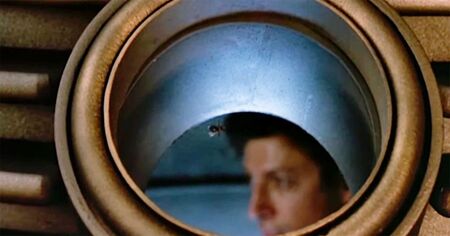
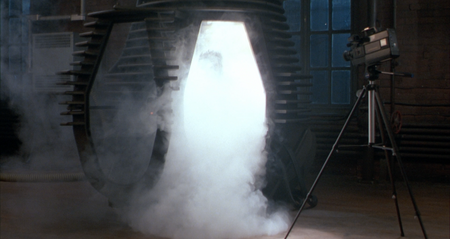
In Kurt Neumann’s film The Fly (1958), André Delambre’s apparatus is conceived as a matter transmitter: the object must vanish in one chamber and reappear in another. Two sealed chambers, connected to laboratory equipment, make the process resemble a controlled scientific experiment. However, the fly, accidentally entering the chamber with the scientist, disrupts this course—resulting in the fusion of human and insect parts. The transmission itself is shown less in detail than its consequences: the threat becomes visible primarily through bodily mutation and the terrifying image of a creature combining human and fly characteristics. In David Cronenberg’s version of The Fly (1986), the same initial idea of matter transference receives a more technologically elaborated realization. The teleporters appear as large vertical chambers linked to a computer; attention is paid to Seth Brandon’s experiments and how the system processes the transferred object. If the 1958 film focuses on the catastrophic outcome of a failed experiment, the 1986 film more thoroughly depicts the device’s trials and transforms the transfer error into a gradual physical transformation of the protagonist. In both versions, the fly entering the chamber violates the boundary between objects, but the visual emphasis differs: in the original, the viewer confronts a sudden, grotesque outcome, whereas in Cronenberg’s film, the body changes unfold sequentially, becoming central to the screen horror. Thus, both films utilize the model of object transfer and subsequent reconstruction, but they portray its failure differently: as a sudden mixing of parts in Neumann’s film and as a prolonged biological alteration in Cronenberg’s film.
The Prestige, 2006. Tesla’s Apparatus
In «The Prestige» (2006), Tesla’s device does not displace the original Angier, nor does it erase him at the point of origin: it creates a copy at a distance while the original remains with the apparatus. Therefore, the «Teletransported Man» focuses only superficially on teleportation—the spatial appearance of the second Angier is achieved not by the disappearance and subsequent reconstruction of the same body, but by duplication. This distinction is particularly vital for visual analysis: the machine is surrounded by electrical discharges and flashes of light, but the film does not show the body decomposing into particles or a continuous transfer between two points. Instead, it builds tension around the sudden appearance of the double and the uncertainty of which of the two is the original. In the stage performance, the copy appears far from the setup, while the Angier left with the machine is hidden in a deadly trap beneath the stage. Thus, the technological effect does more than just shorten the journey; it creates a second instance of the human and then becomes part of a trick that necessitates the death of one of the two. The film uses visual ambiguity to link the apparatus of science fiction to questions of identity and the price of spectacle; its mechanism should therefore be classified more as spatial duplication than as the dematerialization, transport, and reconstruction of the original object.
Stargate SG-1. Asgard Technology
In the universe of «Stargate SG-1» (1997–2007), beam transport is primarily an Asgard technology, distinct from passing through a gate. It allows for the transference of people and objects between points, including between ships and planets. On screen, the process is usually extremely brief: a character enters a directed column of light and almost instantly vanishes, reappearing at the destination. Unlike the transporter from «Star Trek,» the series does not show the detailed dematerialization of the body or its stepwise reconstruction; the transfer appears as a rapid movement managed by an external system. Therefore, the visual effect primarily conveys the precision and power of the technology, rather than its internal physical mechanism. The ability to transport a person without a visible device nearby underscores Asgardian technological superiority; concurrently, episodes where the beam is used to rescue characters or move them suddenly establish it as an important narrative device. For instance, in the episode «Small Victories, ” an Asgardian transporter evacuates O’Neill and Teal’c from a dangerous situation. Within this fictional world, beam transport implies delivering an object to another location, but the series leaves unstated whether the matter itself is transported continuously or if it is transformed and then reconstructed. Consequently, characterizing this model as dematerialization and reassembly must be done with a caveat: the screen directly shows disappearance and reappearance, but it does not explain what happens to the body in between.
Portal Transfer
Stargate, 1994. Portal Gates