Rubrics
- Concept
- Visual Construction of the Screen Image
- Editing and Organization of Movement
- Physical Stunt and Visual Gag
- Features of Comedic Narrative
- Conclusion
Concept
Harold Lloyd cultivated a distinctive comedic style where everyday situations gain a complex visual organization. His films are marked by the consistent development of comedic action, a keen attention to space, precise use of props, and the blend of physical stunts with narrative logic. Unlike comedies structured around a succession of relatively self-contained jokes, Lloyd’s films often integrate individual gags into the character’s overall objective, allowing them to gradually become more intricate. The comedic effect arises from the mismatch between the hero’s intention and the circumstances that impede its realization. Moreover, not only the nature of the events but also the way they are depicted plays a crucial role—the placement of objects in the frame, the direction of movement, the duration of the shot, and the editing sequence all determine how the viewer perceives the unfolding situation. Lloyd’s authorship is interesting precisely because of its combination of established visual techniques, which retain their expressive power across films with diverse plots and spatial settings.
Five full-length silent comedies were selected for the study: «Grandma’s Boy» (1922), «Safety Last!» (1923), «Girl Shy» (1924), «The Freshman» (1925), and «Speedy» (1928). Selecting these films allows for an examination of the diverse artistic solutions characteristic of Lloyd’s work.
One of Lloyd’s most significant characteristics is the active use of space as an element of the action. Architecture, streets, transportation, and environmental objects are not limited to being set dressing; they directly influence the development of comedic situations. In the film «Safe at Last!», the vertical composition and the relationship between the human figure’s scale and the city buildings define the nature of the stunt sequences. In «The Racer, ” the movement of transportation and the organization of urban space create the conditions for obstacles to sequentially emerge. In „Freshman, ” the placement of characters, objects, and set elements allows for the construction of comedic situations within a collective action. Comparing these approaches will allow us to examine the features of Lloyd’s composition, his use of frame depth, wide shots, and spatial references necessary for the viewer to understand what is happening.
Editing and pacing hold a significance in Lloyd’s work that is no less substantial than his creative vision. The comedic effect in his films often builds gradually: an initial scenario develops through repeated actions, the introduction of new obstacles, and shifts in tempo.
One of Lloyd’s most vital characteristics is the active use of space as an integral part of the action. Architecture, streets, transportation, and environmental objects are not limited to being mere set dressing; they directly influence the development of comedic situations. In the film «Finally Safe!», the vertical composition and the relationship between the scale of the human figure and the city buildings define the nature of the stunt sequences. In «The Racer, ” the movement of vehicles and the organization of urban space create the conditions for the sequential emergence of obstacles. In „The Freshman, ” the placement of characters, objects, and environmental elements allows for the construction of comedic situations within collective action. Comparing these approaches will enable an examination of Lloyd’s compositional peculiarities, his use of frame depth, wide shots, and spatial references necessary for the viewer to understand what is unfolding.
Research Hypothesis
Harold Lloyd’s distinctive authorial style is characterized by the systematic integration of visual gags, physical stunts, and narrative action. Frame composition, editing, spatial organization, and the material environment are not employed as independent expressive devices, but rather as interconnected elements that build a comedic situation. Consequently, individual stunts and visual jokes gain a cause-and-effect relationship, and their progressive complication dictates the film’s rhythm and structure.
Key Question
What visual and cinematic techniques shape Harold Lloyd’s signature style in 1920s American silent comedies, and how do they interact to construct comedic narratives?
Visual Construction of the Screen Image
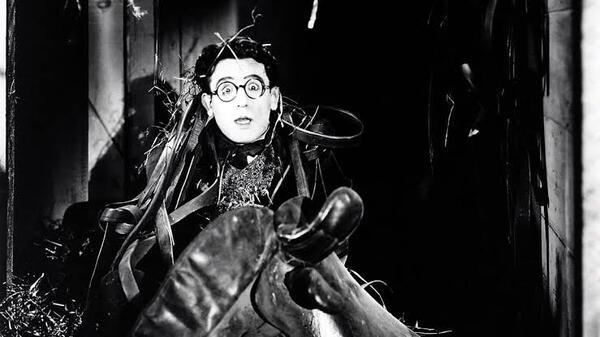
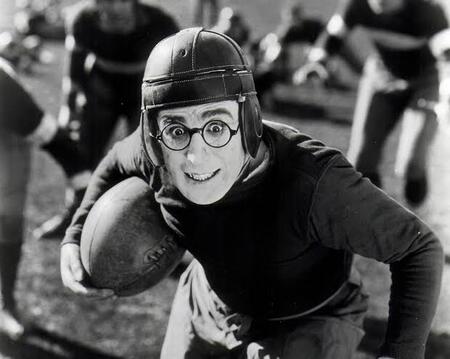
Harold Lloyd «Grandson» (1922) and «Freshman» (1925)
One of the most consistent features of Harold Lloyd’s cinematic style is the creation of a recognizable on-screen persona through external characteristics. In the films The Freshman and The Kid, the character maintains a characteristic look based on a combination of round glasses, neat hair, and everyday attire. Unlike comedic personas built on deliberately distorted clothing proportions or exaggerated eccentricity, Lloyd’s silhouette aligns with common representations of a young American in the 1920s. His costume does not set the character apart from the environment; rather, it makes him visually relatable to the other figures in the action. It is this ordinariness that becomes a key condition for the comedy: a hero whose appearance suggests belonging to the established social order is constantly placed in circumstances that disrupt that stability.
Round Glasses serve in Lloyd’s screen persona not just as a characteristic accessory, but also as a consistent graphic element that maintains the character’s recognizability even when the image scale changes.
Advertising Portrait of Harold Lloyd (1924)
In a close-up, their rounded form stands out against the background of the face, whereas in a wide shot, it becomes part of the cohesive silhouette. This visual distinction is particularly crucial in comedies, where a significant portion of the action is shown from a distance that allows simultaneous observation of the human figure and the surrounding objects. In «Grandma’s Grandson,» a wide shot is necessary to demonstrate spatial relationships and physical obstacles; therefore, the hero’s individuality must remain discernible even when his figure occupies only a small part of the frame.
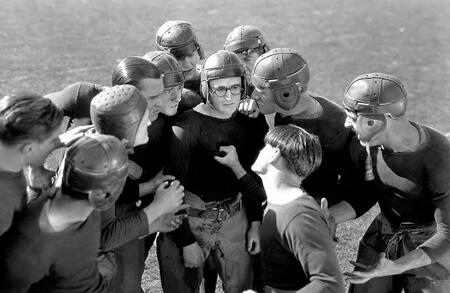
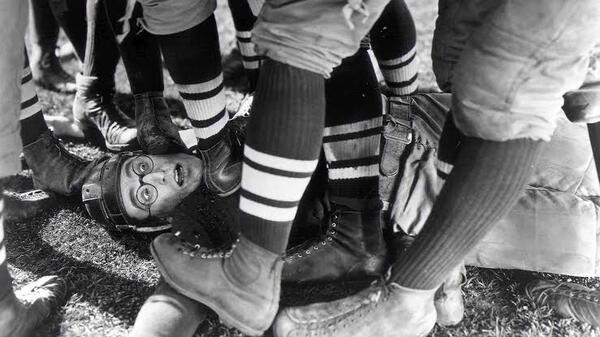
Harold Lloyd, «Freshman» (1925)
In «Freshman, ” Harold’s position among others is particularly noticeable in scenes with the university football team. The players form a cohesive group, united by identical athletic uniforms, physical fitness, and a common goal. Harold strives to become part of this environment, but his presence on the team remains rather nominal. In wide shots, this difference is shown through the placement of figures and the nature of their interaction: the other players participate in training, while the protagonist is often positioned to the side of the main action or is assigned secondary tasks. Even the athletic uniform does not make him an equal member of the team. Lloyd uses group composition to illustrate the discrepancy between how the character presents his status and the actual place he occupies. For the viewer, this incongruity is evident through the ability to observe the hero and the other football players simultaneously.
The comedy stems not from Harold’s unusual appearance, but from his attempts to fit in with a group that has not yet accepted him as a full member.
Harold Lloyd «Freshman» (1925)
For a first-year student, the visual appearance of a character gains additional significance through their interaction with the collective environment. Unlike episodes where the protagonist is the center of independent physical action, here the character’s position relative to other figures in the scene plays a crucial role. Group composition allows us to illustrate the difference between the position a character strives to occupy and the place that is actually allotted to them by those around them.
Lloyd utilizes recognizable student attire and familiar elements of the university setting, yet surface-level conformity does not equate to belonging. In scenes depicting interaction with students, the comic incongruity arises from the disparity between the character’s displayed confidence and the group’s reactions. The audience is able to simultaneously observe the central character’s actions and the behavior of those around him, making the situation comprehensible without detailed verbal explanation. Thus, the group composition serves not only an organizational function but also acts as a visual indicator of social relationships.
Montage and Motion Design
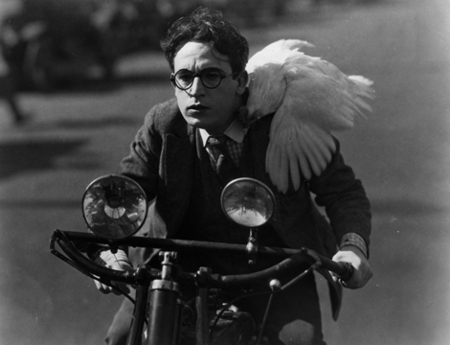
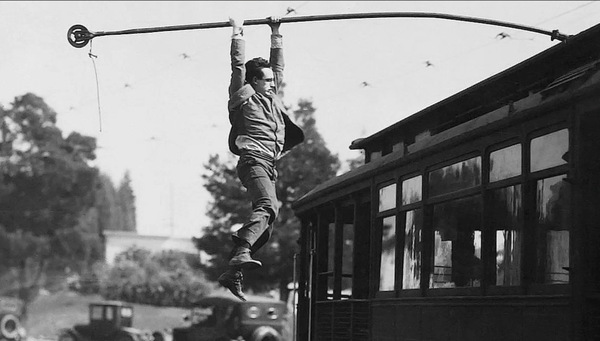
Harold Lloyd, «The Shy» (1924)
The final chase in «The Shy» is constructed as a continuous movement toward a specific goal: Harold is trying to make it to Mary’s wedding. Unlike a comedic episode, which can conclude after one successful gag, here every event delays the protagonist while simultaneously forcing him to find a new way to continue his journey. The editing stitches together separate segments of the route into a sequence where the direction of action remains clear, even as the transportation and surrounding environment constantly change. Lloyd does not show the entire route. Instead, he selects the moments where the movement encounters an obstacle, is interrupted, or resumes.
The omitted segments of the journey do not disrupt the coherence of the episode, as the viewer is primarily focused on the hero’s progress toward the wedding. This organizational structure allows the pace to remain high without the need to detail every movement.
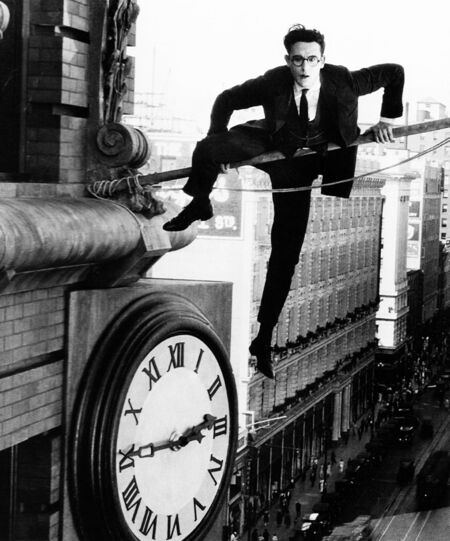
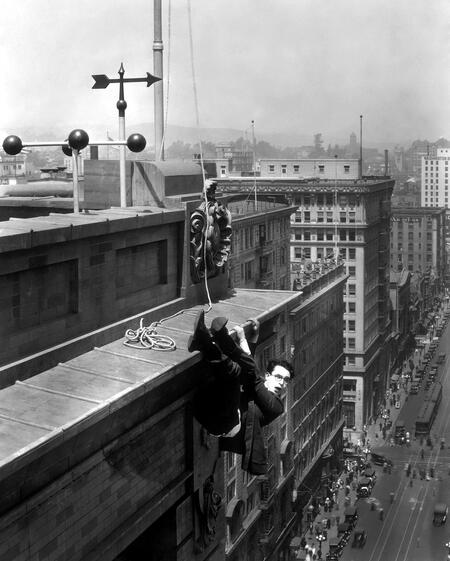
Harold Lloyd «Finally Safe!» («Safety is Paramount!») (1923)
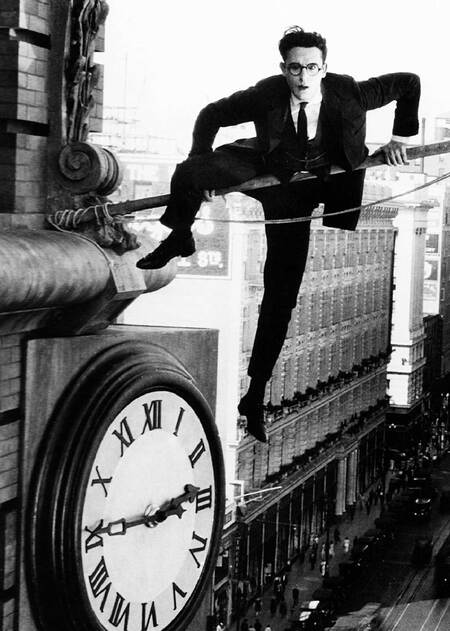
«Finally, in safety!» The montage orchestrates movement differently. The protagonist doesn’t travel along a long route with frequent changes in transport; instead, he ascends along a single facade. Therefore, it is especially crucial to maintain a sense of his position relative to the building. Establishing shots show the distance covered and the height, while closer shots allow the viewer to examine the interaction with windows, cornices, and other details. The transition between shots changes the scale of the image but must not disrupt the feeling of continuous ascent. Unlike the chase in «The Shy, ” where parts of the journey can be skipped, here the viewer must understand the sequence of supports and movements. The montage helps examine an individual stunt without isolating it from the overall spatial environment of the building.