Ikea chair in disassembled form
Concept
The form of an object is determined not only by its use but also by its mode of transportation.
The visual study investigates the influence of logistical constraints on the form-making of industrial design objects. In typical perception, the object is viewed as a finished item designed to perform a specific function. However, before use, it undergoes several stages: production, storage, packaging, transportation, and assembly. Each stage imposes unique requirements on the product—demands that can affect its structure, geometry, and material selection.
The central issue of the research lies in the contradiction between the functional properties of an object and the necessity of its compact placement and mobility. Large-scale items are difficult to transport and store in their assembled state; therefore, designers seek ways to reduce the occupied volume without sacrificing functionality. This gives rise to modular systems, collapsible structures, standardized elements, and inflatable objects. In such cases, transportation becomes not merely an external constraint, but one of the defining factors influencing product design.
The research will examine historical and contemporary examples of product design where storage and transportation requirements have influenced structural and visual solutions. Particular attention will be paid to changes in object structure, methods of element joining, geometric transformation, the use of repeating modules, and the user’s role in the assembly process. Contradictions in logistical optimization will also be reviewed: structural complexity, additional assembly steps, operational limitations, and the material implications of packaging.
How does the necessity of transportation influence the structure and visual language of industrial design objects?
Sections
1. Historical Context
2. Construction and Disassembly
3. Compactness and Transformation
4. Modularity
5. Conclusion
Historical Context
Warehousing and transportation of furniture pieces in the late 19th — early 20th century.
The development of industrial production and international trade altered the scope of object distribution. Goods began moving between cities and countries, which meant their design faced new demands regarding packaging, preservation, and shipping volume.
A finished object occupies space not only because of the material from which it is made, but also because of the voids within its structure. During transport, these voids move along with the piece, increasing the occupied volume.
Industrial Production of Thonet Chairs
Mass production demands the repeatability of elements and precision in their fabrication. Standardized parts are easier to manufacture, replace, and assemble. This sets the groundwork for designs that can be transported as separate components.
Chair No. 14 by Michael Thonet, 1859.
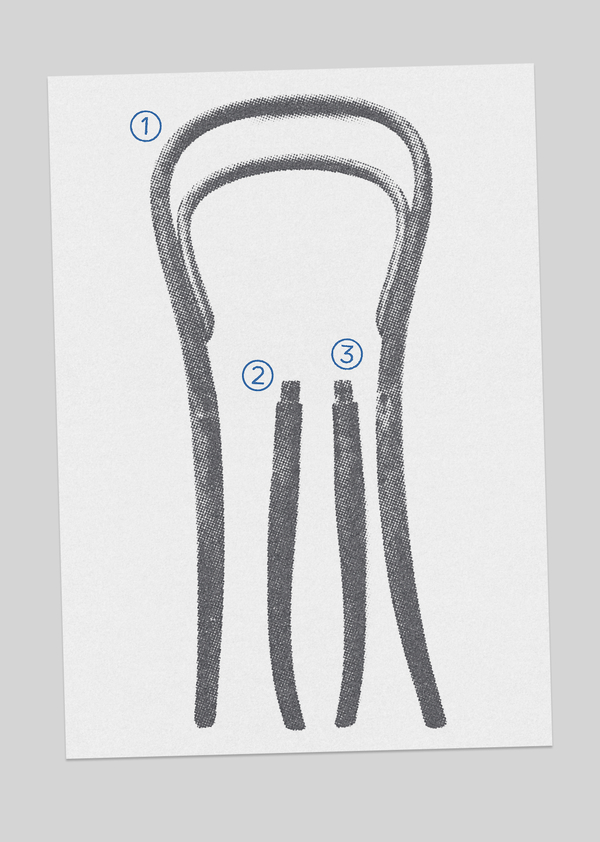
Michael Thonet’s Chair No. 14 became one of the most famous examples of merging industrial production with transportation logistics. Its construction consisted of a relatively small number of parts manufactured according to repeatable standards. The chair utilized bent wooden elements, a seat, and connections that allowed the product to be assembled at the point of sale. This organization simplified storage and transit compared to shipping finished chairs.
Shipping packaging for disassembled chairs No. 14. Thonet company, 19th century.
According to the Vitra Design Museum and Thonet itself, up to 36 disassembled Chair No. 14 could fit into a one-cubic-meter shipping container. At the destination, they were assembled using screw fittings.
In the case of Thonet, compactness was achieved not by altering the packaging of the finished item, but by dividing the chair itself into components. The transportation state was integrated into the design of the object and its joints.
Crate Furniture series, Gerrit Rietveld, 1934.
In 1934, Gerrit Rietveld developed the Crate furniture series. Its pieces were crafted from simple wooden planks, including material commonly used for furniture shipping crates. The series encompassed a chair, a table, and a bookshelf.
Assembly Instructions for Crate Furniture, Gerrit Rietveld, 1934.
Crate Furniture cannot be attributed solely to transportation needs. The availability of materials, the economic climate of the 1930s, and Rietveld’s artistic stance also shaped its design. The pieces were sold as kits for self-assembly, but this was only one part of a broader concept.
Thonet and Rietveld illustrate different approaches to object organization through distinct elements. In the first case, the modularity is linked to mass production and transportation, whereas in the second, it relates to material accessibility, simplicity, and self-assembly.
Thus, disassembly becomes a crucial tool in product design, but its reasons are not always limited to transportation.
Structure and Disassembly
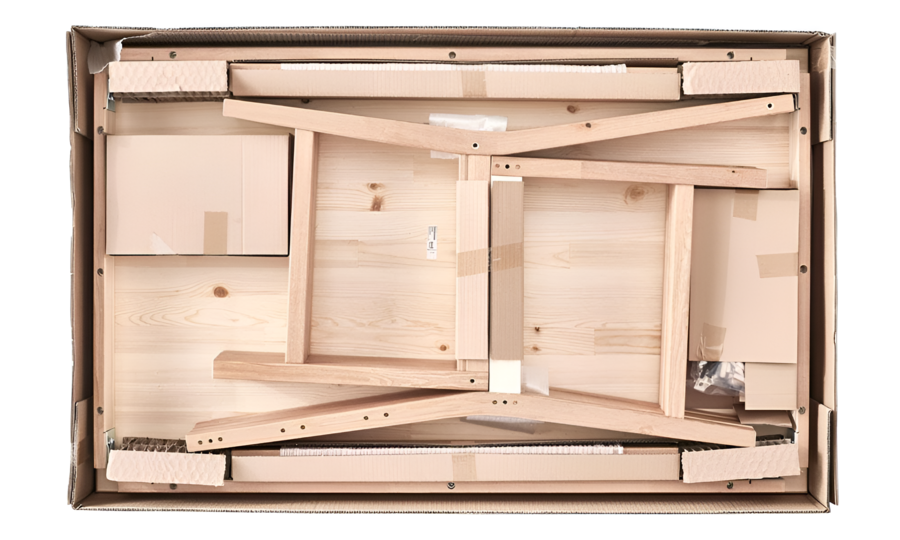
Ikea furniture in disassembled form
Flat-pack—a method of delivering a product in a disassembled or partially disassembled state, where its components are packaged in a compact, flat container. This system reduces transport volume but requires designing the structure with subsequent assembly in mind.
LÖVET coffee table, IKEA, 1955.