Concept
An ordinary room feels like a familiar and understandable place. We know where the door leads, why the staircase is there, and what might be behind the wall. But in the paintings of Dorothea Tanning, everything is different. One door gives way to another; corridors lead into the unknown; and strange events unfold within familiar interiors. Crucially, these rooms often look quite real, which is precisely why the happenings within them feel so unsettling.
Dorothea Tanning (1910–2012) was an American artist associated with Surrealism. I became interested in how her paintings transform ordinary domestic spaces into settings reminiscent of dreams. For this, the artist doesn’t always need fantastical landscapes. Sometimes, altering the conventional placement of objects, presenting an unexpected perspective, or leaving a door slightly ajar is enough.
The central question of this research is: how does Dorothea Tanning generate a sense of unease and dreamlike quality through the depiction of everyday space?
My hypothesis is that the anxiety in her paintings arises from a combination of the familiar and the inexplicable. The viewer recognizes the room, the corridor, or the staircase, but cannot understand what exactly is taking place or where the depicted space leads. The ordinary interior ceases to be a neutral background and becomes a vital component of the action.
For this study, I select works where the representation of space plays a crucial role. I am interested in rooms, corridors, staircases, and doorways that appear recognizable yet evoke a sense of strangeness or uncertainty. It is important that the interior doesn’t merely exist in the painting but actively influences the perception of the events unfolding.
I pay special attention to composition, lighting, perspective, the scale of objects, and the placement of human figures. I aim to understand why some spaces feel infinite, others closed-off, and yet others suggest that something unknown is happening beyond what is visible. Furthermore, I will not interpret every unusual detail as a symbol with a singular meaning. First, it is essential to understand what is depicted and how that affects the viewer.
The research will be grounded in paintings by Tanning, museum descriptions of the works, art historical publications, and comments from the artist herself. The museum materials will help to clarify the dates and creation history of the works, while the study of surrealism will help understand the role that dreams and unconventional spaces play in the art of this movement.
The research will follow a thematic structure. First, I will examine doors and transitions between rooms. Then, I will look at corridors and spaces where the conventional sense of space is disrupted. Following that, I will compare the ways the artist creates an atmosphere of unease through the interaction of interior design, objects, and human figures.
Categories
- How the research was conducted
- The unknown beyond the door
- When a familiar interior becomes strange
- Between reality and dream
- Conclusion
How the research was conducted
In this study, I examine the paintings of Dorothea Tanning, in which rooms, doors, corridors, and other familiar spaces play a significant role. I am interested in why these locations, typically associated with daily life, begin to resemble dreams in her artwork.
To select the works, I utilize museum collections and the artist’s catalogs. The majority of the selection consists of paintings where the interior influences the events taking place, rather than merely serving as a backdrop. I have also included several works in which familiar space gradually dissolves. These help compare Tanning’s early and later works and understand how her approach to depicting space has evolved.
When analyzing the paintings, I pay closest attention to their structure. Where do the doors lead? Can the size of the room be discerned? Why do some objects appear incongruous? How are the figures positioned in relation to their surroundings? These details help decipher what constructs the sense of strangeness.
I also consult museum descriptions, publications on Tanning’s work, and her own commentary. These help clarify the circumstances of the works' creation and correlate my observations with what is known about the artist’s oeuvre. At the same time, I am not seeking a single explanation for every unusual detail: for my inquiry, it is more important how that detail functions within the image.
First, I will examine the doors and the spaces that open behind them. Then, I will move on to interiors where conventional proportions or object arrangements are disrupted. In the final section, I will be interested in how human figures and their environment collectively generate a feeling of dreaminess or unease.
This approach will allow me to compare different modes of representing space and to verify whether the sense of anxiety in Tanning’s paintings is related not so much to individual fantastic images as it is to the alteration of a familiar setting.
Beyond the door—the unknown
A door in a typical apartment leads into a neighboring room or a hallway. We generally imagine what lies beyond it, even when it is closed. But in Dorothea Tanning’s paintings, doors do not always help us understand the layout of space. Sometimes, conversely, they make us wonder where one might go and whether that space has an end.
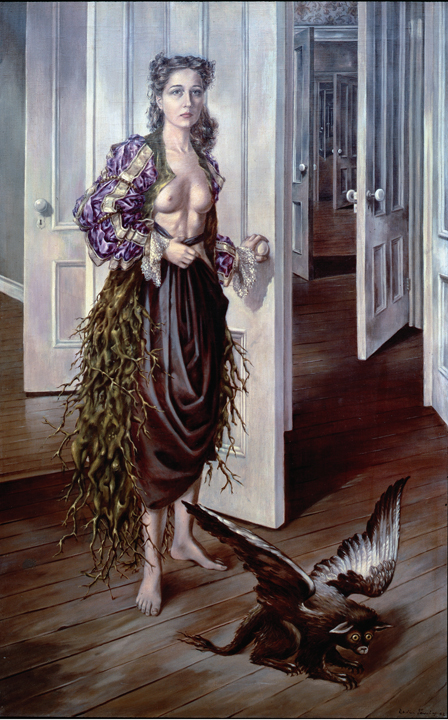
Dorothea Tangney. «Birthday,» 1942. Canvas, oil, 40 ¼ × 25 ¼ in. Philadelphia Museum of Art, USA.
In the painting «Birthday, ” Tanning depicts herself within an unusual interior. Open doors are positioned behind her, revealing subsequent rooms through which the viewer can look. The rooms seem to extend infinitely, even though the doorframes themselves appear quite ordinary.
The artist stands in the foreground, looking directly at the viewer. She is wearing an unconventional costume—a low-cut bodice and a skirt made of botanical elements—and at her feet is a fantastic, winged creature. These details immediately draw the eye, but the space behind Tanning is no less strange. The floors are tilted, the doors repeat one after another, and it is impossible to determine how far this corridor stretches.
Interestingly, the concept for the painting originated from an observation of the artist’s own apartment in New York. Tanning recalled noticing a set of adjacent doors leading into different rooms. In the painting, this ordinary part of the apartment has transformed into a long sequence of openings stretching into the unknown.
The unsettling sensation here arises not only from the fantastic creature or the unusual costume. Even if the interior were shown without the artist’s figure, it would still feel strange. The viewer recognizes ordinary doors and walls, but cannot grasp how the space beyond them is organized. Each open door promises to reveal something new, yet behind it is discovered yet another door.
Dorothea Tanning. «Eine Kleine Nachtmusik, ” 1943. Canvas, oil, 40,7 × 61 cm. Tate Collection, London, UK.
In «Little Nocturne Serenade,» the scene takes place in a hotel hallway. There are also several doors here, but unlike in «Birthday,» they do not recede infinitely into the distance. The space feels cramped and enclosed. On one side are closed doors, and on the other is a staircase leading down.
Two girls in light dresses are in the hallway. One is leaning against a door jamb, and the other is standing in the passageway, her long hair lifted as if by a strong gust of wind. Next to the staircase lies a massive sunflower with a broken stem. Its size is completely disproportionate to the surrounding environment. The stem trails across the carpet, and individual petals are scattered across the steps.
A slightly ajar door, from which bright yellow light shines through, is particularly striking. The rest of the hallway is steeped in twilight, so the gaze is involuntarily drawn back to this opening. However, it is impossible to see what is inside the room. The light hints at some explanation for what is happening, although the painting itself does not provide it.
Tanning connected this piece to a confrontation with unknown forces. In one comment, she referred to the sunflower as an aggressive bloom and described the stairs and hallways as places where personal dramas unfold. Therefore, the strange behavior of the girls and the appearance of the enormous plant can be viewed not as random fantastic details, but as part of a disquieting event whose meaning remains hidden.
If in «Birthday,» the unknown arises from the endless succession of rooms, here it is concentrated behind a single, slightly open door. The viewer sees the consequences of something unusual but does not know what exactly occurred. The ordinary hotel hallway transforms into a place where familiar objects can no longer help to make sense of the events.
Dorothea Tanning. The Mirror, 1950. Canvas, oil, 30,5 × 46.4 cm.
In «Mirror,» Tanning connects two seemingly unrelated objects: a mirror and a sunflower. At the center of the flower is an oval surface resembling mirrored glass. Large yellow petals surround it. The plant seems to have transformed into an object one might find in a room.Nearby, another strange botanical form is visible. It resembles a wilted flower, though its folds and dark patches look almost like parts of fabric or a human body.Unlike «Little Nocturne,» there is no detailed interior or characters. Most of the painting is taken up by a dark background. Consequently, the focus remains on the mirror itself: a familiar object becomes part of a living plant, and its original function no longer seems obvious.
A mirror typically helps us see what is in front of it or to examine our own reflection. But in Tanning’s painting, its surface reveals nothing definite. We see a dull oval surrounded by petals, and we cannot tell if it is reflecting anything.
This image is particularly compelling when viewed alongside «Little Night Serenade.» A sunflower appears in both paintings, yet its role shifts. In the hotel corridor, the enormous flower seems to intrude upon the space, obstructing movement. Here, it transforms into an unusual mirror that provokes questions rather than offering clarity.
In an interview, Alene Geoffroy asked Tanning about her perception of the mirror, and she responded that she views it as a doorway. She meant the possibility of transitioning beyond conventional ways of seeing and depicting the world.
This observation connects «Mirror» with other works in this section. Even when the painting lacks a literal doorway, the artist can address the same idea—that of an unknown space lying beyond a familiar object.
Dorothea Tanning. «The Guest Room, ” 1950–1952. Canvas, oil. 153,2 × 107.3 cm.
In «Guest Room, ” the door no longer leads into an endless sequence of spaces, as it did in „Birthday, ” nor does it conceal a light source, as in „Little Night Serenade.“ Here, it becomes part of a scene where it is difficult to discern who is inside and who is outside.On the right foreground stands a nude girl. Next to her is a dark doorway, and to the left, a bed with several figures is visible. Another small figure stands in the foreground, its head hidden by fabric. The interior doesn’t look fantastical on its own: the walls and door frame are quite recognizable. However, the arrangement of the characters and their stillness create tension.The title of the painting also raises questions. Usually, a guest room implies a temporary stay in someone else’s home, but here, it is difficult to envision the familiar situation of hospitality. We do not know who invited the girl, whom she is waiting for, or why she stands before an open door.Unlike the previous paintings, the uncertainty here is related less to the depth of the space and more to the person’s position on its threshold. The girl stands before a dark opening, and the viewer cannot see what lies behind her. The door separates the visible part of the room from that which remains hidden.In exhibition materials for Tanning at the Reina Sofía Museum, this image is also examined in relation to the transition from childhood to adulthood. This reading helps draw attention to the character’s age and her position at the threshold. Yet, even without a symbolic explanation, the painting retains a sense of unease: we see only part of what is happening, and we do not know what awaits the heroine behind the door.
Dorothea Tanning. «Interior» (Intérieur), 1953. Canvas, oil, 46 × 38.1 cm.
The painting «Interior» depicts a small corridor with several open doorways. Through the central opening, a room is visible, illuminated by a bright yellow light. On either side are darker areas where human figures can barely be discerned.In the middle of the corridor stands a strange creature on slender, bird-like legs. Its elongated body resembles a sack or crumpled fabric, and the upper portion is covered with red material. Another piece of fabric seems to hover above it. To the right, a small, crumpled form lies on the floor that is difficult to recognize at first glance.The corridor itself appears quite ordinary. The wooden doors, handles, and door frames are rendered in detail. However, it is unclear who is in the rooms or why the strange figure has appeared between the doorways. The space seems filled with events that cannot be seen in their entirety.
The contrast between light and darkness is particularly noticeable. The central part of the painting is illuminated by an almost golden light, while the room on the left remains dim. Within it, the figure of a person can be discerned, but their posture and actions are unclear. On the right, another open doorway is visible, leading to no discernible continuation of space.
Because of this, the viewer’s gaze constantly shifts from one opening to the next. Each door reveals only a small fragment of what is happening, and the strange figure positioned in the center prevents the corridor from being imagined as a place one could calmly pass through.
In a 1999 interview, Tanning recalled an unpleasant dream where each open door revealed the next. She recounted that this image later appeared in many of her paintings. In «Interior, ” the doors do not form an infinite sequence, but a similar sense of uncertainty persists.
Here, the viewer stands before several possible directions of movement, unaware of where any of them lead. Even the brightly lit part of the apartment does not clarify the situation.
Dorothea Tanning. «Maternity,» 1946–1947. Canvas, oil. 142,2 × 121.9 cm. Private collection.
In «Motherhood, ” Tanning moves the doors from a familiar interior setting into an open, desolate landscape. In the foreground stands a woman holding a child. Around them stretches a sparsely populated area, and in the background, individual doorways are visible—as if remnants of a vanished house.
At the woman’s feet, on a light-colored fabric, lies another strange creature. Its body resembles a dog, but its face looks childlike. This small detail makes the scene of motherhood even more unconventional: next to the woman and child appears a being that merges human and animal features.
Typically, a door exists alongside walls, dividing two spaces. Here, it is situated in the middle of an open area and separates nothing else. One can pass through it, but it is impossible to say exactly where such a transition leads. The same landscape continues beyond the door, and the conventional purpose of the architectural element loses its meaning.
On the horizon, an unusual white figure can be seen. Its presence makes the desert feel even less like a real place. Despite this, the woman and child are depicted in enough detail to resemble characters from an ordinary motherhood scene. The combination of a familiar narrative and an uncanny setting raises questions about where the characters are and what is happening to them.
Here, Tanning uses the door differently than in her previous works. In „Birthday, ” it connected rooms; in „Little Nocturne, ” it concealed what was happening; and in „Guest Room, ” it separated a character from a dark space. In „Motherhood, ” the door is stripped of the walls it is usually associated with.
This example demonstrates that to evoke a sense of strangeness, an artist does not need to depict unusual architecture. Sometimes, it is enough to place a completely familiar object where it cannot perform its usual function.
When the familiar interior becomes strange
In previous paintings, doorways separated the familiar space from the unknown. But Tanning could evoke a similar feeling without endless corridors or mysterious passages. Sometimes, simply altering the scale of objects, their arrangement, or the conventional relationships between people is enough. The room remains recognizable, yet what transpires within it can no longer be explained by ordinary rules.
Dorothea Tangney. «Family Portrait, ” 1953–1954. Canvas, oil. 100 × 81 cm. Musée National d’Art Moderne, Centre Pompidou, Paris.
In «Family Portrait, ” Tanning addresses a familiar scene: a family gathered around a table. However, the characters are depicted at entirely different scales. A colossal male figure towers over the others, while the other participants in the family scene appear significantly smaller.
Typically in a family portrait, the size of people depends on their placement in space. Here, that rule is violated. Scale seems to be determined not by distance from the viewer, but by each person’s significance within the family.
What is particularly interesting is that the setting itself remains recognizable. The table, the tablecloth, and the arrangement of the figures resemble a typical domestic scene. But due to the disproportionate figures, it begins to look uncomfortable. Instead of familial unity, a sense of inequality arises: one person literally occupies more space than all the others combined.
Tanning herself linked this painting to family hierarchy. In an interview with Marcel Duamel, she explained that the piece was not so much about a specific memory as it was about power dynamics within the family.
Thus, the artist transforms the domestic interior into an image of human relationships. She does not change the function of the table or the room, but she disrupts the conventional scale of the figures. Because of this, the familiar family scene acquires an almost fairy-tale quality—though it is far from harmless.
Dorothea Tanning. «A Very Happy Picture, ” 1947. Canvas, oil, 91,4 × 121.9 cm. National Museum of Modern Art, Centre Pompidou, Paris.
In «Very Happy Painting, ” a vast expanse of gray fabric, intricately folded, dominates most of the space. Among these folds, one can discern human features: a single eye, part of a face, and something resembling a hand. In front of this figure rests a dense bouquet of red roses, which immediately stands out against the muted color palette.To the left, there are crates and architectural elements, while in the background are small structures. On the right, there is a rectangular plane depicting pipes from which smoke rises. These details evoke the real surrounding world, but it is difficult to unify them into a cohesive space.The folds of the fabric occupy too much area—they seem to encompass everything. They pass in front of objects, obscure parts of the image, and form their own curves and passages. Because of this, it is impossible to determine the spatial distance of any object or what exactly is hidden behind the gray surface.
The title of the painting seems unexpected. It is difficult to find anything in the image that clearly suggests joy. The enormous figure, almost entirely concealed by fabric, appears enigmatic, and the bouquet of roses seems overly vibrant against the other elements.
The fabric here simultaneously resembles clothing, a curtain, and part of the surrounding environment. Its folds create a sense of movement, although it is impossible to determine what is causing it. At times, they appear soft and light, while other times they resemble sharp, almost stony surfaces.
It is particularly interesting to compare this painting with «Musical Chairs, ” painted four years later. In both works, Tanning uses massive folds of material to obscure a significant portion of the space. However, in „A Very Happy Painting, ” the fabric almost completely engulfs the human figure, whereas in „Musical Chairs, ” the girl and the furniture are still discernible.
In a diary entry from around 1947, Tanning mused that painting could convey not only visible objects but also imagined events, feelings, and unusual states. In this work, familiar details remain, but the fabric alters their arrangement, preventing the depicted space from being interpreted as real.