Concept
Topic Selection:
Cards and game levels in video games are generally considered a product of the digital age, although their core mechanics predate computers by a long margin. Mancala evolved in Europe in the 16th century—it is known that Francesco Medici sent it as a gift to King Philip II of Spain [4]. It subsequently spread in the form of printed boards and was published until the 19th century. Little is written about this game as a precursor to the visual language of video games; it is usually only regarded as an ancestor of «racing» board games. This is the novelty of the research. Its practical significance lies in demonstrating that by examining pre-digital games, we can identify game path construction techniques that function independent of technology—a valuable insight for modern game design. Furthermore, the study shows that visual conventions familiar to us from video games have a long history and are not dependent on the screen. This is important for designers: understanding how a drawing on a board conveyed a rule without explanation assists in designing game spaces that are immediately legible.Material Selection Principle:
The study utilizes two types of images: printed Goose Game boards from open museum collections and screenshots from video games that feature a sequence of events. Images are selected based on the clarity with which the cellular graphic language is readable, as well as on image quality. Each image is accompanied by an analysis and a caption specifying its source.Categorization Principle:
The study progresses from the general to the specific, then to comparison, and is divided into chapters: The Goose Game: Origin and Board Structure The Board as a «Temporary World»: Play Space and Its Rules Typology of Event Cells: Acceleration, Delay, Return, Finale The Board as a Precursor to Game Maps: Parallels with Video Games ConclusionPrinciple for Selecting and Analyzing Textual Sources:
The theoretical foundation of this research is Johan Huizinga’s book, «Homo Ludens.» Huizinga classifies the game board and the magic circle as playing spaces—that is, as temporary worlds within the ordinary world, where specific rules apply [1, pp. 34–35]. This allows us to view the game of Goose as a closed world whose structure dictates the player’s experience. Historical information about the game was drawn from descriptions of museum artifacts [2; 3; 4]. These descriptions are based on specific, surviving boards, and data from different museums are compared against each other. The texts serve as a framework for analyzing the images, while conclusions are drawn directly from the visuals.Key Question and Hypothesis:
Key Question: What has the game of Goose contributed to video games, given that it lacks player choice and everything is determined by the roll of the dice? The title references this paradox: «path» refers to the route across the board, and «without choice» refers to the player not making decisions, but rather the token moving where the draw directs it. Hypothesis: Video games have inherited not the mechanics, but the visual logic of the route alongside its events. The board transforms the path into a sequence of cells, each governed by different rules (speeding up, delaying, returning), and the graphic on the cell communicates the rule without text. This concept is also used to construct the maps and levels of many video games. This hypothesis will be disproven if the similarity is restricted to the general concept of a «path» and cannot be traced in the graphic language of the cells.The Goose Game: Origin and Structure of the Board
The game of Goose appeared in Europe in the 16th century. It is known that Francesco Medici sent it as a gift to the Spanish King Philip II, indicating that by the end of the century, the game had already attained the status of a courtly entertainment. One of the earliest dated boards in the British Museum’s collection dates to 1598: it features 63 divisions, the rules printed in the center, and jesters depicted in the corners. Half a century later, similar sheets were issued as engravings, and a surviving engraving by Valerio Spada, circa 1650, is part of the Waddesdon Manor collection.
Italy, 18th Century, Engraving, Artist unknown.
How the Board Works:
Players place tokens on square 1, take turns rolling dice, and aim for square 63. There is no decision-making here—the roll determines the move. However, the board is designed so that certain squares alter the course of the game. In an 18th-century Italian engraving, the path begins in the bottom left corner, spirals around in two rings, and ends in the center, where a figure holds a placard marked with the number 63. The squares are separated by columns. Ordinary squares feature concentric circles, while special squares display unique illustrations. Even here, the board’s main mechanic is visible: the standard path looks uniform, but the event is highlighted through its graphic.Italy, 18th Century, hand-colored engraving.
Reproduction of an Italian game from the late 17th century, created in the 19th century; the author is unknown.
On a hand-painted board from the same era, the principle is the same, but the ordinary squares are highlighted in color (pink, blue, green), and images are preserved only on special squares. Jesters are placed at the start and finish. The center is occupied by the rule text, and the board reads like a small, enclosed world. In 19th-century replicas, an entire scene was placed in the center. In Figure 3, a company in 17th–18th-century costumes is gathered around a table, suggesting that the game was an activity of the upper class.
«The Golden Goose,» England, London, 19th Century, by Richard Holmes Lowry.
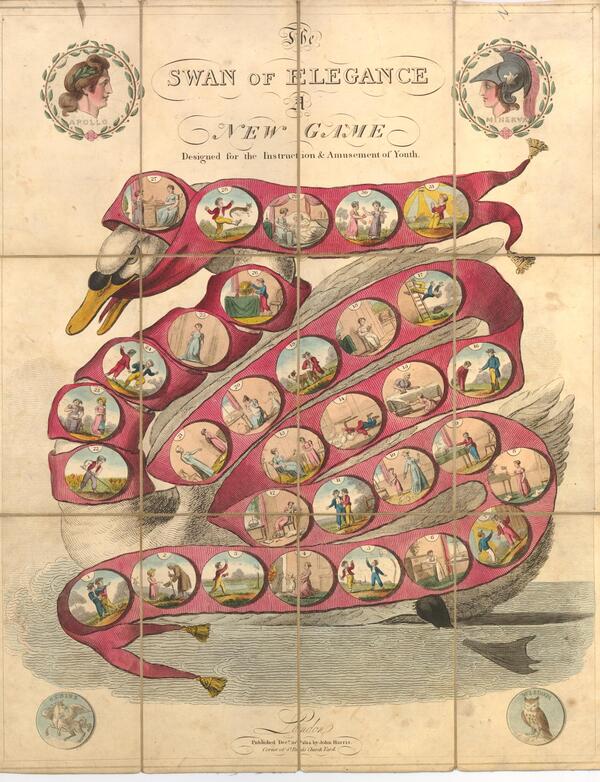
In 19th-century England, the board transformed into an image. In the «Golden Goose» sheet, Lori’s cells are contained within the bird’s body: pink and yellow circles fill the goose’s silhouette, and the drawn cells feature bridges, houses, and a maze. In the «Swan of Elegance,» the path becomes a red ribbon winding around the swan, and 31 medallions depict scenes with children. The inscription promises «instruction and youthful amusement,» so the game acquired an educational function. In the «Noble Swan Game,» the fields are inscribed directly onto the bird’s body, and among the scenes, one can see a crown on a neck, a chain, a flock of sheep, and satirical figures. Thus, by the 19th century, the main element remained: the player moves along a numbered path. What changed was how that path was illustrated.
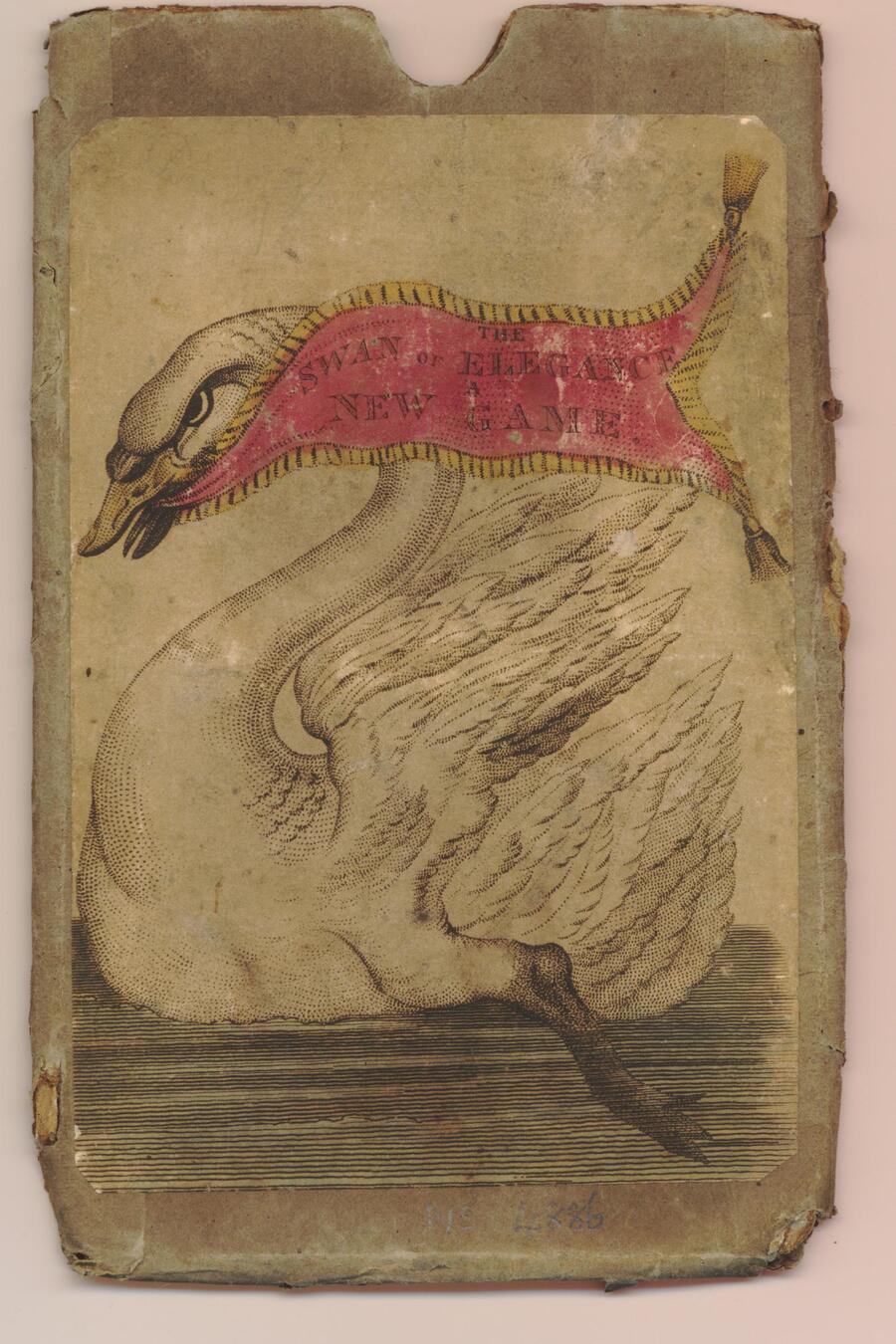
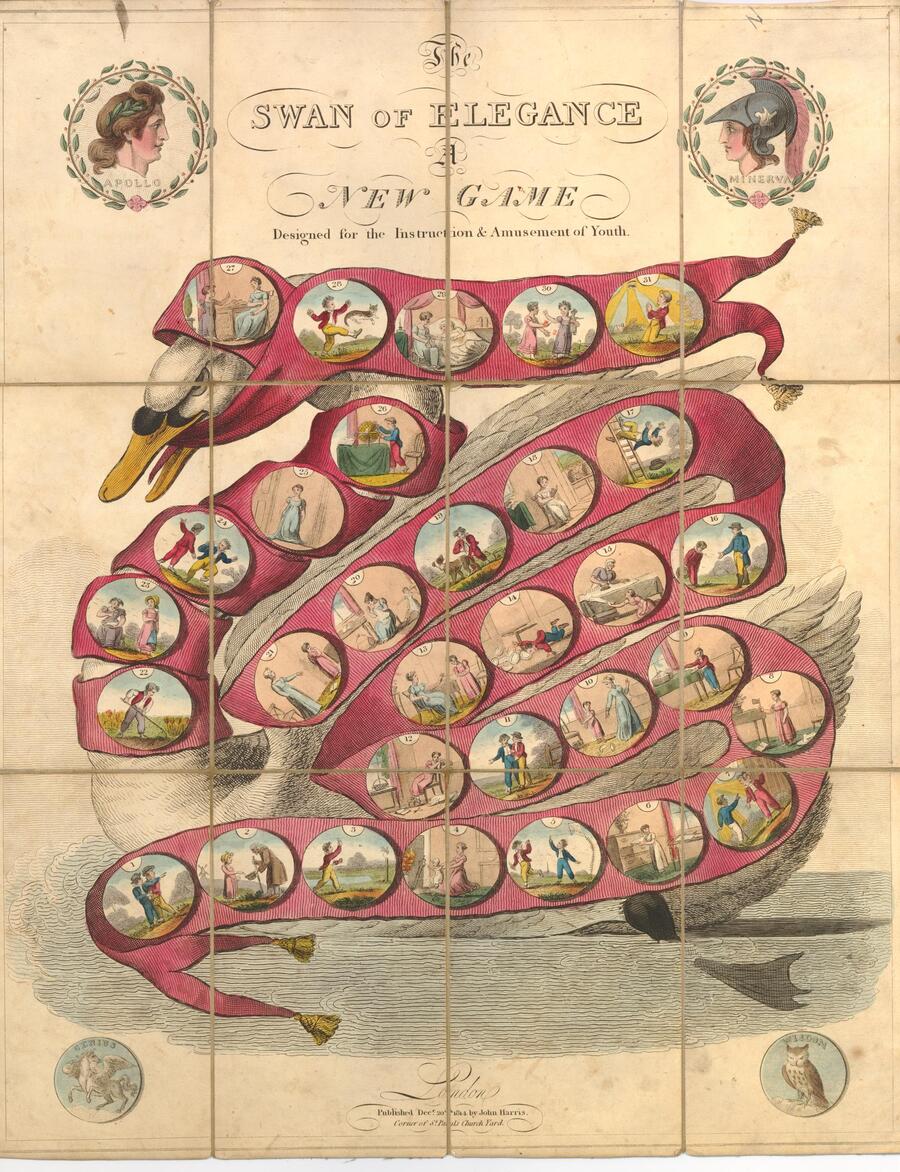
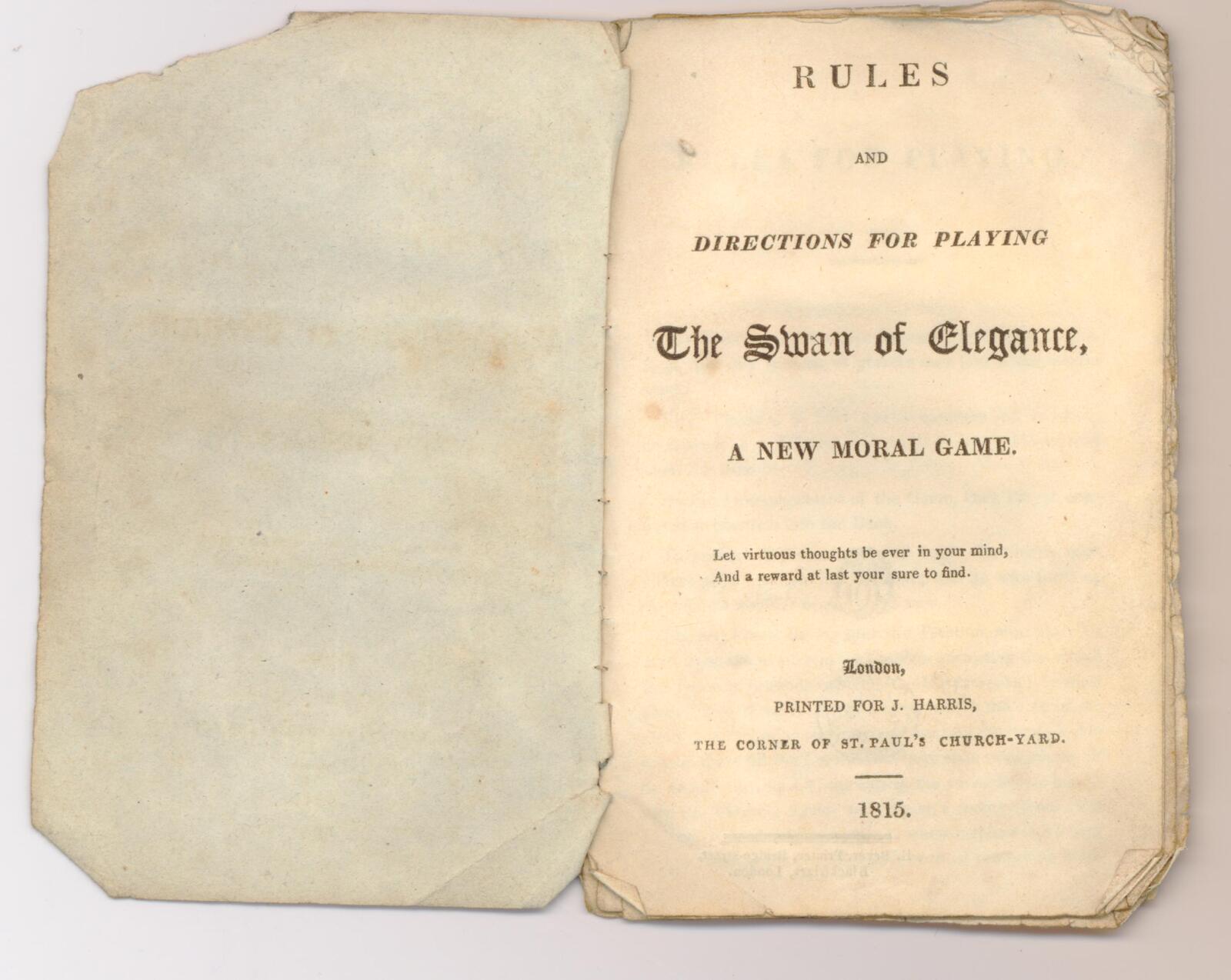
«The Swan of Elegance, ” England, London, 1814, by John Harris.
«The Noble Swan Game,» England, London, 1821, board game tile, by William Darton, printed by George Smallfield.
The Board as a «Temporary World»: Play Space and Its Rules
To understand why the geese board is structured this way, we turn to Johan Huizinga’s book [1]. He describes play as an activity extracted from ordinary life: the play space is separated from the everyday environment, and it operates by its own set of rules [1, pp. 42–43]. He includes the arena, the game table, the magic circle, the temple, the stage, and the screen among such spaces, referring to them as temporary worlds within the world of the mundane [1, pp. 34–35]. For Huizinga, play establishes order and is, in itself, order [1, p. 35].