1. Concept
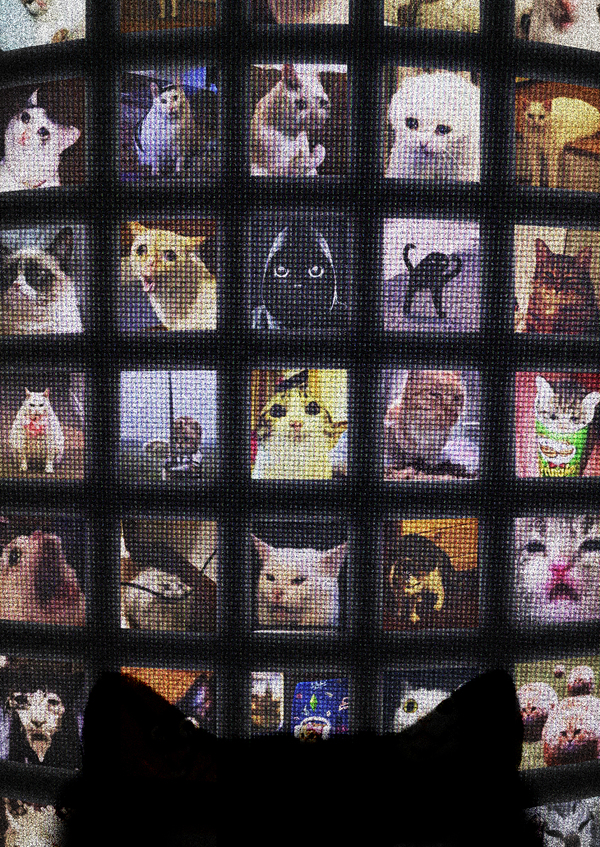
In contemporary and historical media culture, the cat has held—and continues to hold—a unique status as an absolute favorite among animals. Appearing on screens as photographs, animated characters, advertising mascots, internet memes, and sticker packs, this animal has evolved from a common house pet into an autonomous communicative entity and a universal language of emotion.
The choice of this topic stems from my personal experience observing how the media image of the cat influences human perception. Throughout my life, I was prohibited from owning a pet, so my acquaintance with cats occurred exclusively in public spaces and through screens—in photographs, cartoons, and cyberspace. By observing myself and those around me, I noticed a consistent pattern: the appearance of a cat in the information flow elicits a predominantly positive reaction from people, instantly shifting their emotional state, reducing stress and anxiety levels.
This phenomenon posed the research question: why does the cat possess such a powerful and stable influence on the audience, and how has its image transformed as media itself has developed?
Navigation Menu
1. Concept2. First Appearance: The cat tests new media.3. Unique Mechanism of Influence. Why did the media choose the cat?4. The Cat as a Brand and Pop Culture Character.5. The Internet Era. Digital Folklore and Microformats.6. ConclusionThe research is structured around the key formats and functions of the image within the media environment—from early photography to digital microformats. This segmentation allows us to trace the cat’s evolution at the intersection of different platforms and understand what visual and psychological mechanisms enable this image to retain its universality and dominate the economy of attention.
How does the visual plasticity of the cat and the media mechanisms of its use transform this animal into a universal tool of communication that retains its impact when moving from print formats to algorithmic feeds?
Research Hypothesis:The media influence of the cat is ensured by a combination of its visual plasticity and the media mechanisms through which it is utilized. These mechanisms allow the image to adapt to any platform and communicative objective, while simultaneously enabling the viewer to interpret and project any meaning onto the animal.Its static expression, compact framing, and archetypal duality (combining domestic comfort with independence) establish a «blank slate» effect. Media formats—from advertising to memes and sticker packs—actualize this effect as a tool for emotional release, a satirical mirror, or a digital mask, and user practices serve as the catalyst for the image’s endless reproduction. Consequently, the cat functions within media culture as a «universal communicative code, ” where its sustained influence is maintained through the alignment of the animal’s innate plasticity and the logic of modern media platforms.Because of this, the cat retains its dominance in the attention economy as we transition from early photography and print media to algorithmic feeds.
First appearance: a cat tests new media.
Unique influence mechanics. Why did media choose the cat?
The Cat as a Brand and Pop Culture Character.
The Age of the Internet. Digital Folklore and Microformats.
Conclusion
Signature
texttexttexttexttext
texttexttexttexttext