Navigation
— Concept
— Alienation and Loneliness
— Threat and Transformation: Collage and Assemblage
— Uncertainty and Multiplicity: Fog as a Philosophical Medium
— Despair and Wasted Time in «The Heron and the Crane»
— Cosmos Without a Hero: Fatalism and Absence of Addressee in «Blue Meteorite»
— Conclusion
— Bibliography
— Image Sources
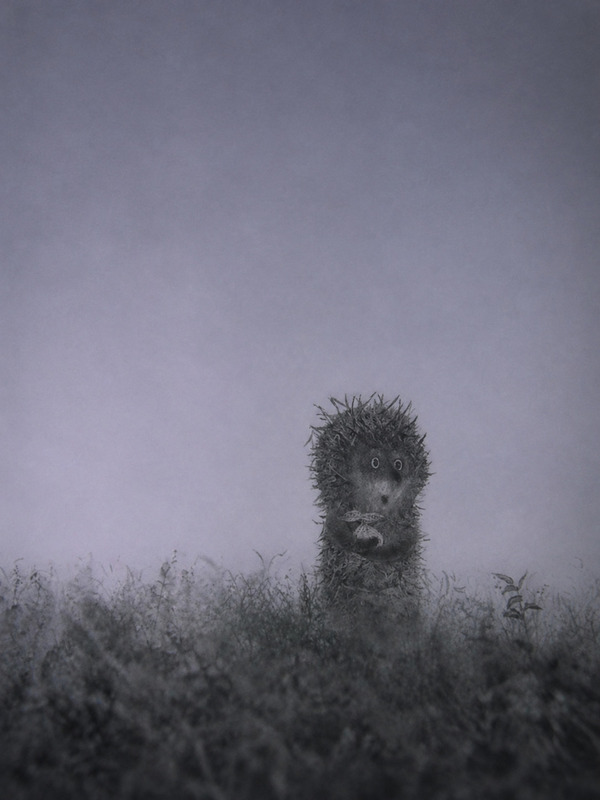
Hedgehog in the Fog, 1975, Yuri Norstein
Concept
Soviet animation of the 1960s and 1970s appears warm and cozy, but beneath that kindness often lies a silence that is difficult to hear. The general audience remembers «Varezhka» as a touching story about a puppy, «Crocodile Geny» as a birthday song, and «Hedgehog in the Fog» as a beautiful adventure. However, a close visual analysis reveals a persistent layer of films that, despite their superficial innocence, convey a hidden existential melancholy, alienation, and psychological vulnerability.
I am interested in how the visual language renders these states visible and physically palpable without resorting to overt menace. This topic stems from a desire to demonstrate that anxiety in Soviet author animation does not contradict a pleasant narrative; rather, it emerges through it.
A key definition of what is meant by «anxious aesthetics.»In this visual study, anxiety is understood as a hidden melancholy, a sense of loss and wasted time, visual discomfort, and hopelessness—elements that are not stated in the plot but are created by the atmosphere of the frame. Alienation is the state of a character who physically exists in the world but does not belong to it (empty sets, gray spaces, a lack of connection to others).This definition allows for the analysis of films that appear benevolent on the surface but visually communicate melancholy and vulnerability.
Material Selection PrincipleFor this analysis, films produced by Soyuzmultfilm between 1967 and 1976 were selected—films where an anxious aesthetic (in the sense defined above) emerges at the intersection of dramaturgy and visual language. The selection criterion is that the film must demonstrate how the choice of technique consciously supports melancholy, alienation, or the uncanny valley effect.
The Principle of TabulationThe research is built around types of visually-dramatic unity. This demonstrates how different techniques address different types of anxiety. First, we examine why the «good» Soviet cartoon is a construct and why it’s worth looking through it. Next, puppet animation shows how the physical «lifelessness» of the puppets and the emptiness of the sets support the theme of alienation. Collage and photomontage work with threat and transformation, while the deformation of images and optical illusions create anxiety at the level of the visual field. Photomontage in «Hedgehog in the Fog» creates an environment for the philosophical theme of invisibility and fear, and its texture in «The Stork and the Crane» gives a sense of viscosity, slowness, and irreversibility. Finally, the omission of a character addresses the theme of inevitability.
Principles for Selecting and Analyzing Textual SourcesTextual sources are selected to complement visual analysis with data regarding directorial intent and production context. These include interviews and creators' memoirs, as well as art historical works on Soviet animation.
Key Hypothesis
The anxious aesthetics of Soviet animation from 1967–1976, with its underlying melancholy and alienation, emerge from the conscious unity of dramaturgy and technique. Different techniques give rise to different types of anxiety.
Technique does not merely illustrate a finished meaning; it participates in its genesis. Anxiety arises at the intersection of conception and material. The specific qualities of animation material—the physical limitations of the puppet, the discreteness of its movement, the layered nature of cutouts, the abstraction of drawn graphics, the deformation of the collage—make the existential motifs of the narrative visible and physically tangible.
Hedgehog in the Fog, 1975, Yuri Norstein
Alienation and Loneliness
«The Mitten» is a story about a lonely girl. Her mother paid her little mind and wouldn’t let her get a puppy, so the girl fashioned a puppy out of a mitten.
Mitten, 1967, Roman Kachanov
A silent film conveys the heroine’s solitude through the organization of the puppet space: the girl and her mother exist in separate settings that the camera rarely unites in a wide shot. The upper tier is a apartment window where the mother is preoccupied with herself, and the lower tier is an empty courtyard where the girl is left to her own devices.
Mitten, 1967, Roman Kachanov
A red knitted mitten transforms into a puppy, but the animation doesn’t complete the metamorphosis: the puppy retains the knitted texture and pattern of the mitten. This is essential—the friend remains imaginary, material only halfway; it grows from an object the girl can touch, because there is no one else to touch. The living creature retains the texture of the inanimate, and in this lies both warmth and anxiety simultaneously. The doll-like lifelessness of the mitten-puppy underscores that the girl’s only friend is a projection of her own imagination, not a real connection to the world.
Mitten, 1967, Roman Kachanov
Mitten, 1967, Roman Kachanov
Gena the Crocodile works at the zoo, but in the evenings, he sits home alone and plays chess with himself, sighing heavily.The puppet texture here serves to create alienation: the fabric, seams, and imperfections render the character tangibly vulnerable, while the empty apartment decor and gray city spaces prevent any sense of comfort. Gena exists in the world, but he does not belong to it. He is polite and kind, but lonely—not because there are no people around, but because there is no genuine connection with them.
Crocodile Gena, 1975, Roman Kachanov
Crocodile Gena, 1969, Roman Kachanov
The melancholy of the film filters through what appears to be a kind story. Cheburashka hides out in a telephone booth, and Galya and the other characters are also lonely—united not by plot-driven friendship, but by a shared sense of being lost in a world where sincerity seems like an anomaly.Even Shainsky’s song, within the context of the shot, does not sound celebratory; rather, it feels like a quiet lament that friends must be sought out and created because the surrounding world doesn’t offer them readily.
Crocodile Gena, 1969, Roman Kachanov
Crocodile Gena, 1969, Roman Kachanov
Threat and Transformation: Collage and Assemblage
«Glass Harmonica» is an example of how anxiety in animation is always different. Here, it is neither quiet nor melancholic, but frightening and uncomfortable, primarily created through color and sound.The film is executed using collage and cut-out animation, but its visual language does not operate through beauty. Dark, murky tones and sudden flashes create a sense that the world within the frame is unsafe. Classical painting—like Bruegel, Archimboldo, and Magritte—becomes material for an allegory about vulgarity and malice.
Glass Harmonica, 1968, Andrei Khrzhanovsky
Glass Harmonica, 1968, Andrey Khrzhanovsky
The sound design amplifies this sensation. The music and noises do not support the visuals; instead, they press against them, creating an atmosphere of unease. Color and sound work in tandem. Where the visuals become particularly aggressive, the sound underscores the discomfort, and vice versa. Consequently, this feeling of unease persists until the end of the film—the viewer cannot relax because both the imagery and the sound constantly remind them that the world of this film is not intended for comfort.