Concept
Duolingo spends attention differently than a typical advertiser. The overwhelming majority of new users arrive organically [1], the campaigns are executed by an internal team [2], and the main character of the advertising originated from the app’s system notifications. We analyzed the advertising copy, publications, and messages from 2023–2025 to understand how the brand’s text operates across different channels and why it appears so unusual.
Material: — app notifications and icon; — urban advertising and Super Bowl commercial; — collaborations with pop culture; — a narrative about the mascot’s death and the crisis surrounding the AI-first declaration.
Key Question
Is there one advertising technique that works across all mediums and brings students back to the lesson?
Duolingo’s advertising is effective not because of its absurd humor in itself. The foundation is simpler: a reminder featuring a threat of loss, delivered in the first person by the character. As long as this messaging drives action within the product, the brand gains both attention and user retention. When companies have to take responsibility for their own decisions, the owl’s voice fails.
We will test this hypothesis using four criteria: the message is recognizable across different platforms; the text drives a specific action; there is an external or measurable result; and the voice withstands a crisis.
Push as the source text
From a marketing perspective, the notification is an extremely impoverished genre: two lines of text, utilizing foreign system layouts, and zero proprietary fonts. With such sparsity, the voice carries the entire weight of the work. Duolingo forgoes the impersonal «Don’t forget your lesson» and signs the message with a name: «Hi! It’s Duo.» The recipient reads the utterance of a character, not a mass mailing from the company.
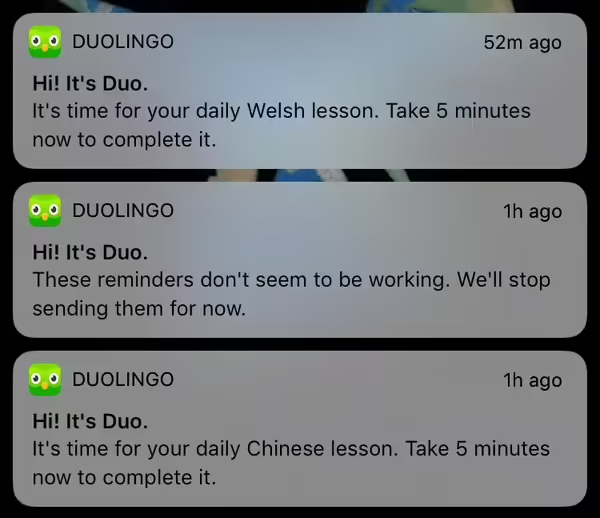
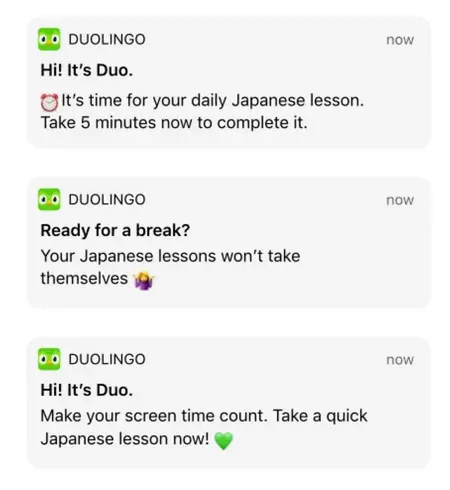
Reminder series with the phrase «It looks like they aren’t working.» User screenshot Text options: duration, hint, screen time comparison. Screenshots, 2024
The abandonment functions strongest here. After several ignored reminders, the owl reports: it seems they are useless until we start sending them. Formally, the application loses. In practice, the reader receives a reprimand—and a small loss—because the character’s attention can also be lost.
Next to it stands a streak mechanic—a series of consecutive days. The company itself describes how, as the streak grows, motivation shifts toward the fear of losing it, citing an internal figure: those who reach seven days are 3.6 times more likely to complete the course [3]. This is a correlational indicator and does not prove causality. Nevertheless, the logic is clear: the copywriter doesn’t have to sell the language study every time; it is enough to remind the person that they risk what they have already accumulated.
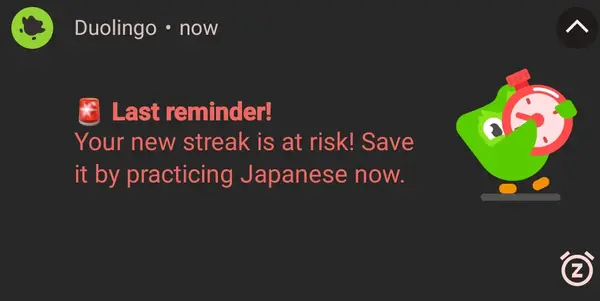
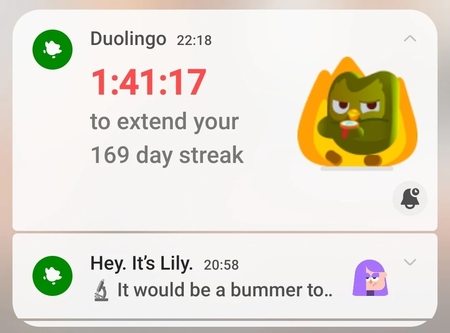
Indentation and owl with alarm clock: «New series in jeopardy» / User Screenshot / 2023 Countdown notification for series in 169 days / User Screenshot / 2024
Visual solutions amplify the same meaning. The red color and the timer translate the request into urgency, while the owl’s alarm makes the threat comical. We believe this balance is key: without a cartoon character, the same text would read as service pressure. Researchers of streak interfaces also warn about the flip side—the «just disappear» effect: after a lapse, a person may abandon the habit entirely [4].
Season loss screen with paid restoration offer / User screenshot
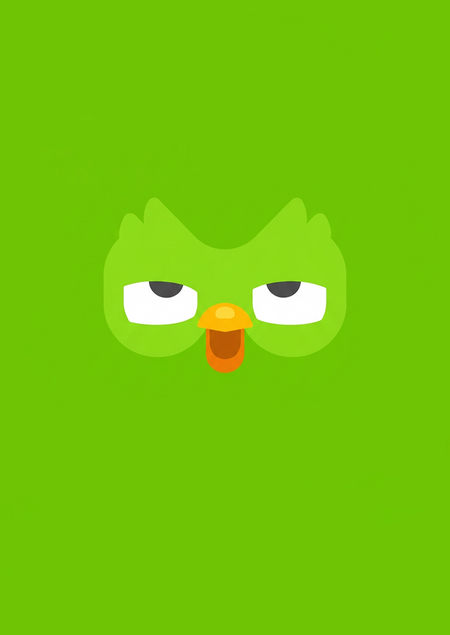
In 2024, the voice transcended words. The application icon gradually became somber, and on August 29, users noticed a very unwell owl with a runny nose and red eyes; a company representative described this as a visual reminder to engage daily [5]. The home screen transformed into a free advertising medium, with the message being grasped in a fraction of a second and without translation into other languages.
Staff and «sick» versions of Duolingo / August 2024
Street: notification without phone
The cleanest translation of the concept to another medium happened on January 13, 2023, in the so-called «Resolution-Abandonment Day,» when many people give up on their New Year’s resolutions. The internal team placed reminders on Times Square billboards, New York subway platforms, sidewalks, and even in fortune cookies, and opened a «repair shop» series [6] in Union Square.
Sidewalk Sticker: «Yes, even here» / January 2023 Metro Platform Duo Fortune in a Cookie / User Reaction
Out-of-home advertising often suffers from a gap: a person sees a poster, but their phone is in their pocket, and the action is delayed. Here, that gap becomes a joke. The pavement card literally copies the notification interface, right down to the «Now» label, and the line, «I won’t let go until you complete the lesson,» reads like playful pursuit.
The creative solution is immediately clear to anyone who has ever received such a push notification. Recognition is the reward for the viewer here. A weaker point, however, is that the company did not publish figures on the effect, so we can only judge the logic, not the outcome. On the plus side, the campaign had product backing, as the series allowed for the first time to restore [6].
Five Seconds: An Ad That Is a Push Notification
For its debut at the 2024 Super Bowl, Duolingo bought a regional five-second slot [7]. It’s impossible to explain the utility of the app in such a short time, and the creators don’t even attempt to. The entire text is condensed to three words: «do your duolingo.» They used an image from already proven material because illustrations featuring Duo’s backside in the widget generated a strong reaction from users [7].
Video frame with the sole text «do your duolingo»
The real discovery isn’t hidden on the television screen—it’s in the viewer’s pocket. Immediately after the screening, about four million users received a notification featuring the pun: «No buts… do a lesson now!» The English phrase «no buts» sounds like the Russian word «zady» (which relates to needing a breather or a pause). According to the company, 95% of relevant users received the message within 3.9 seconds, and 99% within 5.7 seconds [7].
The previous record was 500,000 dispatches per minute, which led to system failures, making the engineering challenge more complex than the narrative one [7]. The takeaway for copywriters is unexpected: strong short copy sometimes depends on the servers just as much as it does on the editor.
Continue on social media: the blogger’s «operation»
The drawback is also obvious. Anatomical humor narrows the audience and says almost nothing about the curriculum. For an educational product, such a joke only works if the brand identity is already established; a beginner unfamiliar with the owl’s character will just get a strange picture.
Another universe, our own text
Partnership campaigns are useful for hypothesis testing because they show what remains after accepting a partnership on another territory. The campaign with Netflix for the second season of «Squid Game» was titled «Learn Korean or Else» [8]. The threat was incorporated into the title, and the line from the notification was almost unchanged in the video.
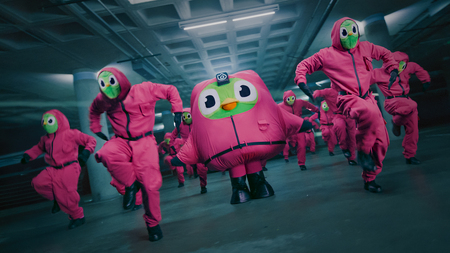

Duo as Guardian / «Learn Korean or Else» / December 2024 The same push notification in a different world: «You missed class. You know what happens now.»