Index
— Concept
— Eerie Domestic Spaces
— The Body as Object
— Urban Isolation and Melancholy
— Self-Reflection
— Conclusions
— References
Concept
The music videos of American singer Billie Eilish present a telling case study for the pop industry, where the visual language does not merely illustrate the music but becomes an instrument for redefining an artistic brand. She entered the industry as a teen, achieved global fame, and earned several Grammys. Throughout her career, she has repeatedly reinvented her image—evolving from a rebellious teen with brightly colored hair to a mature, self-aware young woman—all while maintaining a unique style and audience loyalty. Her persona should be viewed as a series of design decisions, which can be chronologically divided into three phases: a period of affiliation with hip-hop culture and a rejection of hypersexuality; a phase of maturation and the «right to bodily autonomy»; and the current era, which reads simultaneously as cyclical and as a sign of freedom and finding one’s true self. The semantics of themes, imagery, and metaphors in each of her videos astonishingly preserve Billie’s authenticity across every period. The research material consisted of music videos selected based on the principle of analytical representativeness, focusing on moments where Billie’s visual presence is most palpable. Videos from 2016 to 2023 were chosen for review and analysis (starting with her debut, «Ocean Eyes, ” and ending with „What was I made for?“), and were subsequently categorized. Written materials were selected based on their relevance and alignment with the study’s theme, as well as their ability to provide a multifaceted and comprehensive exploration of the examined imagery.

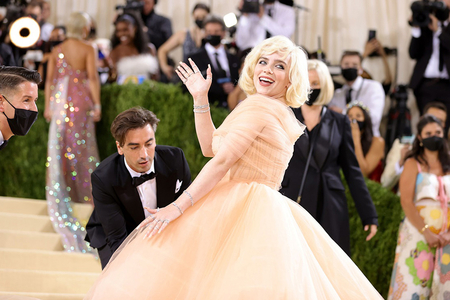
Alberto E. Rodriguez / Getty Images for The Recording Academy; Photo by Taylor Hill/WireImage Billie Eilish attends the 2021 Met Gala
However, the thematic categorization is not built chronologically, but rather around analytically formed image directions that are most vividly traced in the music videos: space, body, environment, memory, and self-reflection. This approach allows for a clearer identification of underlying visual strategies, rather than simply charting the evolution of the artist’s image as she matures. Since following a strict chronology might be overly linear—given the sheer volume of imagery in the videos—it becomes much more productive for research to seek an answer to the question: «How do the visual strategies in Billie Eilish’s videos manage, construct, and redefine her personal brand across several album cycles?» This allows us to move beyond a narrative of image growth and examine a series of strategic redefinitions—from controlling appearance (oversize as a defense against body scrutiny) to claiming the gaze (the right to control her own body) and finally to reflective control. The focus shifts from chronology to interconnectedness. Each stage does not negate the previous one but enters into a dialogue with it, which is what ensures the brand’s consistency despite shifts in visual language.
Creepy home space
bury a friend
«I also confess that I’m this monster, because I’m my own worst enemy. I might be the monster under your bed too.»
«I also confess that I am this monster because I am my own worst enemy. I might be the monster under your bed too.»
Billie Eilish — bury a friend (Official Music Video)
«The Monster Under the Bed"—a readily recognizable and easily digestible image in modern culture, a trope of horror and fear. The role Billy adopts as he explores the boundaries of his own self.
Billie Eilish — bury a friend (Official Music Video)
Faceless hands represent the figure of anonymous control. This is an external violence emanating from an impersonal system, not from a specific individual, and alone, the heroine is incapable of resisting it. Due to the inevitable contact that violates bodily boundaries, she assumes her monstrous form and becomes the «monster» she positions herself to be.
Billie Eilish — bury a friend (Official Music Video)
The flickering, strobe-like light creates a powerful spatial dissociation, and the sharp camera intensifies the feeling of anxiety. The viewer witnesses a transformation—a transition wrought by violence, visualized through the change of pupils from human to reptilian black.
Billie Eilish — bury a friend (Official Music Video)
A familiar space—a bedroom, a hallway—becomes «liminal.» The boundary between the «human» and the «monster» dissolves; the domestic space ceases to be a safe refuge. There is no clear distinction between the body as object or subject; a distinct passivity is present.
xanny
Billie Eilish — xanny (Official Music Video)
«Artificial purity,» light hues throughout the surroundings—particularly the absence of bright dyed hair characteristic of the singer’s era—create a sense of isolation. She contrasts sharply with sharp, unnatural, almost robotic movements.
Billie Eilish — xanny (Official Music Video)
Faceless Hands—this clip repeats the image of «faceless external violence.» Numerous hands invade personal space, violate bodily integrity, and the burns left on the heroine’s face serve as a visual marker of the act of violence.
Billie Eilish — xanny (Official Music Video)
All the visuals and elements—the white room, the white bench, the white light, Billy’s white clothing—point to a clinical sterility. This «clean, safe» space becomes a refuge from newly depersonalized violence. However, this time, the body gains subjectivity and the ability to leave the scene independently.
Male Fantasy
Billie Eilish — Male Fantasy (Official Music Video)
Muted, muddy colors are actively used to convey mood, camera angles are framed from «behind the corner, ” and the frames are cropped, creating a sense of voyeurism.
Billie Eilish — Male Fantasy (Official Music Video)
The home becomes a space of depression. There are many locations—but only Billy. Depression is reconstructed through a cycle of repetition leading to exhaustion; we see the same places several times. With the figure in complete passivity and isolation, her vulnerability is undeniable.
This recurring cycle, from which the «willless body» cannot escape on its own, creates a sense of temporal drag—its weight. The visual elements become looped, while maintaining a uniform rhythm of cuts throughout the clip, without sudden jumps.
Happier Than Ever
The door is an element that divides life into «before» and «after» a catastrophe. Visually, this is explored through contrasting colors: water absorbs the space, taking the color with it. Yellow (the house) represents the illusion of control—a perceived calm and safety—while dark blue (the element) signifies accepting reality and liberation.
Billie Eilish — Happier Than Ever (Official Music Video)