Navigator
1. Concept
2. Spatial Composition
3. Color Triggers
4. Recurring Motifs
5. Conclusion
1. Concept
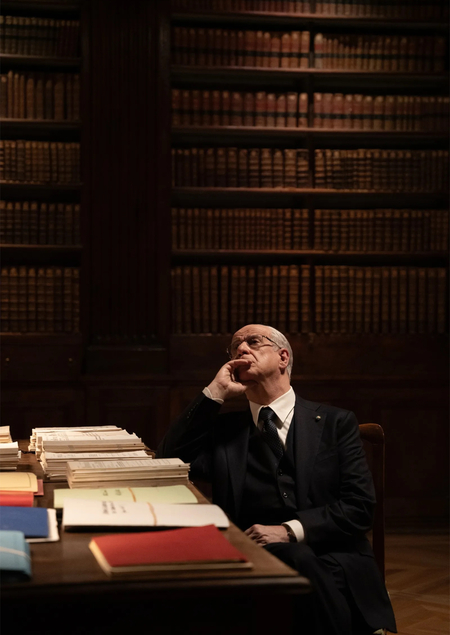
«Grace”—Paolo Sorrentino’s latest film, which continues his meditations on politics and individuals vested with public power. It concludes his trilogy of films: „The Spectacular, ” „Loro, ” and „Grace.“ The director focuses not on the public image of the politician, but on the person in office—their beliefs, doubts, fears, and attempts to understand themselves. This is precisely why I chose this film for analysis. I was interested by the idea that Sorrentino’s cinema recalls Russian classical literature: the works of Leo Tolstoy, Fyodor Dostoevsky, and Nikolai Gogol. This similarity is evident in the attention paid to the hero’s inner world, the psychological complexity of the characters, and the philosophical reflections that resonate like an internal monologue or the voiceover of one’s own „self.“
The quest for identity is ultimately what allows Sorrentino’s characters to transcend the superficiality and frivolousness of aimless existence. Only when a character attains their own identity, life and reality itself become meaningful—and only then does reality cease to be a fluid mass of disconnected facts (a «spectacle,» in a Baudrillardian sense) and transform into something that can be interpreted and judged.
«The search for identity—ultimately, it is what allows the Sorrentine characters to overcome the superficiality and frivolity of goal-less existence. Only when a character achieves their own individuality do life and reality, as such, gain meaning, and only then does reality cease to be a fleeting collection of unconnected facts (a ‘spectacle’ in the Debordian sense) and transforms into something that can be interpreted and assessed.»
Paolo Sorrentino, «Grace.» 2025.
Beneath the image of a reserved president lies a man grappling with loss, doubting his own decisions, and attempting to make sense of his past. The film’s visual language serves to articulate this rift: the external stillness and order of the world contrast sharply with the character’s complex inner life.
The plot of «Graces» revolves around the fictional President of Italy, Mariano De Santis, who has about six months left in his term. During this time, he must make difficult decisions: define his stance on the euthanasia law and review pardon requests. However, state affairs become merely a part of his internal conflict. The President confronts his daughter, processes the death of his wife, and strives to uncover the identity of her lover. Thus, the protagonist’s personal struggles become interwoven with decisions that affect the lives of others.The political setting in the film is portrayed as restrained and closed off. Protocol, distance, and the necessity of controlling emotions barely allow space for their open expression. Therefore, a character’s internal state cannot always be conveyed through words or actions. Visual elements thus gain special importance: frame composition, mise-en-scène, camera movement, light, color, space, and the actors' physical presence. Only in rare moments of connection with loved ones does Mariano allow himself to express his feelings openly; the rest of the time, the viewer must interpret his state through visual «clues.»
In my visual research, I plan to trace how Paolo Sorrentino uses cinematic language to reveal the psychological portrait of Mariano De Santis—his internal experiences, triggers, and doubts. I will focus on the visual decisions that convey the character’s internal and external conflicts, how his psychological state relates to the surrounding environment, and how the character’s restraint aligns with the expressiveness of the imagery. For primary sources, I will use interviews and articles from the people directly responsible for the film’s visual elements: the director, the cinematographer, and the production designer.
2. Composition and Space
It is unusual for a head of state to be captured from a vulnerable angle. His position in the frame—always surrounded and constrained by visual boundaries—indicates this to us.
Paolo Sorrentino, «Grace.» 2025.
Paolo Sorrentino, «Grace.» 2025.
But having said that, yes, the script is somewhat like a prison cell, and it can be hard to find an escape route out of it.
«But, nevertheless, yes, the scenario somewhat resembles a prison cell, and sometimes it is difficult to find a way out of this cell.»
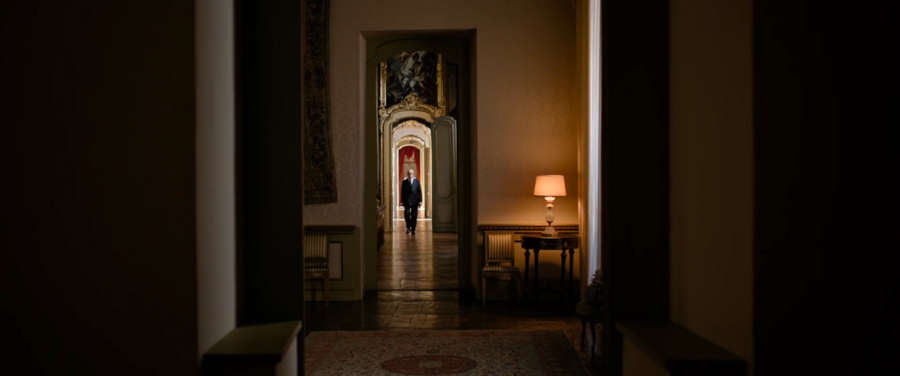
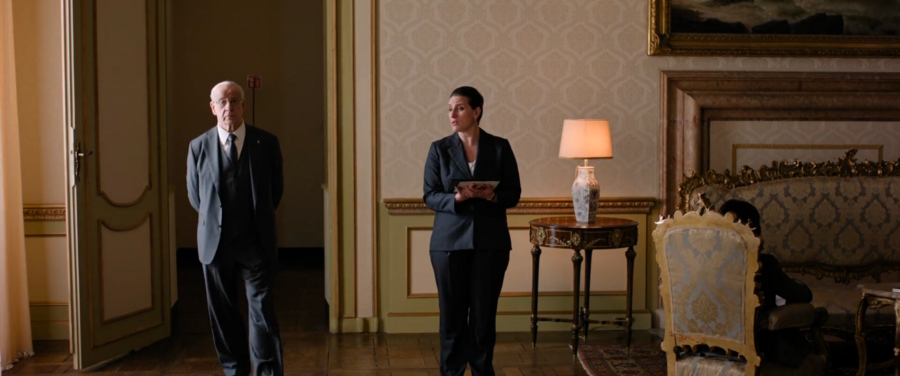
Paolo Sorrentino, «Grace.» 2025.
The only thing that transcends these boundaries is Mariana’s wife in his memories.
Paolo Sorrentino, «Grace.» 2025.

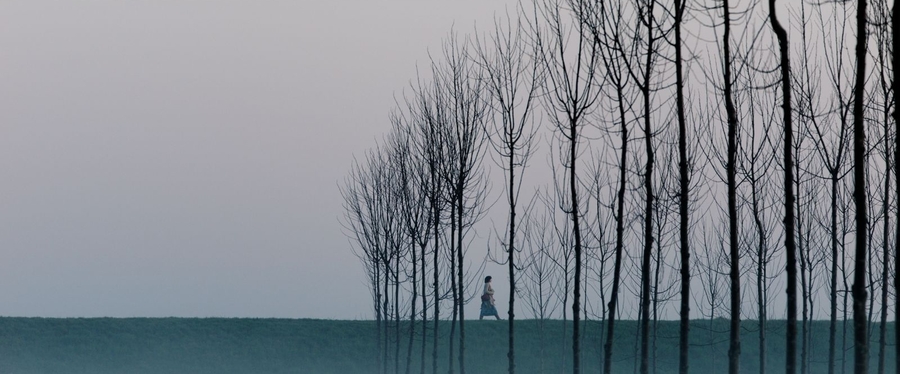
Paolo Sorrentino, «Grace.» 2025.
The shots where the open sky stretches out without frames around him are during breaks, when he secretly smokes a cigarette away from his daughter and reminisces about his wife.
Paolo Sorrentino, «Grace.» 2025.
Paolo Sorrentino, «Grace.» 2025.
Mariano’s vulnerability illustrates the scale of the palace, where the president looks ridiculous within the interior featuring massive sofas, shelving units, tables, lamps, and chairs.
Paolo Sorrentino, «Grace.» 2025.
Amid the stuccoed, damask-covered walls and ornamental details, our focus remained solely on the man—on his doubts, his crisis.
Translation: «Amidst the stucco, the walls covered in damask patterns, and the decorative details, we wanted to focus on the human—on his doubts, on his crisis.»
Paolo Sorrentino, «Grace.» 2025.
Symmetrical compositions symbolize the order of the state apparatus in which the protagonist is situated.
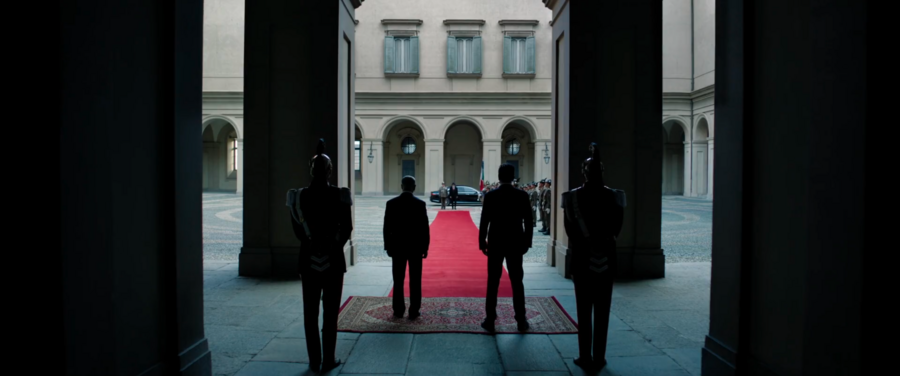
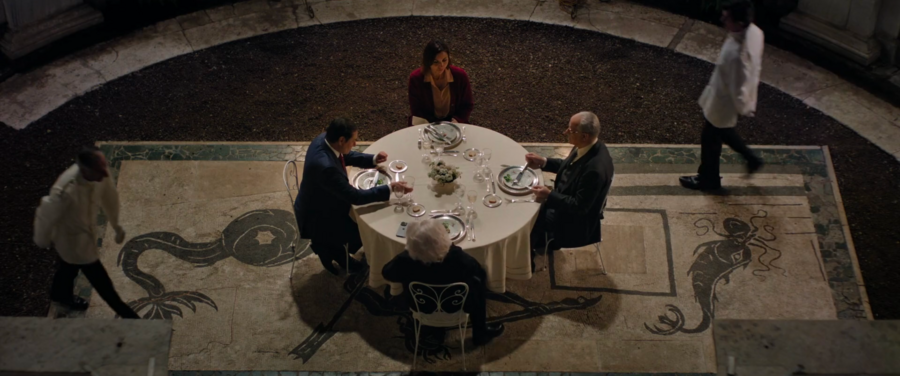
Paolo Sorrentino, «Grace.» 2025.