Introduction
Animation is an incredible process of creating moving images through frame-by-frame capture, invented by the French inventor Émile Reynaud on October 28, 1882, who first charmed French audiences with his glowing pantomimes.
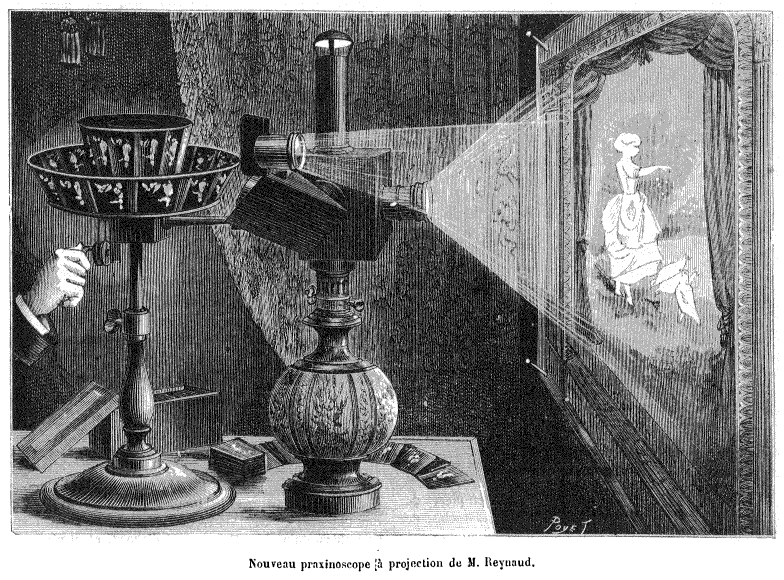
Émile Reynaud and the use of the rotoscop, 1882.
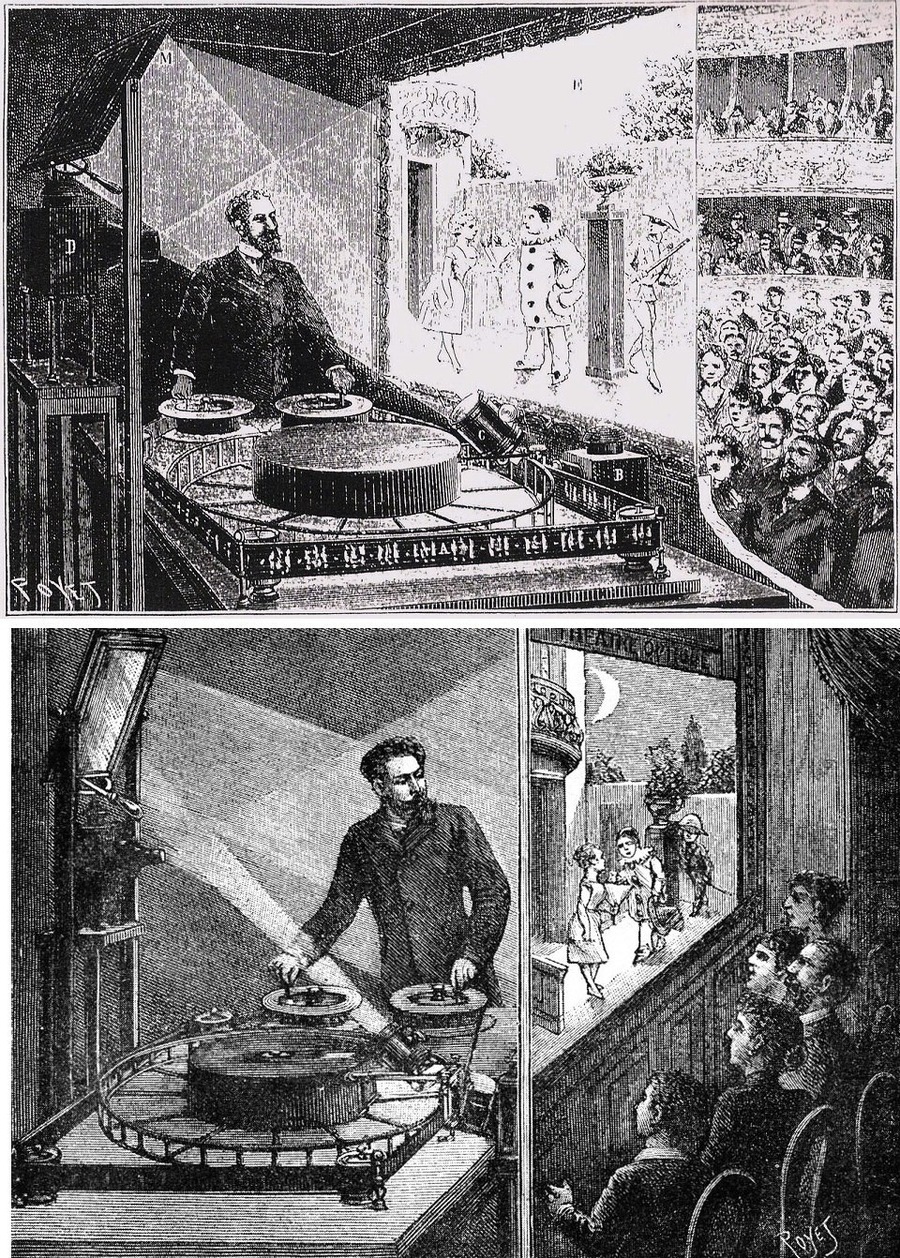
Emile Renoir Panorama Display, 1892
Animators of past centuries frequently encountered the imperfections of film stock and the lack of complex special effects needed to create vivid and rich frames. The Fleischer brothers, being highly talented animators, managed to transform these technical limitations into a unique artistic technique, merging live acting and frame-by-frame animation through a specific method—rotoscoping—which is a technique for creating animations and special effects.
Rotoscoping process, 1915
In the 1920s, the industry was just beginning to define its visual language long before the popularity of Walt Disney and his studio, where masterpieces created to this day delight animation enthusiasts. The timeline shows a transition from the flat comic-book imagery of Felix the Cat to the revolutionary plasticity of Fleischer and Disney’s early experiments in Kansas City.
Design during the «Out of the Inkwell» period, 1921–1923.
Design for Bray Productions Studio, 1918–1921
Classic depiction of Coco the Clown, 1923–1929.
Additionally, the success of this episode, which featured a clown, was due to a family duo that divided the technical and creative responsibilities. Max Fleischer served as the inventor and chief visual artist in the frame, while his brother Dave handled the direction, the rhythm of the animation gags, and acted as a live model for the main character. The five-minute short film was released in 1920 with the support of John Randolph Bray’s studio, a key producer of early American animation. The film integrates three technologies: classical live-action filming, rotoscoping, and early work on transparent celluloid sheets.
Studio workflow leading to the final result of the animated film «The Clown’s Little Brother, ” 1920.
Portraits of the Co-Founders. Archival photographs of Max and Dave Fleischer in their offices.
Rotoscoping and double plating
Physics of Motion
In 1920, most drawn characters moved through jerks, adhering to a primitive «rubbery» plasticity. Flesher countered this by juxtaposing realistic human biomechanics against conventional grotesque animation within a single frame. Max Flesher developed the rotoscoping technique in 1914 and, after filing an application in 1915, successfully obtained a U.S. patent in October 1917. This device clearly projected frames filmed from live motion picture film onto the frosted glass of an easel, allowing the artist to trace live movement according to a pre-existing contour.
Rotoscope diagram, 1915–1917
Rotoscoping diagram, 1917.
To achieve convincing fluidity, Dave Fleischer performed a series of acrobatic routines on Coney Island beach while dressed in a Pierrot clown costume. Following this process, photographs from the filming and frames from the movie had to be matched, which proves how accurately the drawing preserves the proportions of real human movement. During the frame-by-frame analysis of the dance, Coco demonstrates intricate work with inertia—that is, the transfer of weight from one foot to another and the natural folds of the loose costume. For audiences of that era, such smoothness seemed like a genuine marvel, radically contrasting with the angular movements of other cartoon characters. The second character drawn by the artist serves as a pivotal moment in the plot, appearing from a random splash of ink without relying on film footage. Thus, two fundamentally different animation schools collide in one space—photorealistic tracing versus the artist’s rich imagination.
Archival still from the 1918 filming.
Hybrid Space and the «Fourth Wall»
The creator’s seemingly ordinary wooden table in the film transforms into a complete theatrical stage, onto which the plane of a two-dimensional piece of paper organically integrates into the three-dimensional interior of a real studio.
Still frame from the cartoon «The Clown’s Little Brother,» 1920.
A still frame from the animated short «The Clown’s Little Brother, ” 1920.
Interaction of drawn characters with a three-dimensional world, «The Clown’s Little Brother, ” 1920.
Undoubtedly, the centerpiece of the animated film is the lidded inkwell, which serves as the main narrative and compositional anchor throughout the runtime. It is through this inkwell that the characters emerge from the liquid black mass onto the paper’s surface and subsequently return there in the finale.
The appearance of Coco the clown from a diluted inkblot, «The Clown’s little brother,» 1920.
The return of the excited clowns to the inkwell, «The Clown’s little brother, ” 1920.
Coco possesses a rare sensibility for early cinema: he keenly understands that he is a drawing on paper. The clown frequently addresses the moviegoer directly and engages in emotional debates with his creator.
Still frame of the interaction between the clown and the creator, «The Clown’s little brother, ” 1920.