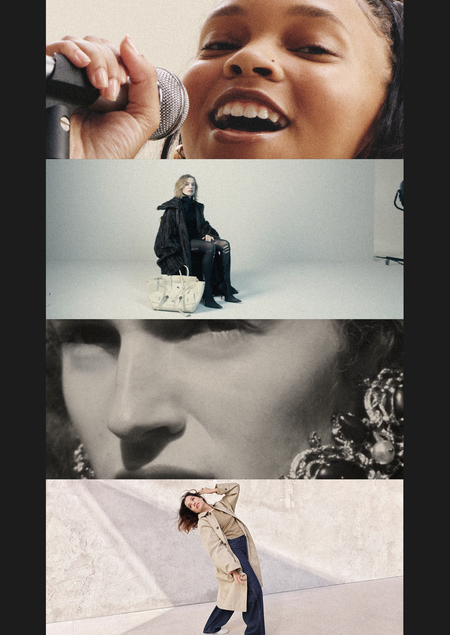

H&M Summer 2024 Campaign Knocks It Out of the Park, H&M Studio A/W 2026, Saint Laurent AW25 'Velvet Heat'
Navigation
1 / Introduction 2 / Concept 3 / Perspective 3.1. Direction and Nature 3.2. Facial Expressions 4/ Pose and Body Posture 5 / Conclusion 6 / Bibliography 7 / Image Sources
1 / Introduction
When searching for a research topic, I tried to latch onto something. To find something that I could approach seriously, yet simultaneously with a degree of lightness and playfulness.Then I remembered the first scene from Ruben Östlund’s film «The Square, ” where, during casting, the interviewer asks models to change their expressions and poses depending on the brand: Balenciaga is accompanied by a demonstration of strength, impenetrability, and emotional coldness, while H&M embodies joy, friendliness, and carefree spirit.I remember finding that scene amusing at the time—I thought it was silly and candid. Now, I want to return to it within a visual study and examine more closely how advertising communication is structured. Does luxury truly convey opulence and a lavish lifestyle through stern faces, strength, and impenetrability, while mass-market, following the film’s satirical logic, remains the domain of happy, smiling poor people?
2 / Concept
The core of this study is the model as a tool for nonverbal brand communication. Through the model’s face and body—their gaze, facial expressions, postures, and physical grace—the brand sets the tone of its address to the viewer and indicates how it wishes to connect with lifestyles and behaviors. As Roland Barthes writes in «Mythologies, ” „the meaning of any advertising image is always and undoubtedly intentional“ [1], meaning it is deliberately established. In this sense, the model’s behavior can be viewed as a system of visual signs: the viewer reads confidence, impenetrability, friendliness, or casualness from these signs, and through these qualities forms an impression of the brand and the people to whom it appeals.
The research examines the advertising campaigns of Balenciaga, Saint Laurent, H&M, and Gap from 2024–2026. A comparative analysis of the gaze—including facial expressions—and the physical presence, revealed through postures and gestures, will allow us to test the hypothesis regarding the distance and exclusivity of luxury versus the openness and friendliness of mass-market brands. The focus is on how the model’s nonverbal behavior contributes to brand positioning.
The material for this study will be the advertising campaigns of Balenciaga, Saint Laurent, H&M, and Gap from 2024–2026.
Key Question: To what extent does the contrast seen in the film „Triangle of Sorrow“ correspond to the advertising of the chosen brands: does luxury truly create an image that is cold, arrogant, and aloof, while mass-market models convey openness and friendliness?
Hypothesis: It is proposed that in the campaigns for Balenciaga and Saint Laurent, the models' gaze, facial expressions, and physical grace more frequently establish social distance, supporting an image of an elite and inaccessible world. In the campaigns for H&M and Gap, the models' nonverbal behavior more often expresses emotional openness and ease, shaping an image of brands accessible to a broad audience. This study will test this assumption and identify instances where it is not supported.
3 / Perspective
A model’s gaze defines the brand’s character. Eyes directed toward the camera can invite connection, express confidence, or be perceived as a challenge. A averted gaze can create a sense of detachment or introspection.
In this chapter, advertising imagery from Balenciaga, Saint Laurent, H&M, and Gap is examined in terms of how the model establishes or avoids contact with the viewer and what emotional tone it sets.
3.1. Direction and Nature of Vision
Let’s start with a look directly into the camera—that immediately establishes contact. But what kind of contact will it be? One gaze creates a feeling of coldness and inaccessibility; another suggests emotional openness and invitation. A direct gaze doesn’t necessarily create intimacy, just as an unfriendly gaze doesn’t necessarily preclude conversation.
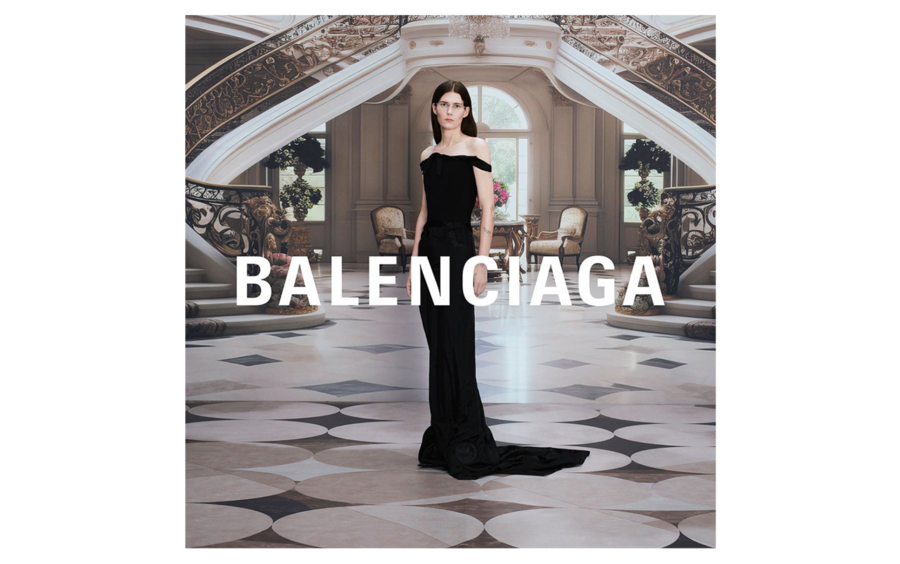
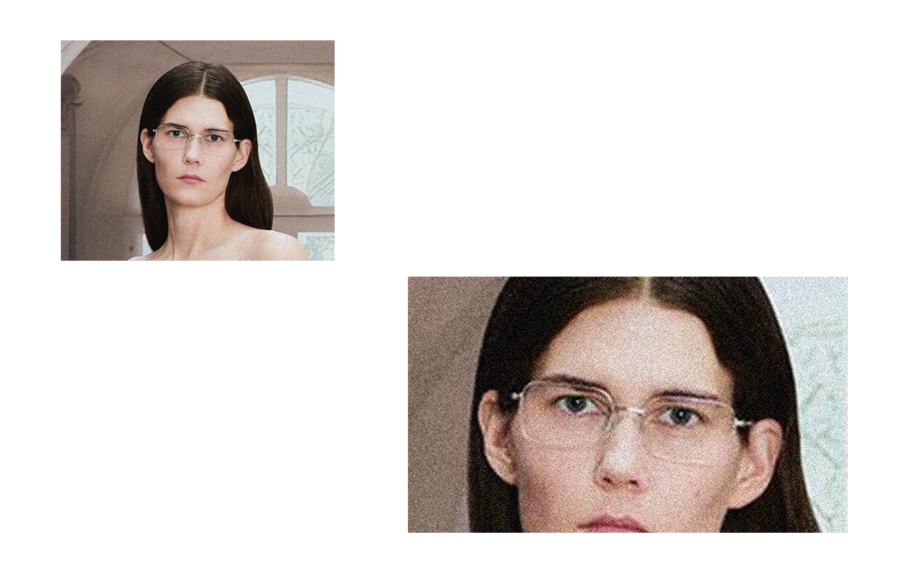
Eliza Douglas in the Balenciaga Summer 2024 advertising campaign
Eliza Douglas is featured in the Balenciaga Summer 2024 campaign. Her gaze is directed toward the camera, yet it conveys no discernible interest in the viewer. It is difficult to read an invitation or a challenge in her look—it feels more indifferent. There is a sense that the model is looking at us, but our presence changes nothing for her. This direct gaze does not create intimacy.
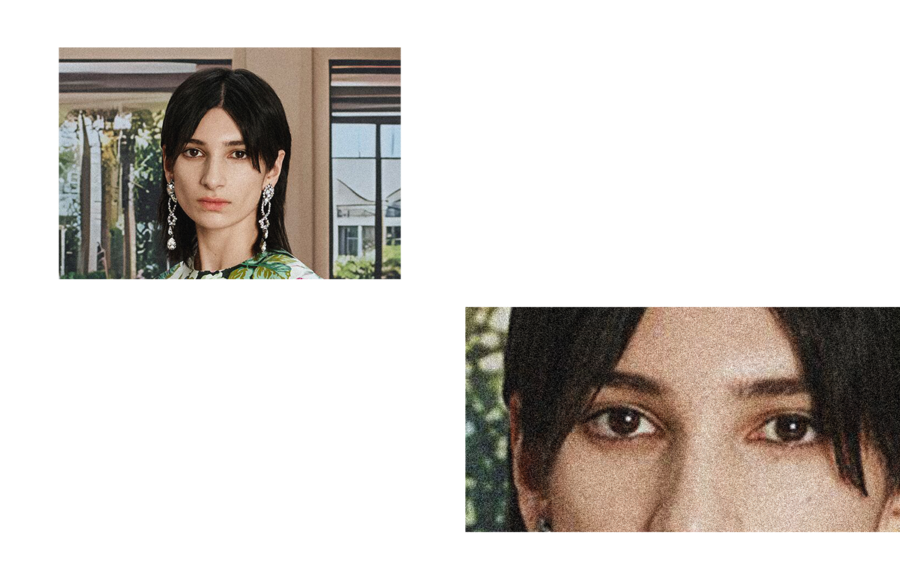
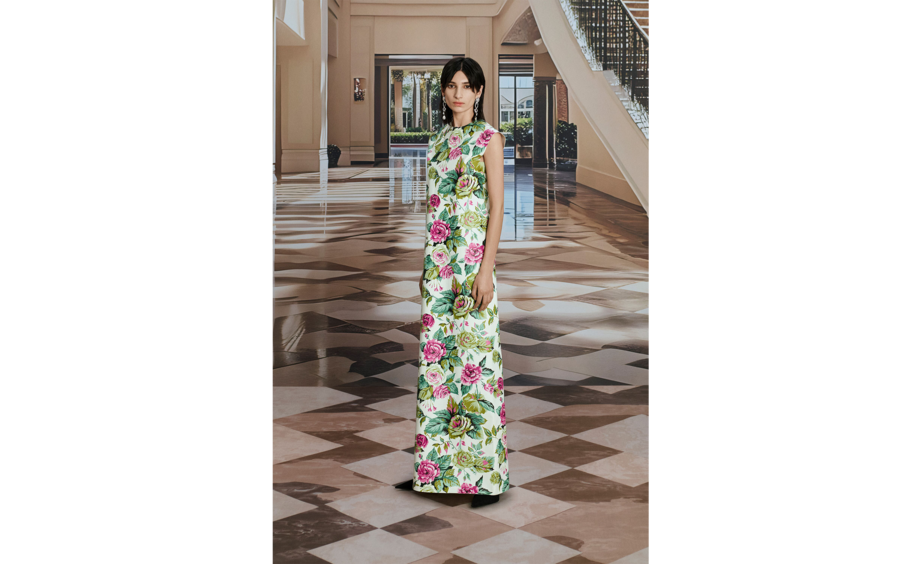
Balenciaga Summer 2024 Advertising Campaign
The model’s gaze is directed at the camera. Like Eliza’s, it draws attention, although it’s unclear whether it stems from interest in us. It evokes the feeling of a chance encounter with a stranger on the street: for a moment, your gazes meet, creating a fleeting illusion of connection—but then she looks away. In reality, she wasn’t looking at you.
«When participants look at the viewer, vectors formed by their eyelines connect the participants with the viewer. Contact is established, even if only on an imaginary level.» [2]
Now, let’s turn to the H&M A/W 2024 advertising campaign. Lola Bailey’s gaze might initially seem cold—even unfriendly. It is intense and taut, as if challenging the viewer. However, it is this directness toward us that creates a sense of a more defined connection: it feels like we have been noticed and are being waited for to react. Charli XCX’s gaze is different—languid, with half-closed eyelids, perceived more as an allure.
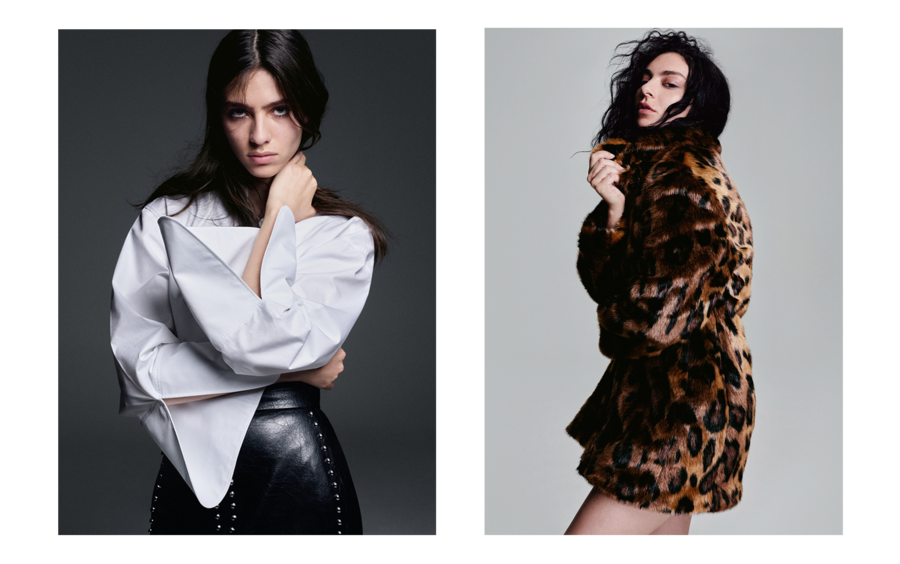
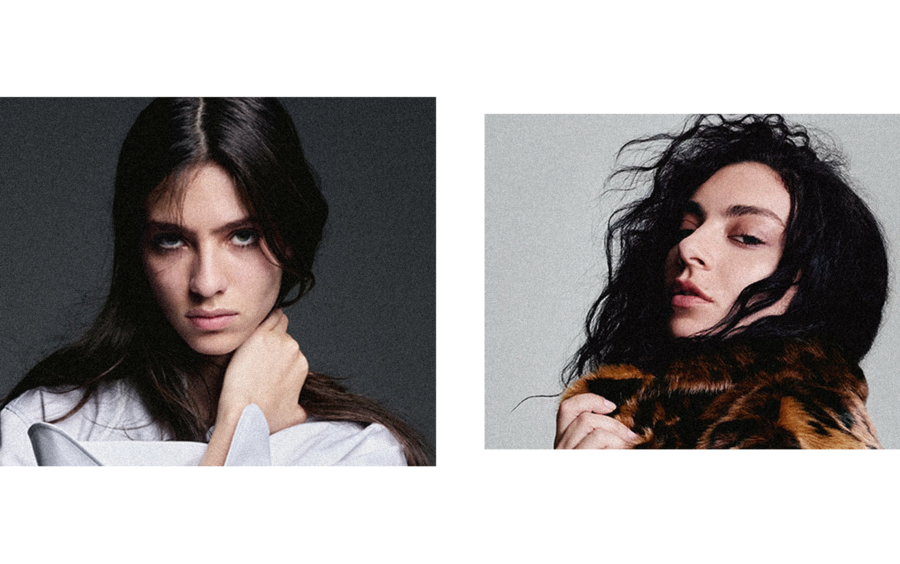
Loli Bahia (left) and Charli XCX (right) in the H&M A/W 2024 campaign
Here, it is important to distinguish between unkindness and indifference. A gaze can be sharp or provocative while still actively engaging the viewer. In Adams and Kleck’s work, it is stated that emotions like anger, for instance, when conveyed through direct eye contact, fall into the category of approach-oriented emotions:»…direct gaze would facilitate the processing of facially communicated approach-oriented emotions (e.g., anger and joy)…» [6]Approach here does not necessarily imply friendliness; it can also suggest confrontation.In the portraits of Balenciaga we examined, the direct gaze created a feeling of uncertainty: is he truly looking at us? In the H&M shots, the address seems more explicit. It is not necessarily friendly, but it demands a response. If the unfamiliar girl from the previous comparison seems to be looking past us, this girl sees us.
Snippets from the Balenciaga Summer 2024 advertising campaign (left) and H&M A/W 2024 (right)
To conclude the discussion on looking at the camera, we will compare two more examples—Saint Laurent and Gap.
Fragments from the Saint Laurent Fall 2024 advertising campaign (left) and Gap Summer 2024 with Kiko Mizuhara (right)
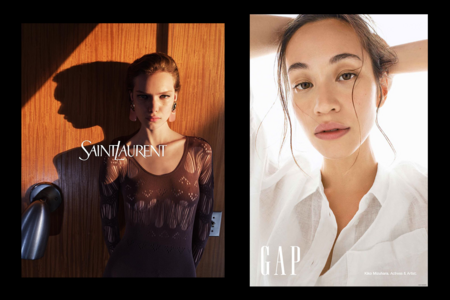
In the Saint Laurent advertisement, the model’s gaze is perceived as intense, confident, and sensual. Unlike the Balenciaga portraits examined, this gaze appears clearly directed at the viewer, yet it does not evoke a sense of openness. One can read caution and a degree of challenge in it: contact is established, but distance is maintained. This look calls to mind the femme fatale of espionage films—attractive, reserved, and unwilling to reveal her intentions.In the Kiko Mizuhara portrait for Gap, the sensuality takes on a softer, more relaxed character. The gaze is also aimed at the viewer, but it lacks tension; it has more openness, softness, and flirtatiousness. This image is more reminiscent of a romantic comedy heroine: meeting her feels like a part of daily life rather than an introduction to a closed, mysterious world.It was interesting to recall Barthes and the «fragment of symbolic fabric» [1] here. That is to say, a gaze is a fragment of the language of the image. And it can express two completely opposite images and two different ways of life.
Now let’s shift our focus. The model does not meet our gaze; we observe her as if remaining unnoticed. However, the lack of direct contact does not make the look unexpressive. It can appear thoughtful, wary, detached, or interested in something outside the frame. As Adams and Kleck note, «gaze direction and facial expression are combined in the processing of emotionally relevant facial information» [6].
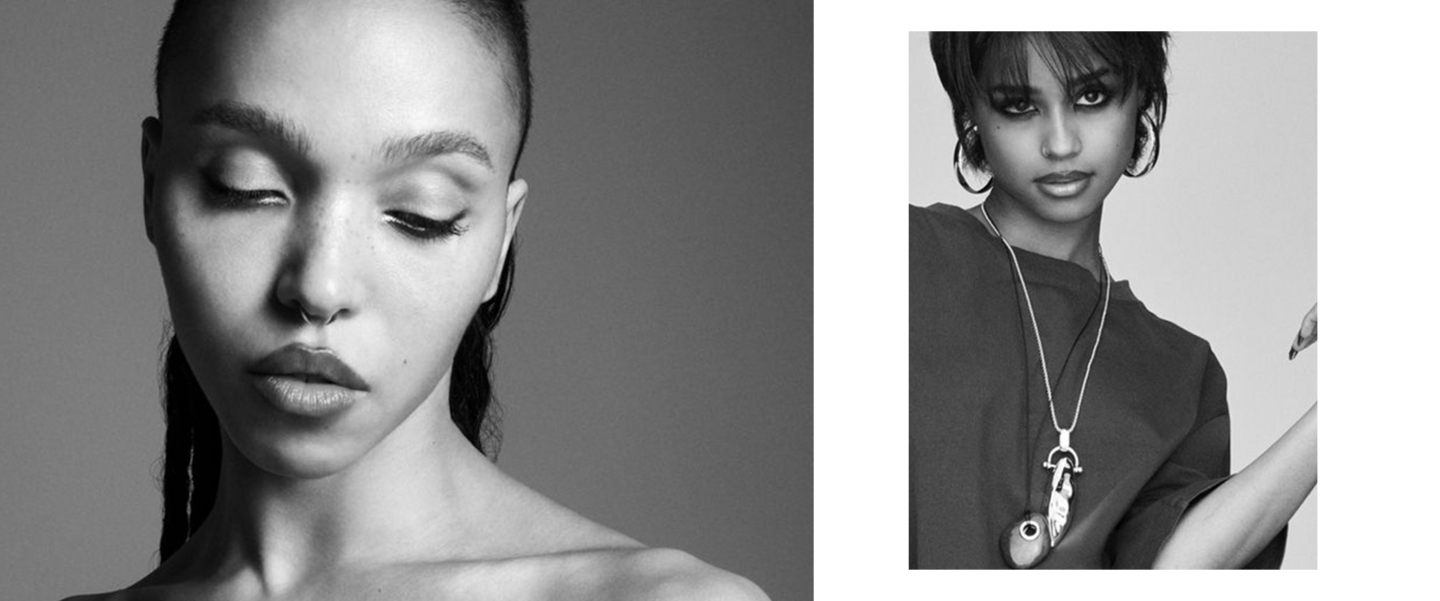
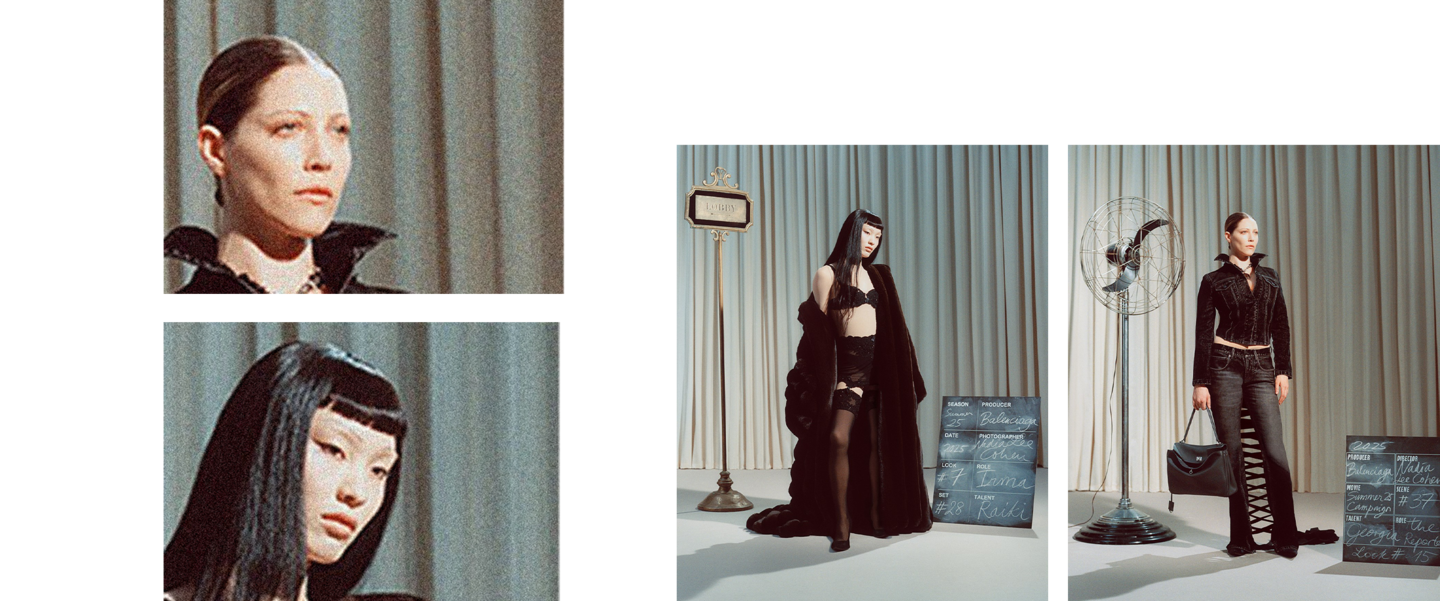
Balenciaga, Summer 2025 advertising campaign, H&M, «Dreamscape» 2025 advertising campaign
In the Balenciaga photographs, the models' gazes are directed beyond the frame, yet it is difficult to discern what captures their attention. They are looking, but as if noticing nothing. The gaze appears staged—almost artificial—its direction set, but its emotional content remains ambiguous. As Macrae and colleagues note, «person construal was facilitated when targets displayed direct eye gaze» [5]. It is precisely this uncertainty that intrigues and simultaneously maintains a distance—the viewer struggles to understand what is happening to the subjects and how to approach them.In the H&M «Dreamscape» portraits, the gaze is perceived differently. FKA twigs’ lowered eyes convey an impression of a pause, self-absorption, or perhaps anticipation. Here, the lack of direct contact with the viewer allows for an interpretation of internal experience. Tyla’s gaze is bolder and more engaged, as if she is addressing a specific interlocutor—teasing him. A sense of interaction arises: «whether maintained stare is a sign of dislike or like, it is certainly an indication for a potential social interaction» [5].Thus, the difference between these examples is linked to the emotional definiteness of the gaze. With Balenciaga, it remains a mystery, sustaining a sense of unattainability. With H&M, it is easier to imagine the situation and the relationships behind it. This engagement does not necessarily imply friendliness, but it makes the depicted world more recognizable and emotionally accessible.
Michelle Pfeiffer in the Saint Laurent Summer 2025 campaign (left), Parker Posey in the Gap Spring 2025 campaign (right)
In the Saint Laurent advertisement, Michelle Pfeiffer’s gaze is directed off-camera and appears focused—as if someone just outside the frame is capturing her attention. Unlike the images from Balenciaga, there is a sense of engagement here. However, her character remains enigmatic. This distance is maintained through suggestion.
In the Gap advertisement, Parker Posey’s gaze is also directed off-camera, but it feels lighter and more playful. Her raised eyes, combined with a smile, convey an impression of pleasant surprise or joyful anticipation.
In both cases, there is no direct eye contact, but the perceived accessibility of the subject differs: Saint Laurent leaves her experience unstated, while Gap makes it more open to the viewer.
3.2. Facial Expressions and Affect