INTRODUCTION
The city exists because of people, yet in photography, it is capable of existing without them.
Empty streets, facades, industrial buildings, and endless rows of windows transform into autonomous images. Human presence recedes into the background, and the architecture begins to define the composition.
Why do photographers turn to the empty city? And what can one discover in a familiar space when the human element is removed?
WHAT IS A GHOST TOWN?
An empty city is not necessarily a space completely devoid of people. In photography, emptiness can be created through composition, the choice of shooting time, the scale of the architecture, or the point of view.
Sometimes a person is physically absent from the frame. In other cases, they are so small relative to the surrounding development that they cease to be the main subject of the image.
Thus, emptiness becomes not just a characteristic of a space, but a method of its visual representation.
VISUAL AIDS OF VOID
The study examines several fundamental techniques:
Perspective — the direction of gaze into the depth of space.
Scale — the relationship between the human figure, buildings, and the urban environment.
Geometry — lines, planes, rectangles, and repeating shapes.
Light — the emphasis of architectural details and the creation of a spatial mood.
Rhythm — the repetition of windows, facades, buildings, and urban elements.
Shot point — the selection of the position from which the city is perceived as a composition.
It is the combination of these elements that forms the various images of the empty city.
FIVE PHOTOS—FIVE PERSPECTIVES
The study examines five photographers working with architecture and the urban environment:
Eugène Atget — the city as historical memory.
Lewis Balz — the industrial environment and geometry.
Gabrielle Basilico — architecture and the scale of the city.
Thomas Struth — everyday urban space.
Michael Wolff — building density and abstraction.
Their works allow us to trace how the photographic representation of the city has changed throughout the 20th and 21st centuries.
ZHEN ATZE
THE CITY AS HISTORICAL MEMORY
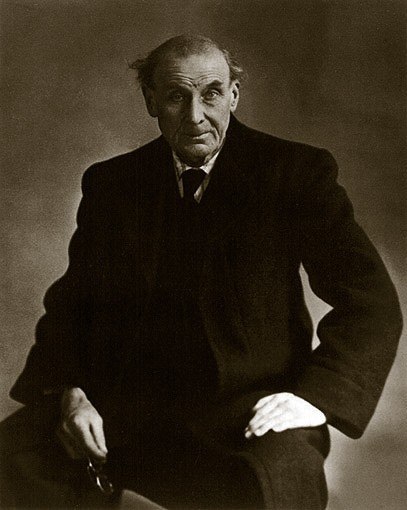
Eugène Atget (1857–1927) was a French photographer who dedicated a significant portion of his life to documenting Paris.Beginning in the late 19th century, he created photographs of streets, buildings, courtyards, storefronts, and architectural details. His works captured the city during a period of massive transformation, as historical architecture gradually gave way to the modern urban landscape.Atget viewed photography as a means of preserving the visual memory of the city.
PARIS WITHOUT THE DAILY RUSHIn Atje’s photographs, the city often appears unusually serene. The streets and squares resemble theatrical backdrops, and the architecture becomes the central subject of the image.The absence of people allows for an examination of details that are usually lost in the hustle of daily life: old masonry, window openings, signage, and the peculiarities of urban perspective.Paris in Atje’s shots is not just a setting—it is an independent historical artifact.
DOCUMENTATION AND PERSPECTIVE
Atje often composes shots so that the viewer’s gaze travels along the street into the depth of the frame.
The architecture forms a spatial axis: the facades enclose the street, and the perspective unifies the individual buildings into a cohesive whole.
The documentary nature of the photograph does not preclude artistic expression. On the contrary, the precise capture of space allows us to see its compositional structure.
WORK ANALYSIS
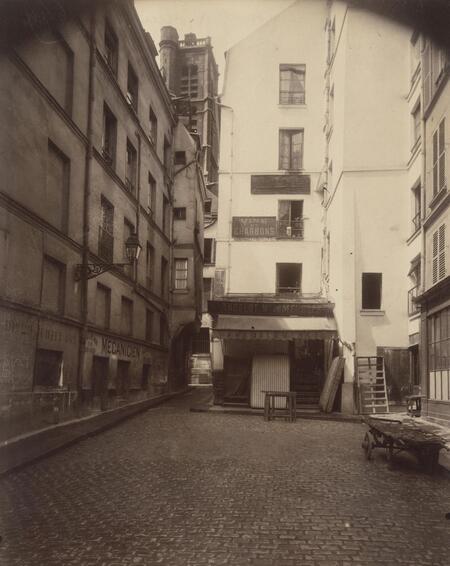
Eugène Atget. Rue de Nevers. 1924.
This photograph depicts a Parisian street. The space is organized through perspective, which directs the gaze into the depth and highlights the characteristics of the historic architecture.
Despite the presence of a car, the human figures do not become the focal point of the composition. The city is perceived through its architecture and the traces of everyday life.
This example demonstrates that emptiness need not be absolute, but relative—the surrounding space holds greater significance than the individual person.
ATZE’S STRATEGYDocumentary StrategyAtze does not seek to transform the city into an abstract geometric composition. He is interested in the specific urban environment—its history and material characteristics.Negative space helps separate the architecture from daily movement, allowing it to be viewed as a testament to a particular era.The city becomes an archive: every building, street, and facade retains information about the time in which it existed.
VISUAL STYLE: ATJE
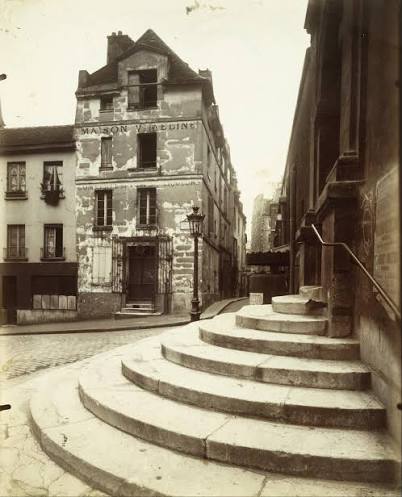
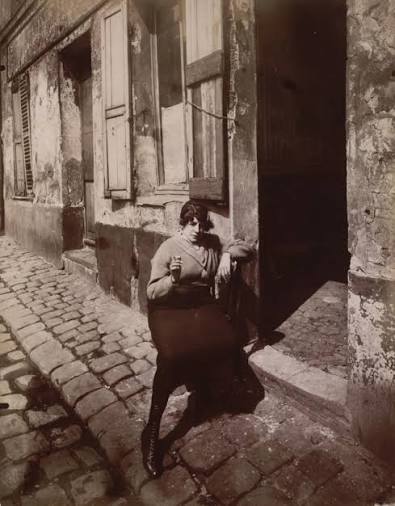
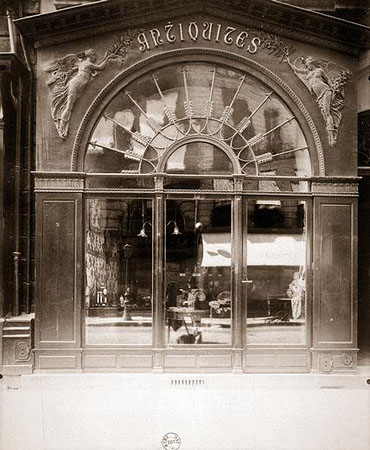
Conclusion: Atze’s emptiness allows one to view the city as a historical environment that exists independently of human daily activity.
LOUIS BALZ
INDUSTRIAL ENVIRONMENT AND GEOMETRY
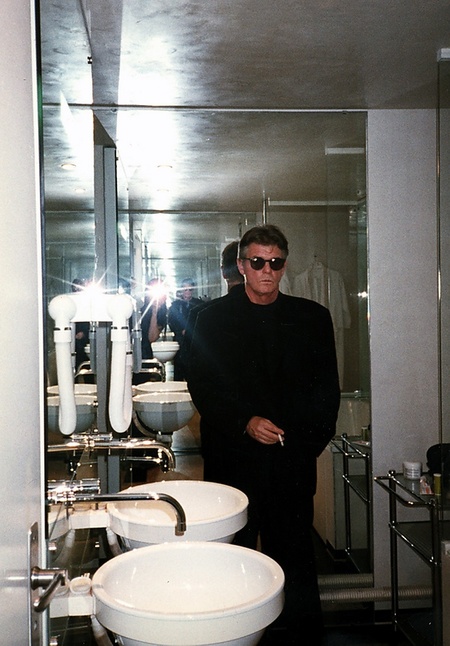
Lewis Baltz (1945–2014) was an American photographer and one of the key figures of the New Topographics movement. In the 1970s, he focused on territories that rarely featured in traditional art photography: industrial zones, warehouses, parking lots, and new residential developments. Baltz viewed architecture not as a symbol of beauty or grandeur, but as an integral part of the everyday, man-made landscape.
NEW INDUSTRIAL LANDSCAPE
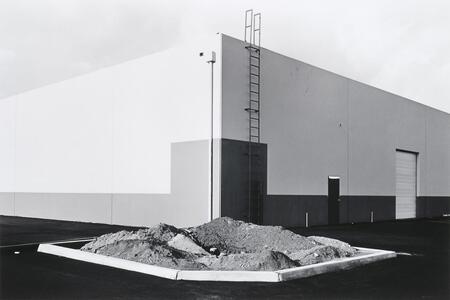
The New Industrial Parks series, created near Irvine, California, in 1974, features the photographer’s exploration of the new industrial zones of Southern California. His frames capture factory walls, empty parking lots, utility structures, and the facades of warehouse buildings. These spaces appear nearly lifeless—yet they are precisely what reveal how human activity transforms the environment.
FRONTALITYFrontal photography is one of Balz’s primary techniques.The photographer often positions the camera facing a wall or facade. The building transforms into a flat plane, and its architectural features are perceived through proportion, texture, and the arrangement of details.Conventional perspective gives way to an almost two-dimensional image. The viewer begins to perceive the facade as an independent geometric composition.
REPETITION AND RHYTHM
In Balts’s work, similar architectural elements—windows, doors, walls, and technical structures—are often repeated. Rhythm arises from the sequence of rectangular forms and uniform details. Because of this, the industrial area is perceived as a system built according to specific rules.
The absence of people intensifies the feeling of the space’s impersonality. The architecture seems designed not for individual perception, but for the execution of a specific function.
WORK ANALYSIS
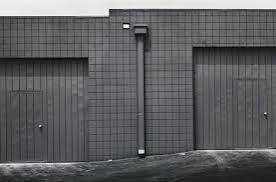
Lewis Baltz. Unoccupied Warehouse, Santa Ana. 1974.The photograph depicts an industrial space devoid of people. The building is perceived as the result of human activity, even though no human is present in the frame.The neutral presentation plays a crucial role: the photographer avoids dramatic lighting or emotional perspective. The architecture is presented almost analytically.The emptiness here does not evoke a sense of romantic solitude. Instead, it emphasizes the functionality and depersonalization of the industrial environment.
BALTZ’S STRATEGY
Typological and analytical approach
Baltz portrays the city through recurring elements and archetypal architectural forms. His photographs resemble a visual classification of industrial space. Each building is treated as an individual example within a broader urban system. Emptiness becomes a method of neutral observation—it allows focus on the structure of the urban environment rather than the events unfolding within it.
VISUAL STYLE: BALZ
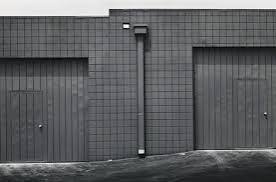
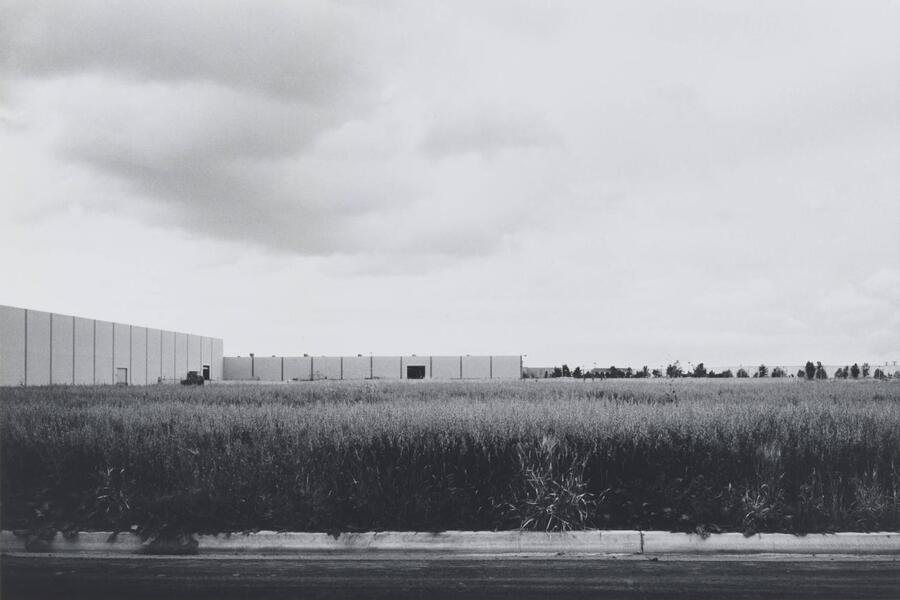
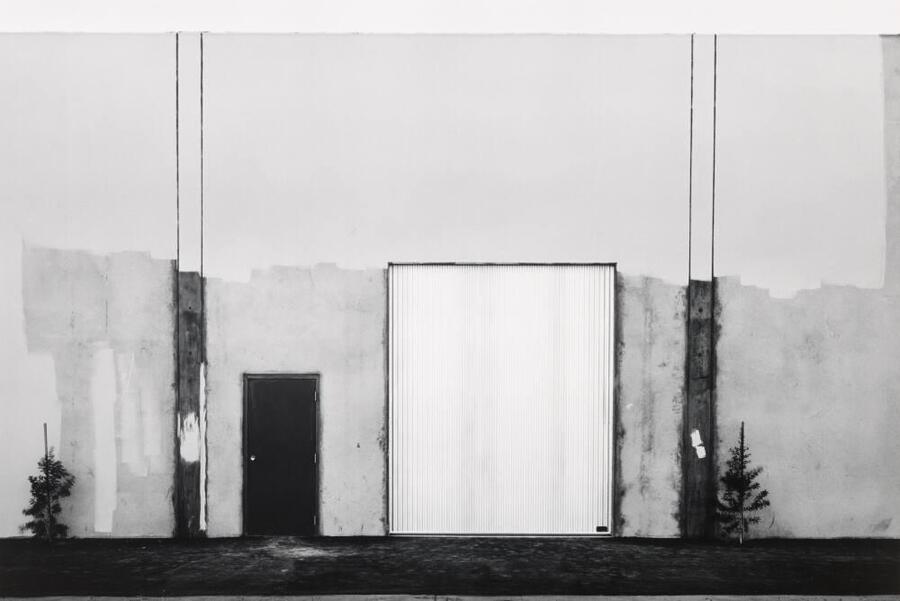
Conclusion: In Balzac’s work, the empty city becomes a geometric system where architecture is perceived through repetition, frontality, and functionality.