Categories
1. The Factory as a Symbol of a New Era
2. Scale of Production: Architecture, Workshops, and Mechanisms
3. Man at the Machine: Labor in a Photographic Frame
4. The Rhythm of the Machine: Geometry and Composition of Production
5. Angle and Scale: How Photographers Depicted Humans and Technology
6. From Workshop to Magazine: Industrial Photography in Soviet Print Media
7. Man and Machine Beyond the USSR: International Context
8. Conclusion
The Factory as a Symbol of a New Era
In the late 1920s and 1930s in the USSR, new enterprises were constructed and existing factories were expanded. Industrial development became a vital part of state policy, a movement known as industrialization. Factory buildings, smokestacks, cranes, and power lines altered the cityscape, becoming integral to the everyday landscape.
Photographers paid attention to these structures not just as production sites. They searched industrial architecture for expressive forms, shooting the facilities from various perspectives and contrasting them with the surrounding city. The factory simultaneously became a document of its era and an icon of the industrial age.
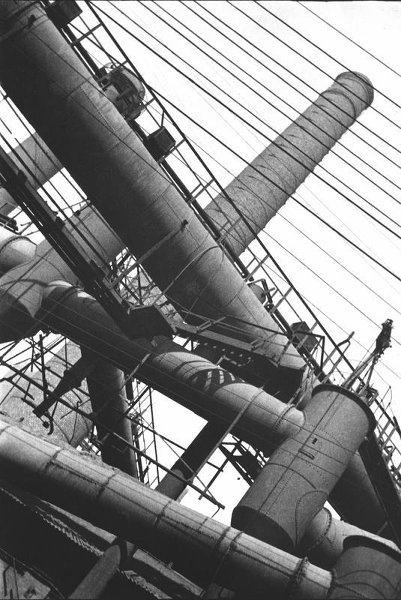
Boris Ignatovich. «Factory.» 1930s.
In the photograph, Boris Ignatovich depicts the factory through its external features—pipes and industrial structures. The focus is on the enterprise as a whole, rather than on a specific worker or production operation. The shot allows the factory to be viewed as part of a landscape; its architecture becomes an independent subject of the photograph. Furthermore, the viewer sees the facility from the outside and does not yet know what is happening inside.
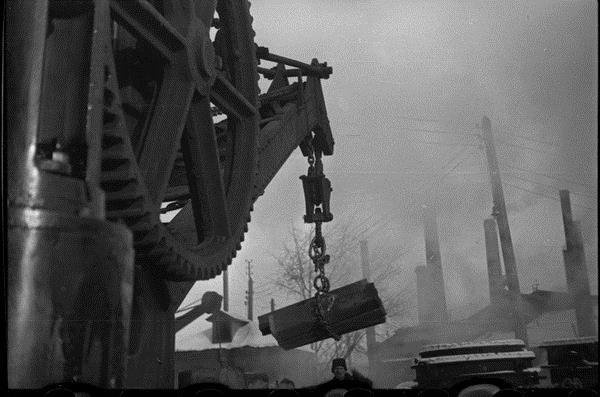
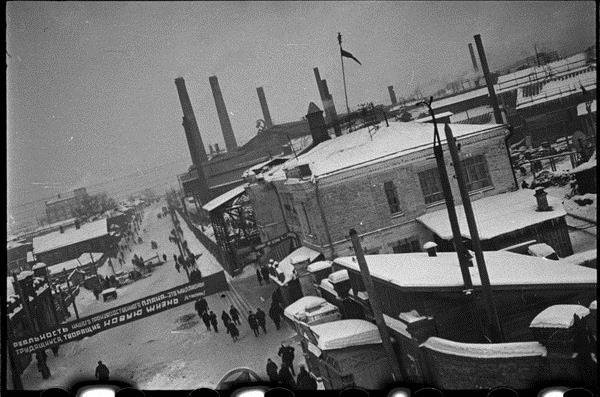
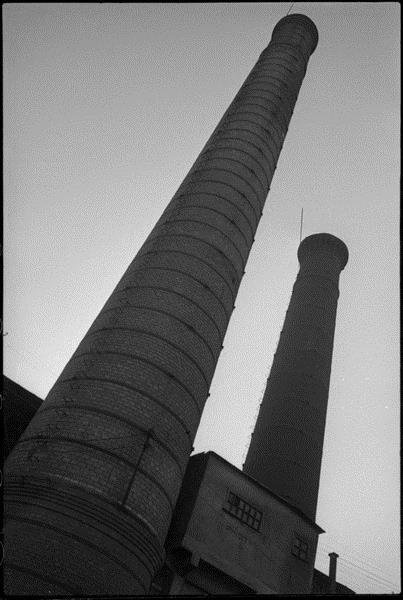
Alexander Rodchenko. «Factory 'Sickle and Hammer.' No. 2, ” „Factory 'Sickle and Hammer.' No. 3, ” „Factory 'Sickle and Hammer.' No. 4.“ 1931.
In a series about the «Serp i Molot» factory, Aleksandr Rodchenko depicts the enterprise from various perspectives. In the first shot, the factory exists alongside the surrounding city—the frame includes a street, power lines, and pedestrians. Human figures and elements of the urban environment provide the viewer with reference points against which they can gauge the size of the industrial structures.
In the next photograph, Rodchenko focuses on the factory smokestacks. The low-angle shot alters the conventional perception of the structure; the pipes become the foundation of the composition. In another frame, smoke, a crane, and metal structures are added. The image of the enterprise is thus constructed from several forms and directions that the photographer unifies within a single image.
Alexander Rodchenko. «AMO Factory.» 1929.
Rodchenko’s photographs can be viewed together: the overall view shows the factory’s location in the city, while individual angles draw attention to its structure. The enterprise appears both as part of everyday space and as a combination of industrial forms that can be studied separately.
In the shot of the AMO factory next to the brick building, people and a truck appear. If the pipes and structures help reveal the factory’s external appearance, the people bring us back to its function. The factory is a space of human labor connected to production and machinery. To examine this connection in more detail, one must move inside the enterprise—into the workshops, machinery, and workspaces.
Production Scale: Architecture, Workshops, and Mechanisms
The exterior of the factory allows one to grasp its place within the city. A photograph of the workshop serves a different purpose: it reveals the production space from the inside, showing people, machinery, and structures situated close together. The portrayal of this space depends on the photographer’s choices. A wide shot allows for a comparison between the equipment, the size of the workshop, and the human figure. A closer frame shifts focus to a specific machine or operation. Let’s examine how photographers have used scale and framing to illustrate the relationship between humans and production.
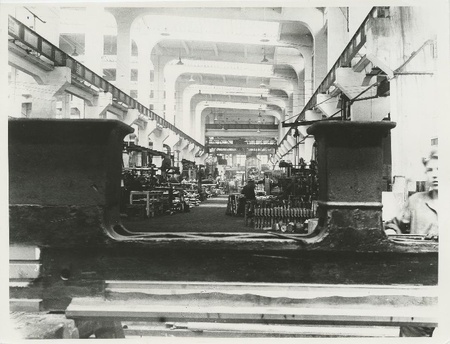
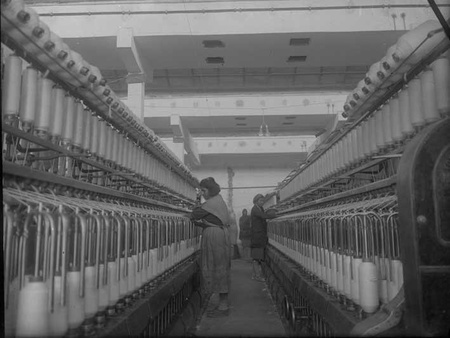
Max Alpert, Solomon Tules, Arkady Shaykhet. «General view of the workshop of the 'Red Proletarian' mechanical plant, where N. F. Filippov and his son Kostya work.» 1931. Arkady Shaykhet. «Textile factory. Weaving department.» 1930.
Both photographs depict production beyond a single workstation. Instead of a large portrait, the viewer receives an overview of the shop floor, allowing them to see how people and equipment coexist within one space. The scale of the frame helps connect the individual worker with the surrounding production environment.
Furthermore, the caption for the «Red Proletariat» factory photo adds information unattainable from a single image: N. F. Filippov and his son Kostya worked in this shop. Since the photograph is part of the series «24 Hours in the Filippovs' Lives,» the overall view becomes part of a story about a specific family.
By juxtaposing it with Shaykhet Weaving Mill, one can compare two distinct production environments using a single technique: displaying the workspace in an aerial plan. The viewer notices not only the people but also the arrangement of equipment surrounding them.
Alexander Rodchenko. «Moscow Metallurgical Plant 'Sickle and Hammer'.» 1931.
Alexander Rodchenko. «Serp i Molot Factory. No. 5.» 1931.
Rodchenko’s photographs of the «Hammer and Sickle» feature workers, machinery, and workshop structures. Unlike the shot where the person is highlighted in a close-up, here the figure must be considered along with the surrounding equipment. This way, the photograph depicts the worker not in isolation, but within the production environment.
In these frames, the relationship of scale is important: the size of the person helps us gauge the machinery and the space surrounding it. Simultaneously, the viewer’s attention is distributed between the figure and the mechanisms. The human remains a participant in the action but does not become the sole focal point of the image.
The series allows for a comparison between the external and internal appearance of a single enterprise. In the first section, Rodchenko showed the factory through its pipes and structures. Here, workstations and the people connected to them appear in the frame.
Unknown artist. «Svetlana Factory. Hydro-turbine workshop. Drilling of parts.» 1930s.
The name of the «Svetlana» factory photo indicates a specific operation—drilling parts. Compared to the general views of the workshops, attention here can be directed toward a particular production area and the equipment associated with that work.
This is how the viewer’s task changes: first, they examine the enterprise as a space, and then an individual workstation. In the following section, this perspective will become even closer—the focus will be on a person at a machine.
The Person at the Machine: Labor in a Photographic Frame
In general views of the workshop, the person is part of a large production space. As the photographer moves closer to the workstation, the relationship between the human and the machine becomes more evident: the viewer sees the hands, the gaze, the body posture, and the machine’s details.
The photographer can highlight the worker’s face, show their interaction with the machinery, or make a close-up detail of the machine the main element of the composition. This determines whether we perceive the photograph primarily as a portrait of a person or as an image of the production process.
Boris Ignatovich. «Worker at the Machine.» 1930s.
In Boris Ignatovitch’s photograph, the mechanism’s gear dominates most of the frame. The worker is positioned behind it, in the left part of the image. The machine does not merely serve as a background for the portrait; it is closer to the viewer and partially obscures the human figure.
The lines of the structure cut diagonally across the frame, connecting the foreground with the workstation in the distance. Despite this, the man’s face and hand remain visible—the viewer perceives not only the machinery but also that the worker is engaged in maintaining it.
This composition helps convey the scale of the mechanism through its comparison with the human figure. The gaze first rests on the large gear and then moves to the person behind it.
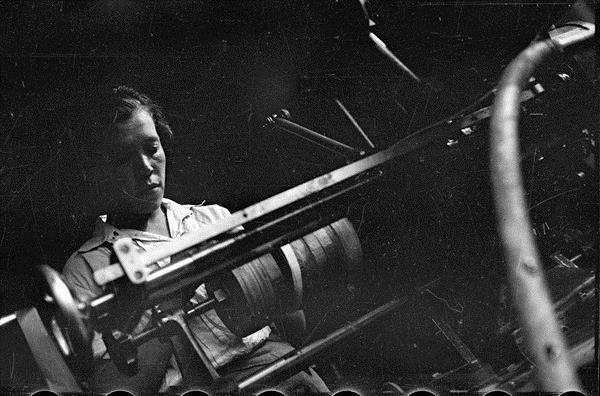
Alexander Rodchenko. «Electrovod. No. 2.» 1929. Alexander Rodchenko. «Electrovod. No. 6.» 1929.
In the photograph «Electrovod. No. 2, ” Rodchenko captures a worker behind machinery. Her face and light-colored clothing stand out against the dark background, while the details of the equipment pass before her figure. A diagonal line of the machine cuts across the frame, directing the viewer’s gaze from the mechanism to the person.
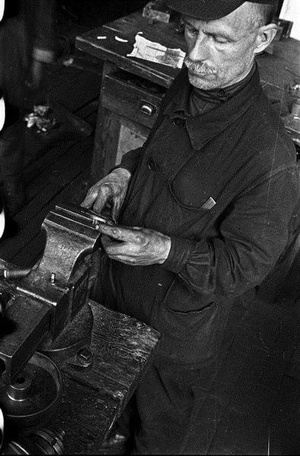
In the shot „Electrovod. No. 6, ” the photographer opts for a high-angle view. From this perspective, the worker’s face, hands, and vise are visible simultaneously. The viewer’s eye is drawn downward—to the detail the person is working on.
Both photographs connect portraiture with the depiction of labor, yet they establish a relationship between the two in different ways. In the first frame, the equipment partially separates the worker from the viewer. In the second, the hands and tools become an essential part of the portrait.
Alexander Rodchenko. «Electrovod. No. 10.» 1929.
In another photograph, Rodchenko captures a factory worker beside a small device at the Electrovzod. Her face and hands are visible in the frame, with the mechanism and tools laid out on the workbench before her. Unlike Ignatovich’s photograph, where a large wheel dominates the foreground, here the viewer’s gaze can transition sequentially from the worker’s face to her hands and the device’s details.
Comparing the photographs shows that the depiction of labor is constructed through the choice of shot size, angle, and object placement. The photographer decides what to bring closer to the viewer: the human, their action, or the machine. Even with a similar subject, these choices alter how we perceive the relationship between labor and technology.
In the next section, the focus will shift to the mechanisms themselves—their details, recurring forms, and the rhythm within the frame.
Machine Rhythm: Geometry and the Composition of Production