INDEX
Introduction
1. Memory and Expectation
2. What Sounds Nearby
3. When Sound Disappears
4. How We Participate in Sound
Conclusion
Sources
Introduction
When a chord returns at a moment when I am already anticipating something else, I hear it differently than the first time. I recognize the familiar sound, and by the fact that it surprises me, I realize that I have already prepared myself for a change. Some time has passed between the first chord and its return. During that time, what I expect from the sound has also changed. Until the chord returned, I might not have even registered it.In this study, I want to understand whether such a shift can be noticed during contemplative listening—I call it contemplative listening because it is when a person notices how the soundscape unfolds and how they themselves participate in it. I call this sense of personal involvement presence; it can arise even when I perceive my own expectation and understand why a familiar sound now sounds different.I am comparing the structure of sound works with what people report about their encounters with them. From the score, one can know how many repetitions will complete the cycle. From the listener’s account—one can understand whether that repetition held meaning for them and what else they managed to hear. When accounts of the same sound diverge, it becomes clear where the description of the work’s structure ends and the experience of the individual begins.
1. Memory and Anticipation
I hear the second chord as a return because I still remember the first. This property of listening itself is clearly visible in a simple example by Bergson. The notes sound one after the other, and the last one is perceived as a continuation of all the preceding ones. The duration of the melody can be measured. To understand why the same note sounds different to a listener in different places in the melody, one must consider what they have already heard by that point. [1]
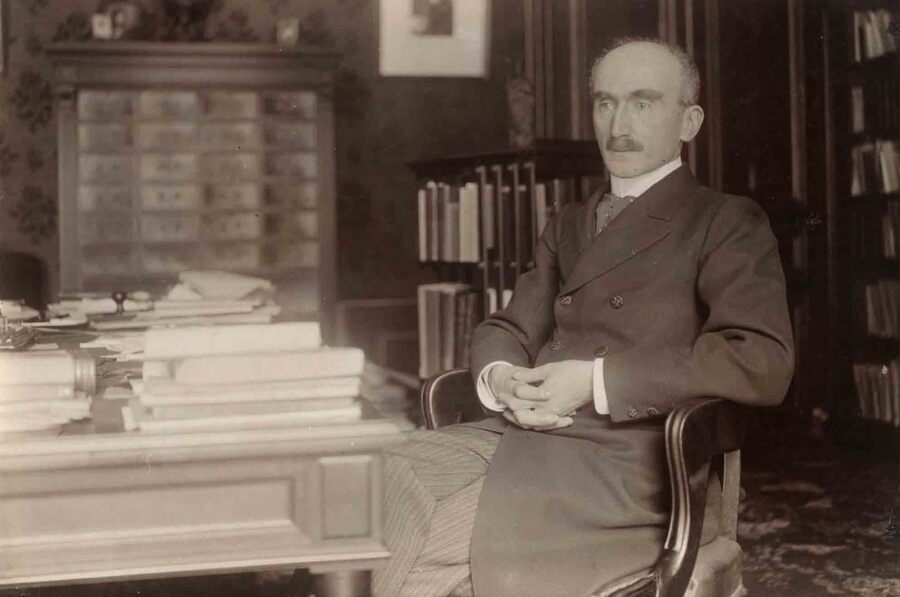
Henri Bergson
With repetition, the relationship between sounds becomes more complex. One can recognize a motif immediately, yet lose track of how many times it has appeared. In such a case, the familiar sound provides me with an anchor, but simply recognizing it makes it difficult to know where I am in the piece or how much time is left. If I expect the motif to end soon, another repetition becomes an event in itself. The chord itself may sound almost exactly as it did before.
One can stop tracking the repetitions for a while and then return to them. The motif is still recognizable, but I am no longer sure how many times it has sounded during that time. This gap allows me to notice that my attention has shifted while the music continued. This return to a chosen object is also highlighted in descriptions of meditation with focused attention. [2] In music, with such a return, I can choose what to track next. I can once again wait for a chord change or try to listen through the chord that I already recognized from the initial sounds.
The Practice of Attentive Listening
Repetition can be structured so that we either recognize a familiar passage or lose confidence in knowing its continuation. For instance, in Triadic Memories (1981), Morton Feldman alters the number of chord repetitions. In his essay, he links this technique to memory disorientation and, when discussing motif work, describes motifs as established forms that can be extended. For the listener, this means the passage may already be quite recognizable, yet the timing of its conclusion remains open. [3]
Portrait of Morton Feldman
On page 23 of the score, you can see how a small sign determines how long we will hear the same group of sounds. Pianist Jean-Luc Fafcham compared two editions. In the 1987 edition, the groups are printed without numbers. In the corrected 1991 edition, they have $\times 5$, $\times 3$, and $\times 7$ above them. On this page, these differences can be seen at a glance. Audibly, they unfold gradually. To understand that another repetition has occurred, you need to wait for it to appear and compare it to what is still in memory. [4]
2. What Sounds Nearby
When a single sound remains familiar for a long time, what is heard nearby can also change. At the premiere of Feldman’s work, Dominic Gill gradually began paying attention to the sounds in the hall. At one point, the water in the downspouts sounded to him like accompaniment to the piece.
I am interested here in the word «accompaniment.» Gill discerned the water and connected it to the music for which he had come. The boundary of what he perceived as part of the piece has now shifted, which is close to Oliveros’s idea that attention to a single sound can coexist with the perceptiveness of the entire surrounding soundscape. [5, 6]
If the water sounds like an interference, I can wait for the piano to cover it again. Hearing it alongside the piano, I can catch the moment when one moves forward and the other recedes. Even a pause in the piece is perceived differently then. While the pianist lets an chord fade, there is still something for me to listen to within the hall itself.
At the same concert, Robert Henderson remarked on the effort required for listening, while Hugo Cole noted that several listeners left early. [5]One might stay in place simply because they want to listen until the end. Then, with every return of a chord, I can recalculate how much time is left. Even if the piece itself remains interesting to me, some of my attention is already dedicated to enduring its duration. Therefore, when I say that long listening allows one to hear more, it is important for me to also remember the effort it demands. The willingness to listen also changes throughout the piece.
Gill describes how, throughout the play, his attention shifted toward what was playing nearby. In Dream House, one can explore the connection to sound through one’s own position. There is a passageway between the hall featuring sustained tones by Lamont Young and the adjacent gallery where Chong Hee Chwe’s work is playing—a space where both pieces can be heard. According to Chwe, even changing position within her space alters how the tones are perceived. A few steps become a method for understanding where and how a person was listening just moments before. [7]
La Monte Young, Marian Zazeela, Jung Hee Choi Dream House, 2023
Pausing in the aisle, you can return to where you were just listening. If the familiar tonal relationship is reestablished in the original spot, it provides a basis to connect the difference to the position in the room. This change can be noticed on the move. To understand how it developed, I would pause briefly. Did one tone become louder, or did the neighboring tone that was overpowering it weaken? If I wait a little longer, I will have something to compare with what I hear next.
The memory of the sound can maintain this connection even beyond the threshold. After about an hour in Dream House, Matt Smith found the street outside to be muffled. Later, he began noticing sounds in the city that resembled those he had heard inside. His account is significant precisely because the comparison continued after leaving. His time in the room was over, yet what he had heard there still influenced how he perceived the street. [8]
3. When Sound Disappears
You can compare two sounds even while staying in place. In Max Neuhaus’s Time Piece Beacon, the tone gradually builds and cuts off at the hour mark. A person might notice that the sound that just vanished is one they haven’t yet had a chance to listen to individually. Feldman provides a reason to compare the sounds with the return of a chord. Here, the impetus arises when the tone concludes. [9]
Max Neuhaus Circumscription Drawing
Imagine I arrive mid-hour, waiting for someone near a museum. Before the cliff edge, I might not even question whether the hum has sounded here for a long time. When it disappears, I notice the difference and try to remember if I’ve heard it on the way to the museum before. The time I would have only registered as waiting for a meeting is now also tied to this resonance. I clearly heard when it stopped. But perhaps it started even before I arrived.
Even such a distinct moment depends on what sounds accompany it. During an organized listening session at the Dia Beacon museum, journalist Rosalia Jovanovic perceived a rising tone, which was eventually drowned out by a train whistle. Another participant noticed how the whistle’s pitch combined with the tone’s pitch. For the same sound, listeners found different places within the auditory experience. The whistle could obstruct hearing the piece, or it could become an integral part of what was meant to be listened to. [10]
Dia Beacon Museum
If I came to hear the moment of the crash, I might decide that I missed the most important part. Another person standing next to me might remember exactly those few seconds when the tone and the horn sounded together. Later, when recalling those minutes, I might only speak about how I stood there waiting. But for them, something else may have already happened in that same time. Even when two people are focused on the same task, their attention can break the time into different moments that are worth remembering.