Navigation
- Concept (Introduction)
- Kant on Genius, Taste, and Spirit
- «Taste Without Genius»: Salon Painting through the Example of William-Adolph Buggler
- «Genius Without Taste»: Later William Turner
- Comparison
- Conclusion
- Bibliography
Concept
Have you ever stood before a painting, unable to understand it, yet unable to bring yourself to walk away? Or perhaps the reverse: looking at a flawless, «perfect» canvas where everything is in its place, but feeling no emotional pull? The first describes the experience of «genius» without «taste.» The second is the experience of «taste» without «genius.» Kant helps explain how this internal response functions and why it is possible at all.
In «Critique of Judgment, ” Kant introduces three concepts that explain how art is constructed.
Spirit—this is the spark, the life of the work. When you look at something and feel, „there is something in it, it is alive”—that is the spirit. It compels the viewer’s thought and feeling to engage, rather than remain passive: the gaze keeps returning to the painting, associations continue to multiply, and you cannot fully articulate what is holding you. Without spirit, everything is correct, but dead: the form is present, but there is no life.
Genius—this is the ability to invent something original. Not following a template, not „like everyone else.“ Genius discovers an image that no one has thought of before and creates it in a way that others feel it. It establishes a new rule, and that rule then becomes a model for those who follow.
Taste—this is the ability to make something beautiful and understandable. It imposes order, eliminating the superfluous. Without taste, even the most brilliant idea devolves into a mess that no one will comprehend; taste makes it communicable—that is, shareable by another viewer.
It would seem that these three qualities are inseparable: a work of art requires life (spirit), rule (genius), and communicability (taste). Yet Kant also writes that in real works, they diverge: «In one, a genius without taste; in another, a taste without genius.» A work can be original but formless; or formally impeccable but failing to establish a new rule. In such a case, the question is not «who is better, ” but what happens to the Kantian concept of art when this theoretical possibility becomes historical fact—that is, when entire movements of painting begin to embody it in practice.
»…if, when these two qualities (taste and genius) collide in a work of art, something must be sacrificed, that sacrifice should rather belong to genius.»
@ Immanuel Kant
Kant created the «Critique of Judgment» in 1790, a time when European painting had not yet experienced the split that would later make this formula historically illustrative. This was the era of Neoclassicism, when art was produced in homage to ancient traditions. This work addresses the first half of the nineteenth century, when the fine arts began taking on a transitional character. Thirty years later, painting precisely reproduces Kant’s antinomy in two opposing camps, each driving one side of it to its extreme.
In the 1640s, French artistic production was still regulated by the medieval guild system, primarily the Parisian guild of painters and sculptors, which operated under the statutes of 1391. Such craft organizations ensured consistent production and trade: they held a monopoly on labor within the city, controlled quality, and protected the rights of their members. The guilds strictly regulated the professional lives of both masters and craftsmen. Painting and sculpture were officially considered a craft, not a liberal art, so their practitioners were subject to guild rules, oversight, and taxation.
«Artisans with Tools» (fragment from the miniature in the dedicatory prologue to Duke Berrier). Unknown master, mid-15th century (c. 1480).
Those perceived as «true artists» considered it degrading to be in the same guild hall as common artisans. They viewed themselves as intellectuals, equal to poets and scholars. However, under Parisian laws, a royal painter creating mythological scenes was legally equated with a painter who painted fences or a furniture carver. The guild master could inspect the workshop at any time—measuring, for instance, the thickness of a board and demanding a rework—and could also demand the payment of the guild tax. This seemed insulting to the masters: how could a semi-literate signboard artisan critique their work? Furthermore, they were prohibited from hiring assistants or taking private commissions in Paris unless the artist had passed the artisanal exam. This is how Nicolas Poussin faced slander from artisans while decorating the Louvre.
During the Fronde, the conflict between artists and craftspeople—who felt they could act with impunity—reached a peak. The victory of royal authority made the establishment of salons and the official recognition of artists possible. Following the Fronde, the ruling family viewed craftspeople as politically unreliable; consequently, artists received full support.
François-Joseph Hémin. Paris Salon, 1824, 1827.
On January 20, 1648 (the official charter was granted on January 27, and it was legally founded on February 1), a group of artists, under the patronage of Regent Anna of Austria and First Minister (Chancellor) Pierre Segois, established the Royal Academy of Painting and Sculpture. The appearance of the Salon was intended to clearly illustrate the distinction between «high art» and common craftsmanship. Other goals were also pursued: artists received scholarships, commissions, and privileges from the monarchs, and such an exhibition served as a report to the ruling elite on the results of their work. The most crucial goal, however, was the glorification of the rulers—and this became the element that steered art toward one, hypertrophied direction.
Between the founding of the academy in 1648 and the flourishing of the academic system that interests us in the 19th century lies a century and a half of institutional evolution: the restoration of the Salon in 1748, the debates over «drawing versus color» in the mid-18th century, David’s reforms on the eve of the revolution, and the subsequent reorganization of academic education under Napoleon. By the 19th century, the French academic system was a mature mechanism with an established hierarchy of genres, a medal system, stipends in Rome, and a rigorous Salon jury. It was this mature system—not its origins from a century and a half ago—that provided the environment where «taste» acquired institutional form and achieved its ultimate expression.
Kant on Genius, Taste, and Spirit
Previously, we identified three forces involved in the creation and perception of art: spirit (life), genius (originality), and taste (form). Now, we need to understand precisely how these elements interact within Kant’s theory. Later, by analyzing the works of J.M.W. Turner and Wilhelm Adolph Bugro, we will apply Kant’s theory to examine what ultimately prevailed in the work, why it occurred, and how this affects perception.
In the «Critique of Judgment, ” Kant describes the process of perceiving the beautiful as the „free play“ of two of our faculties: imagination and understanding.
Imagination provides the material, creating images and associations (this is the work of spirit). It leads to the creation of something new and unconventional.
Understanding is our logic, the ability to order and grasp form (this is the work of taste). It demands order and rules.
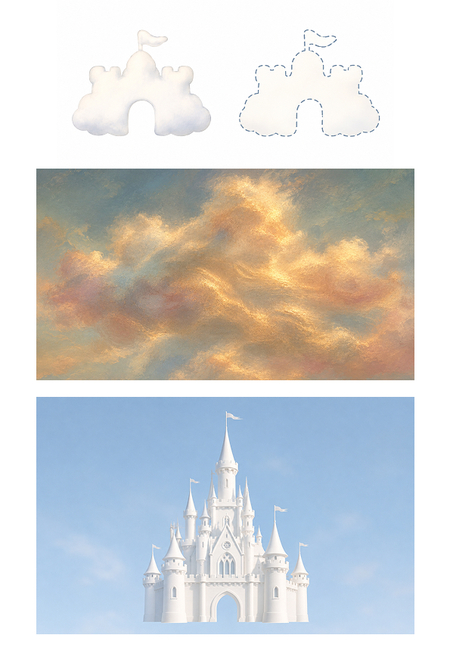
Imagine looking at clouds. Your imagination paints a castle in the cloud. But at the same time, your reason tells you it is just a cloud. In this moment, your abilities are in harmony: imagination is at play, and reason neither interferes with it nor lets it descend into complete chaos. Kant emphasized that true art requires balance. If only imagination functions, the result is an incomprehensible chaos (genius without taste). If only reason functions, the result is a dry schema that moves no one (taste without genius).
The images presented in this block were created with the help of ChatGPT to convey ideas more clearly.
However, this balance is not an arithmetic equality. In $\S 49$, Kant introduces the concept of spirit as the «principle that animates the soul”—that is, the capacity to represent aesthetic ideas.The aesthetic idea is an imaginative representation for which no adequate concept exists. It is the excess of imagination over reason that creates what we perceive as the life of a work: its meaning cannot be entirely captured by what can be formulated. In this sense, spirit is not a third faculty alongside genius and taste; it is the inner life of genius—what distinguishes a truly original work from a mere combination of the known.
William-Adolph Bugro’s salon painting possesses absolute communicability: any contemporary viewer would instantly «read» the subject matter and idealized composition because they were rendered according to strict academic rules. However, it is precisely because of this hypertrophied, «porcelain-like» clarity and the flawless smoothness of his work that they lose the capacity to convey the «inexpressible.» Bugro’s paintings only communicate to the viewer what is already on the surface (impeccable form), but they remain silent about what is hidden within (spirit). This is «dead beauty»: communication exists, but life does not.
«Taste Without Genius»:
Salon Painting Exemplified by William-Adolph Bugro
Why was Wilhelm Adolf Bugro chosen to analyze the «extreme case» of taste without genius in the research? He was not merely a participant in the Paris Salon; he was its embodiment and the chief guardian of academic rules. Every one of his works was perceived as exemplary.
Clarification: Before proceeding with the analysis, it is necessary to make an important disclaimer. The term «taste without genius, ” taken from § 48 of the „Critique of Judgment, ” is used here not as a quality assessment but as a tool for theoretical analysis. The work does not seek to state that Bugro’s works are „bad“ or that he is an „uninspired artist.“ On the contrary, his technical perfection, drawing precision, and excellent command of the smooth style inspire admiration. However, the study’s objective is to attempt to show what happens to a work when one of the Kantian faculties (taste) reaches an absolute peak and begins to supplant another (genius and spirit). In this sense, Wilhelm-Adolf Bugro is an ideal subject for consideration. The work analyzes not his talent, but the structural imbalance described in Kantian theory.
In 1857, he was awarded the prestigious Salon Medal. Starting in 1876, he was an active member of the Academy of Fine Arts, and by 1888, he had become a professor at the Academy of Fine Arts. In 1885, he received the Commandeur’s Cross of the Legion of Honor. That same year, he was granted the Grand Medal of the Salon—the highest recognition the academic system could bestow upon him. In other words, Bugro didn’t just «follow» the rules; he embodied the norms of his time.His work served as a benchmark for students, and his position on juries and within the Academy allowed him to influence which works were even permitted to be exhibited. It is noteworthy that Bugro strongly opposed Impressionism and new movements, using administrative influence to do so. He considered their paintings to be «unfinished sketches» and actively obstructed their display in the Salon. Importantly, Bugro didn’t merely observe the Salon’s operation or its trajectory—he actively shaped and maintained that direction.
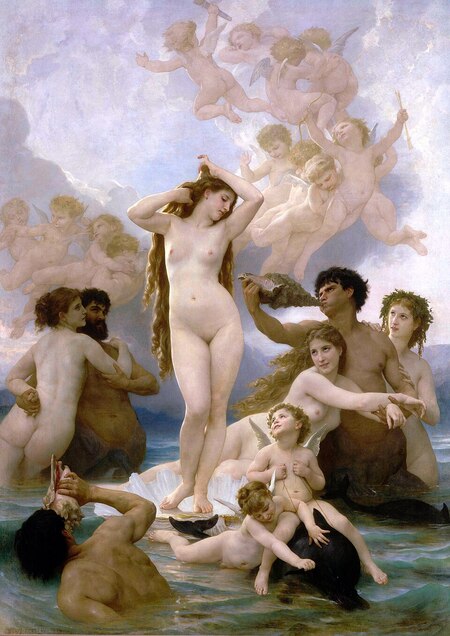
Official recognition was accompanied by commercial success. Buogro was in demand among American millionaires who considered him «the most important French artist of his time» and actively purchased his canvases. Buogro’s paintings were regularly acquired by the state; for example, «The Birth of Venus» (1879) was purchased by the Luxembourg Museum directly from the Salon for 15,000 francs ($\approx$ 43,245,000 euros).
Buogro’s success is a success of communicability in its most straightforward, market-driven sense. His paintings were understandable, pleasing, and desired by a broad audience. However, it is precisely this ease of consumption that raises a concern from Kant’s perspective. A taste that meets no resistance—one that does not require the imagination to work, but merely confirms pre-existing expectations—risks devolving into automatism. Yet, the artist perfected this very automatism.
«The Birth of Venus» by Sandro Botticelli, 1484–1486
Before analyzing William-Adolphe Bouguereau’s «Birth of Venus, ” one should examine the work from which the idea was borrowed—Sandro Botticelli’s „The Birth of Venus“ (1486). In ancient tradition, Venus was typically depicted emerging from the water, often with unbound hair that she was drying. This is a narrative: the action has a beginning and an end. Botticelli approaches this differently: his painting conveys not a birth, but the goddess’s arrival on the coast of Cyprus. Venus is already standing on the scallop shell, but the shell has not yet docked; she is simultaneously here and not here. The artist captures a liminal state where the goddess belongs neither to the sea nor to the land. Furthermore, for Botticelli, the expressiveness of the line is more important than the anatomical correctness of the body. Kenneth Clark wrote of this:„Her body is anatomically implausible, with an elongated neck and torso. Her pose is impossible: although she stands in a classical contrapposto, her weight is shifted too far onto her left leg to sustain that posture.“
It is this very impossibility that creates the free play Kant speaks of: the imagination provides the lines, reason attempts to assemble them into a «body, ” and a complete correspondence does not occur. A surplus remains—precisely what Kant calls the „aesthetic idea”—a material for thought, an inexhaustible concept. Thus, Botticelli combines genius and taste to the extent that Kant’s theory deems ideal: the artist introduces a new rule but remains within rational bounds—we understand what is depicted, yet what we see is not entirely familiar, leaving room for contemplation.
In Botticelli, the distortion is not additive (like in Crivelli), not capricious (like in Parmigianino), and not functionally symbolic (like in El Greco). It is structural. Go Liang (a professor at the Shanghai Academy of Fine Arts) described it this way:
„His goal is to realize the ideal of beauty in painting, and if a form richer in imagination serves the overall aesthetic concept better, he will abandon realism.“
This means that Botticelli’s distortion is subservient to the idea, not the effect. This is why Botticelli’s distortions should be understood as a principle.
«The Birth of Venus» by William-Adolphe Bouguereau, 1879