The Human Body in Sculpture: From the Egyptian Schema and the Greek Kouros to Donatello’s «David»
Navigator
Sections: I. Schema · II. Weight · III. Feeling · IV. Memory
Research Concept
To observe how art evolves, it is easiest to examine what is familiar to everyone. This is the human body—we instinctively understand how a living person stands, so any deviation from this norm—a statue’s stillness, transferring weight onto one leg, a tense or relaxed arm—is immediately noticeable, even without specialized training. In Greek sculpture from the 6th to 4th centuries BCE, the journey from a static schema to a figure that stands, moves, and feels took approximately two centuries, and this progression forms the bedrock of the entire European tradition right up to the Renaissance. This theme allows us to focus specifically on the works, rather than on myths or biographies: to understand these statues, one only needs to know what they depict and the purpose for which they were created.
The study includes eight sculptures, each representing a new stage in the depiction of the body. I selected not just sculptures that can be viewed from all angles, excluding vase painting, small-scale plastic arts, and other applied arts. The criteria were: the work must be pivotal, directly comparable to its neighbors in the sequence, and there must be reliable information about it—specifically, the museum provenance and date. An important caveat: most Greek originals (particularly bronze works) are lost, so figures like the Discobolus, Doryphoros, Aphrodite of Knidos, and the Wounded Gallic are known through Roman marble copies. I do not obscure this limitation; rather, I incorporate it into the narrative: we view Greek ideas through the eyes of the Romans. For contrast, an Egyptian statuette of Menkaure and his queen (circa 2490–2472 BCE) is placed at the beginning of the sequence, and Donatello’s David (15th century) concludes it, illustrating how the Renaissance returned to the antique nude.
The research is divided into four sections, each corresponding to an «instrument» through which the sculptor masters the body: «Schema» (the initial formula of the figure), «Weight» (balance and movement), «Feeling» (softness and pain), and «Memory» (the revival of the antique ideal in the 15th century). The sections follow chronological order but are unified not by dates, but by a central problem: within each piece, the works are juxtaposed against each other so that the change is visible through comparison, rather than merely being described with words.
The texts were selected across three levels. The first involved broad treatises on art history, which set the general framework. The second comprised specialized works on Ancient Greek art, which analyzed the artistic method and the stages of sculptural development.
I. Scheme: Body as Formula
Both the Egyptian couple and the Greek Kouros depict the body not as the eye sees it, but as it should remain eternally: straight, symmetrical, ready to step—yet not taking the step.
1. «Menkaure and the Queen.» Egypt, Old Kingdom, 4th Dynasty, circa 2490–2472 BCE. Grauwacke, height 142 cm. Museum of Fine Arts, Boston.
The left leg of both figures is extended forward, but the weight remains balanced on both legs—the statue appears to be «striding» without actually moving. Both face directly ahead, with a shared base plate behind them. The only gesture of connection is the queen’s arm embracing her spouse. The bodies are youthful and idealized: the eternal formula is more important than resemblance to a living person. The sculpture is unfinished, but the concept is clearly discernible. The queen’s identity is not precisely established.
2. «Kuros from Anavissos.» Attic, circa 530 BCE. Paros marble, height approx. 1.94 m. National Archaeological Museum, Athens
The Greek master takes the same schema—frontality, left leg forward, arms at the sides—but cuts the figure entirely from the block: there is no base plate, and the statue can be walked around in a circle. The muscles, knees, and ribs are worked out in detail, and the face bears the «archaic smile.» Yet, the body remains symmetrical: the weight is distributed evenly on both legs, and the smile is not connected to any specific state. The statue stood above the grave of a young man named Croesus; many scholars view it not as a portrait, but as an embodiment of idealized youth.
II. Weight: The body finds equilibrium
The next step is the most crucial. The sculpture stops building the figure along the axis of symmetry: weight shifts onto one leg, and consequently, the entire body restructures itself.
3. On the left, «The Boy of Kritios» («Youth Statue»). Athens, circa 480 BCE. Paros marble. Acropolis Museum, Athens. On the right, «Kouros from Anavyssos» (full figure).
The statue, «Kritios Boy,» was discovered among the ruins left after the sacking of the Acropolis by the Persians in 480 BCE. The main discovery is the pose: weight is shifted onto one leg while the other is slightly relaxed, and the pelvis and shoulders are tilted in opposite directions, with the head slightly turned. The youth stands in a manner never seen before in figures representing living humans. This stance is called contrapposto (Italian for «counterweight»); it is believed to be the first known ancient statue employing this technique. The title is conventional, as it relates to the resemblance to the works of the sculptor Kritios, but authorship has not been proven.
4. «Discobolus» by Myron. Original — bronze, circa 460–450 BCE (lost). Roman marble copy, circa 140 CE («Discobolus Lancelotti»), height 156 cm. National Museum of Rome, Palazzo Massimo alle Terme
If Kritios is a boy, then the Discobolus is at work: the body is twisted like a spring in the pause before the throw. The statue was primarily designed for a frontal view, and the movement is frozen like a single frame. The face remains calm in this moment: harmony, not exertion, is what matters to the sculptor. We must remember that this is a Roman copy; the original is lost, and the details vary among the copies.
5. «Doriphoros» (Spear Bearer) by Polycleitus. Original — bronze, c. 450–440 BCE (lost). Roman marble copy from Pompeii, height 212 cm. National Archaeological Museum, Naples
Polykleitos transforms the discovered contrapposto into a system. According to ancient authors, Polykleitos laid out the rules of ideal proportions in his treatise, the «Canon, ” and the statue itself was also called the „Canon.“ This is a model of the ideal, not the portrait, body: individual features are not important here; the muscles are organized into a clear schematic. The copy we see is Roman.
III. Sensation: the body begins to experience
Once pose and proportion are mastered, sculpture achieves what was previously almost impossible—a state. The body can be relaxed, shy, or wounded.
6. Praxiteles' «Aphrodite of Knidos.» Original—marble, c. 350 BCE (lost). Roman copy—the so-called «Venus Colonna.» Vatican Museums (Pius Clementine Museum).
The original stood in a sanctuary on Cnidus like a cult statue. In Greek sculpture, it was usually a man shown nude before her; Praxiteles depicts the female body without clothes—and without the rigor of Polykleitos. With one hand, the goddess covers herself; with the other, she holds fabric draped over a water vessel. The pose is gentle, the body line curving smoothly. The body is built not from strength and proportion, but from curve and softness. The «Venus de' Medici» is considered one of the most accurate copies, but it is Roman, not Greek.
7. «The Dying Gaul.» Roman marble copy (1st–2nd centuries CE) of a lost bronze, believed to have been created around 230–220 BCE for Attalus I, King of Pergamon. Marble, 93 × 186 × 89 cm. Capitoline Museums, Rome
The wounded warrior is semi-seated on a shield, leaning on his arm; nearby are weapons and a horn. His head is bowed, his face contorted by pain, and his body is being held up by the last of his strength to prevent a fall. This is a stark turn from the serene faces of the 5th century: the sculptor does not hide suffering yet depicts the defeated enemy with respect—the warrior wears a torque, a characteristic Celtic adornment, and the figure is rendered in detail, devoid of caricature. The body here is no longer a formula or an ideal; it is growing weaker and sagging under its own weight.
IV. Memory: The Body Returns
After a long hiatus, the ancient system returns: a 15th-century Florentine sculptor once again sets a nude figure upright.
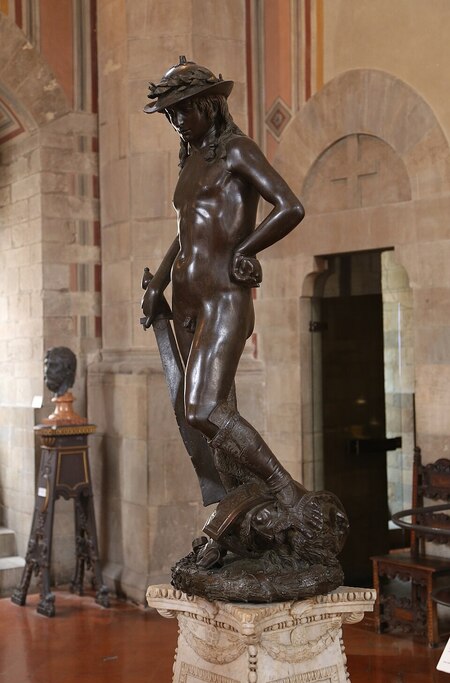
8. Donatello. David. Florence, c. 1440 (dating is disputed: from the 1430s to the 1460s). Bronze, 158 cm high. Bargello National Museum, Florence.
It is considered the first free-standing nude statue since antiquity. The pose is recognizable: weight on one leg, hip thrust forward, head inclined. However, the youth does not replicate the Doryphoros: the body of a teenager—slender and not yet fully formed—the face is pensive, and the attire consists only of a hat with a wreath and boots, while one leg rests upon the severed head of Goliath. The ancient system (contrapposto) connects here with the Renaissance’s new interest in the living, imperfect body. The biblical narrative—the youth’s victory over the giant—is significant only as a pretext for such a figure.
Conclusion