Concept: A vertical Constructivist photo-collage rendered in a restricted palette reminiscent of rotogravure printing (deep sepia-black, the hue of aged coated paper, with a single accent element in scarlet or cobalt). The foundation is a dynamic diagonal: the low-angle perspective of the Dneprostroy metal truss (M. Alpert) intersects with the open white dome of a parachute from Number 12 (A. Rodchenko, V. Stepanova) dating from 1935, while a rhythmic «slice» of newspaper mesh runs along the edge. The absence of typography underscores the work’s central idea: in «The USSR Under Construction, ” the image itself became the language.
Rubricator:
1. Export Showcase in Rotogravure: The Birth of a New Type of Photojournalism
2. The Page as a Cinema Screen: Photo-Montage, Angle, and the Rhythm of a Spread
3. The Paper Theater: Flaps, Folds, Die-cuts, and Tactile Dramaturgy
4. Between Fact and Myth: Documentation, Retouching, and the Aesthetics of Industry
5. Soviet Photomodernism on the World Stage: Dialogue and Echoes in 1930s Press
Rationale for Topic Selection.The monthly illustrated magazine «USSR at Work» (1930–1941, 1949), conceived through the initiative of Maxim Gorky as the primary export publication of the Soviet Union in Russian, English, German, French (and Spanish starting in 1938), occupies a unique position in the history of global graphic design and photography. In the 1930s, as Soviet avant-garde was gradually being displaced from easel art and architecture under the pressure of the Socialist Realism doctrine, print media became the last space for radical visual experimentation. Studying this phenomenon allows us to trace how photography ceased to be a passive illustration for text and transformed into an autonomous architectural and cinematic tool for constructing the printed spread.
Material Selection Principle.The temporal scope of the research covers the first decade of the journal’s existence (1930–1939), aligning with the chronological framework of the course and reflecting the complete cycle of the publication’s evolution: from early constructivist asceticism to the monumental grandeur of the «grand style.» The selection of visual material was not based on the monograph of a single author, but rather on comparing the work of various artistic teams—from the journal’s chief artist, Nikolai Troshin, to invited avant-garde masters such as El Lissitzky, Alexander Rodchenko, Varvara Stepanova, Solomon Tenglater, and photojournalists Arkady Shaykhet, Max Alpert, Boris Ignatovich, Georgy Petrusov, and Mark Markov-Grinberg. To avoid localized insularity, the sample also includes key international analogues and successors from the 1920s–1940s: Germany’s Berliner Illustrirte Zeitung and Arbeiter-Illustrierte-Zeitung (AIZ), France’s Vu, the US publications Fortune and Life, as well as the Japanese journal FRONT.
The main hypothesis (idea) of the visual research.
The visual revolution in «USSR on the Construction Site» lay in the radical rethinking of the journal’s nature: it ceased to function as a collection of illustrated articles and transformed into a totally directed photo-film and a spatial art object. The combination of reportage photography with Constructivist photomontage, deep rotogravure printing, and complex paper engineering (flaps, folding panoramas, tactile inserts) allowed this ideological chronicle of industrialization to become a universal international language of visual design, which directly influenced the establishment of global photojournalism in the 20th century.
Material Structuring Principle (Rubrics)
Instead of a linear, chronological recounting of issues, the work is organized into five problem-analytical blocks. The first section unveils the magazine’s media and print foundation—format, circulation, and the technology of rotogravure. The second is dedicated to the plastic language of the spread, where photography submits to the laws of film editing and «new typography.» The third explores the materiality of the publication—the projection of the image into the third dimension through printing tricks. The fourth analyzes the contradiction between documentary capture and ideological myth-making (up to the transition to Socialist Realism). The fifth section places «USSR on Construction» within the international media context, comparing its techniques with Western and Asian illustrated press.
Principles for Selecting and Analyzing Textual Sources.
The source base integrates three levels of analysis. First, there are primary documents from the era—programmatic texts and memoirs from the creators of the visual language (A. Rodchenko, El Lissitzky, Ya. Tschichold). Second, there are foundational works by domestic and international historians of photography and books (A. Lavrentiev, M. Karasik, V. Levashov, M. Tupitsyna, S. Khan-Magomedov, V. Margolin), which allow for the assessment of Constructivist layouts within the context of design theory. Third, there are contemporary interdisciplinary studies on media propaganda and the transfer of visual technologies (L. Dickerman, A. Germer), necessary for critically examining the role of the magazine on the international stage.
N. Troshin (design). Cover of the magazine «USSR on Construction, ” No. 9 („The XIII Year of the Revolution“), 1930. From its first issue, the magazine established a monumental format (approximately 42 × 30 cm)—closer to an exhibition album than to mass-market press.
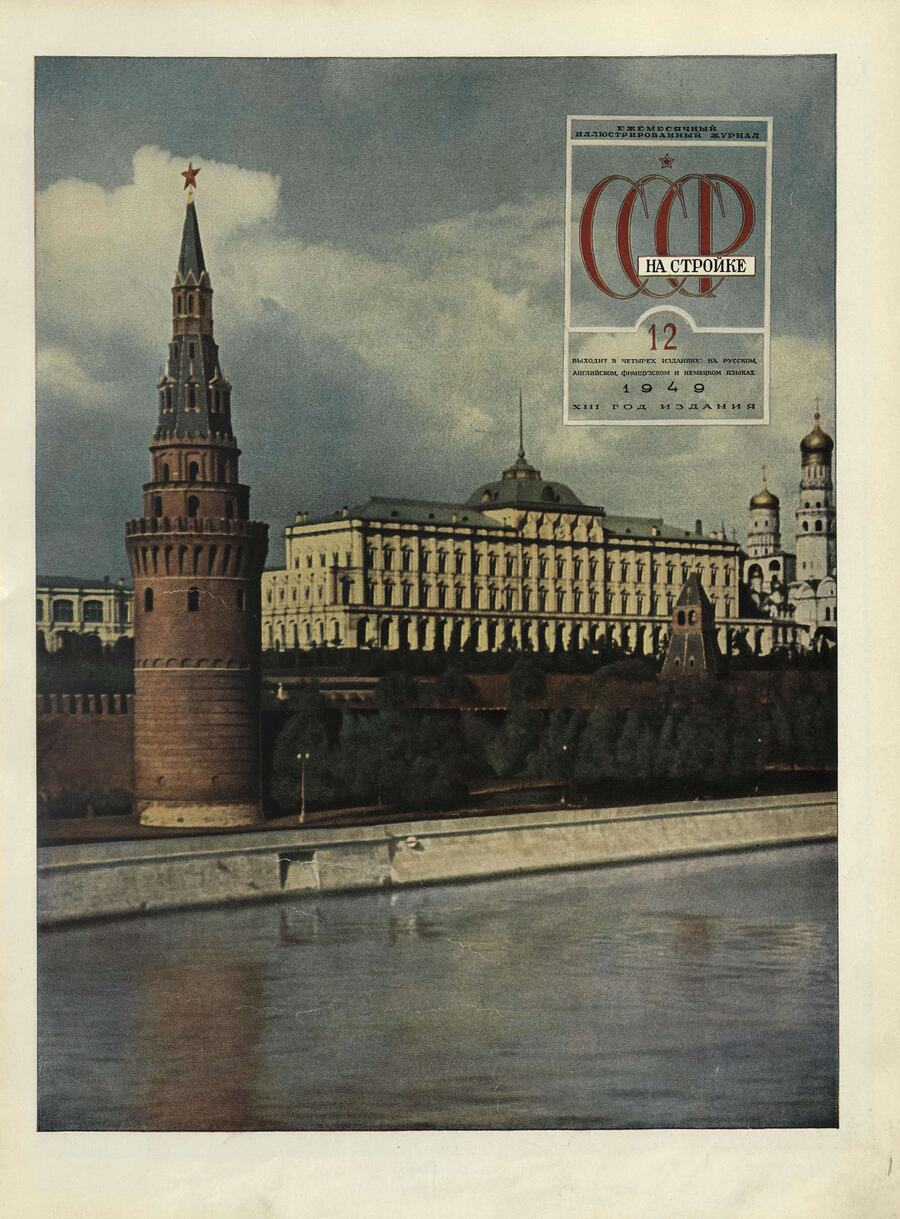
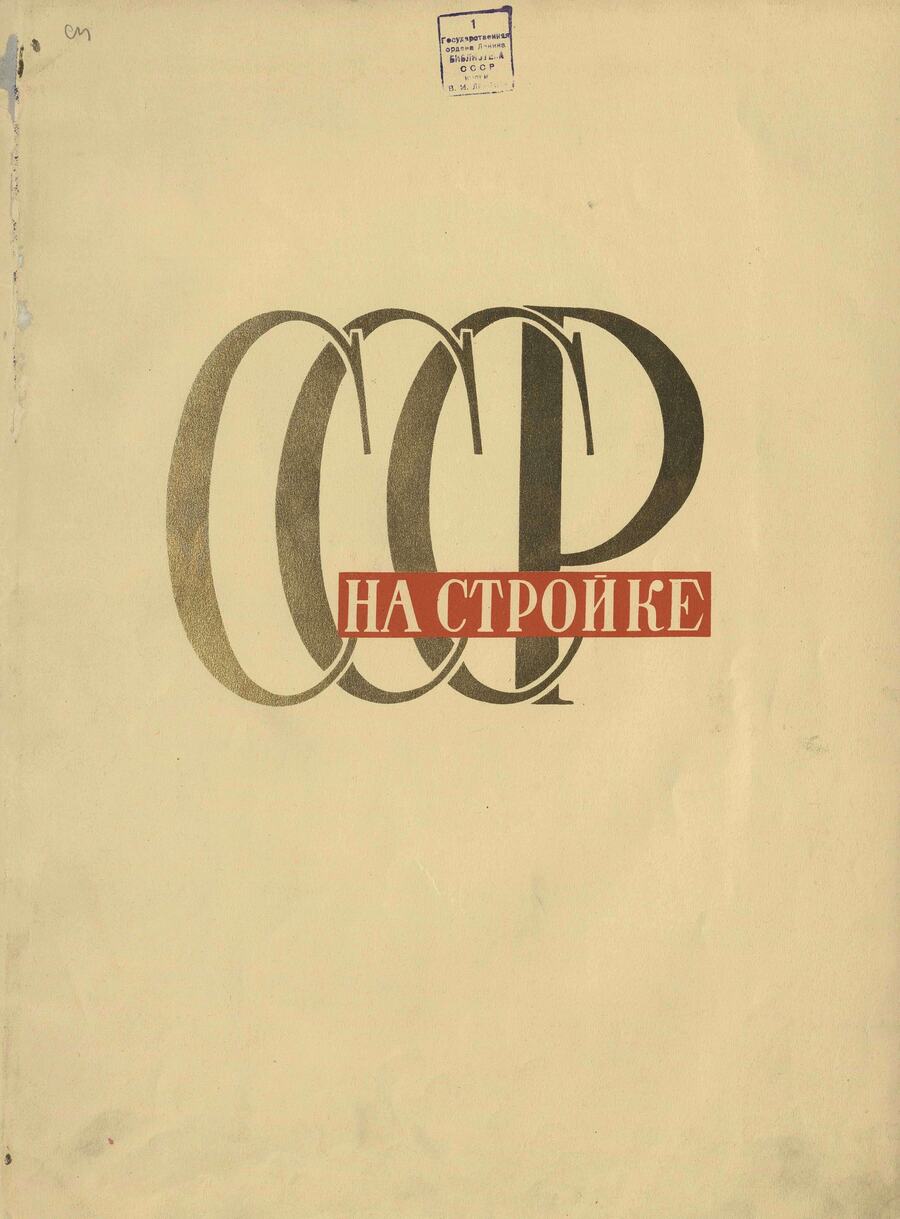
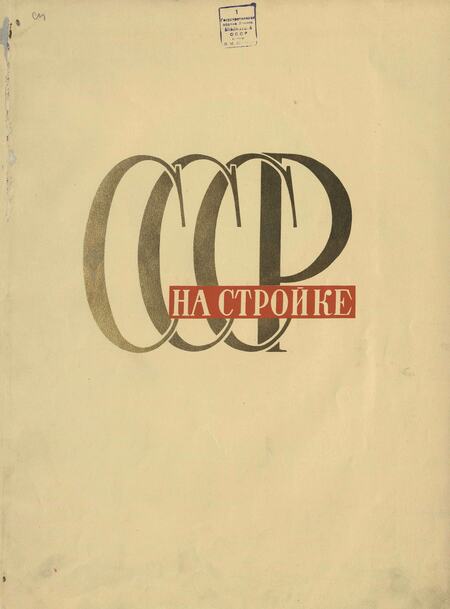
N. Troshin (design). Cover/title page of the magazine «USSR on the Construction Site, ” 1930s. (Specify year and issue number if it is a specific edition).
Extreme graphic minimalism: a cropped „USSR“ logo along the top edge and a bright red banner reading „ON THE CONSTRUCTION SITE“ leave almost the entire page blank.
Strip: «Ivanovo-Voznesensk Textile Worker at Work.» Journal «USSR on Construction,» No. 2, 1930. In early issues from 1930–1931, the inertia of the classical magazine layout is still noticeable: the photograph is placed in a rigid rectangular frame with wide margins and accompanied by a concise caption.
N. Troshin (layout). Cover of the double issue of the magazine «USSR at the Construction Site,» No. 5–6 («The XIII Year of the Revolution»), 1930. Introducing the thematic principle («one issue—one construction site, republic, or event») radically distinguished the magazine from weekly publications like «Ogonyok.»
M. Alpert, A. Shaiket, S. Tules. Frame from the photo essay «24 Hours in the Life of the Filippov Family» (for the magazine Arbeiter-Illustrierte-Zeitung), 1931.
Although the famous series was created for Arbeiter-Illustrierte-Zeitung, it helped shape the very methodology of the Soviet photo essay, which was later adopted by USSR in Construction: the personal story of a worker becomes a microcosm of state transformation.
Cover of the journal «USSR on Construction, ” No. 1 (January), 1932. The massive format of the spread transforms industrial architecture into pure avant-garde graphic design.
Spread, «House of State Industry» (pages 22–23). USSR on Construction magazine, early 1930s. This is a classic example of architectural photojournalism, where the spread functions as a unified panoramic screen: the top daytime shot and the bottom nighttime frame with illuminated windows flow seamlessly across the spine, underscoring the gigantic scale of the constructivist complex.
El Lissitzky (design). Cover and title page of the photo album «USSR Builds Socialism» (IZOGIZ, Moscow), 1933. El Lissitzky’s arrival in 1932 shifted Soviet photo publications—both the magazine «USSR on Construction» and the accompanying photo albums published in IZOGIZ—from a phase of quality photojournalism to a phase of visual revolution.
El Lissitzky (design). Cover of the magazine «USSR in Construction,» Issue No. 2 («15 Years of the Red Army,» 16th Year of the Revolution), 1933. The bold Constructivist close-up transforms a fragment of a Red Army greatcoat into a powerful geometric form: a sharp diagonal of the hem and the vertical of the rifle on the left cut through the sheet, setting an impression of relentless movement.
Credit: El Lissitzky (design). Cover of the magazine «USSR on the Construction Site, ” No. 9 („Soviet Arctic, ” 16th Year of the Revolution), 1933. The „cinematic eye“ principle is already at work on this cover: a sharp low angle and a dense grid of ship rigging create a feeling of dynamic energy and presence on the icebreaker’s deck.
A. Rodchenko. Series of photographs from the construction of the White Sea–Baltic Canal (materials for the issue «USSR at Work,» No. 12), 1933.
Rodchenko functions here simultaneously as a photographer and a designer. His signature «Rodchenko angles» (shooting sharply from top-down and bottom-up) break the conventional horizon, transforming the construction pit and the giant sluice gates into abstract geometric
A. Rodchenko (design). Cover/spread from the issue «Belomorsk-Baltic Canal named after Comrade Stalin, ” „The USSR at Work, ” No. 12, 1933. Etching the background (photomontage element) liberates the figure from the confines of the rectangular frame, transforming the image into a constructive element of photomontage.
Collaboration with the masters of the «Oktyabr» group brought the journal a cult of the diagonal and fragmentation. Cropping the frame at the edge creates the effect of unfinished action—the industry continues moving beyond the paper.
Spread titled «We Have Soviet Aluminum!» from the magazine «USSR on Construction, ” 1932. Collaboration with the masters of the „October“ group introduced the cult of the diagonal and fragmentation into the magazine.
Credit: El Lissitzky (design). Spread «Expedition to Bolshevik Island (Severnaya Zemlya), ” „The USSR Under Construction, ” No. 9, 1933.
Deep intaglio printing allows for the rendering of the leaden Arctic sky and the mirrored reflections on the ice without losing detail in the shadows.
El Lissitzky, S. Lisitskaya-Cuppers (design). Cover of the journal «USSR on Construction,» No. 10, 1934.
An example of the ideal fusion of photography and typography: the slogan «Hello to the Heroes of the Arctic» is not placed in a separate headline, but is literally woven into the silhouettes of three airplanes arranged along a dynamic Constructivist diagonal.
Cover of the magazine «USSR on Construction, ” No. 11 („The 19th Year of the Revolution“), 1935. Even in an issue built entirely on photography, the cover could radically eschew the image in favor of purely monumental typography.
Cover of the magazine «USSR on Construction,» Issue No. 6 («The 18th Year of Revolution»), 1935. Rigid serial modularity allowed the magazine to retain instant recognizability despite changes in topics and artists.
Cover of the journal «USSR at Work,» No. 9 («The Nineteen Years of the Revolution,» September), 1936. Commentary: In the second half of the 1930s, constructivist asceticism increasingly merged with decorative and national codes.
El Lissitzky (design). Cover of the magazine «USSR in Construction, ” No. 10 („Dniprostroi, ” 15th year of the revolution), 1932. A night photograph of a dam illuminated by searchlights organically dissolves into the deep black background of the cover, which is rendered in rotogravure printing.
A. Rodchenko, V. Stepanova (design). Cover of the magazine «USSR in Construction,» No. 12 («Brave Soviet Paratroopers, ” December), 1935. One of the most expressive examples of working with scale and „air“: the deep blue-gray background occupies almost the entire cover, reading as endless sky.
A. Rodchenko, V. Stepanova (design). Cover of the magazine «USSR on Construction, ” No. 12 („Brave Soviet Paratroopers, ” December), 1935. This is one of the most expressive examples of working with scale and „air“: almost the entire cover area is taken up by a deep blue-gray background that reads as endless sky.
El Lissitzky (design). Cover of the magazine «USSR in Construction,» No. 9 («Soviet Arctic»), 1933.
The sharp, constructivist perspective from below transforms the pipes and the ship’s mast into a monumental monument to technological progress.