Research Concept
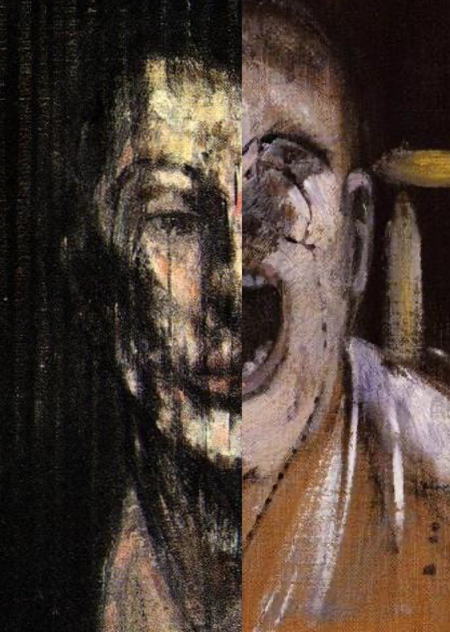
Francis Bacon—a self-taught artist with no formal education or experience, and an Irish modernist expressionist. His paintings are shocking, not only for their painterly technique but also for their subject matter. In this study, I aim to focus on the portrait, which constitutes a large portion of Bacon’s work and, in my opinion, most vividly reflects one of the unique characteristics of his art. This artist shocked London critics and audiences with his triptych reinterpreting the Crucifixion and portraits of Roman Popes at his very first exhibition. One particularly unsettling detail in Francis’s paintings is the scream—the depiction of a frozen face, like a mask. I want to analyze not just how the artist portrays a face at an emotional peak, but also his attempt to convey movement and the sensation of change. I believe the feeling his paintings evoke is the most extraordinary element of his artistic journey. The research structure is divided into several parts: first, a discussion of the human body—how the flesh or meat on the canvases becomes an expressive medium, transcending the familiar image; how the deformation of the body becomes a material for emotional expression for the artist. Following that are works where the human face transforms so much that it seems to gradually move beyond the biological, deforming across time: the heads in the portraits appear frozen mid-motion. The final part of the study will examine the scream as a counterpoint to all the other portraits in Bacon’s oeuvre—as a reinterpretation of the two preceding approaches—addressing the role of cinema and whether the artist succeeded in depicting emotion «in action,» in motion. This constitutes the hypothesis of my research. Material Selection: For this study, I used official galleries featuring Francis Bacon’s works and categorized them into three groups: 1) portraits with pronounced facial and proportional deformation, which includes the series of self-portrait studies and the self-portrait itself; 2) images of people with blurring and facial alterations, and portrait triptychs; and 3) studies and paintings depicting Popes, works featuring strong emotion and the scream.
Navigation:
- Bacon’s Portraiture and Facial Deformation.
- Changing Faces and Capturing Movement
- The Scream in Francis Bacon’s Paintings: Framing and Frozen Emotion
- Crucifixions and the Rejection of the Human Body
- Conclusion
1. Bacon’s Portraiture and Facial Distortion.
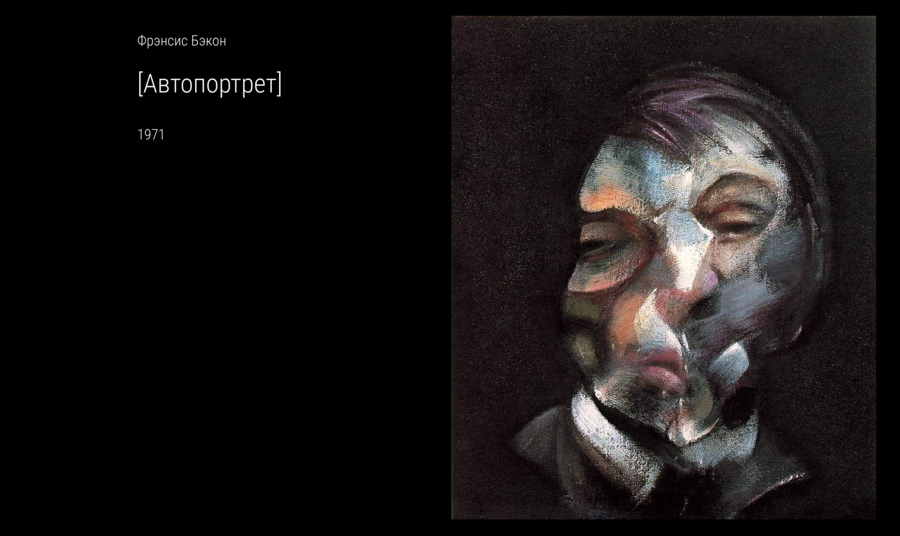
Historically, the portrait has always held significant meaning in human culture, particularly in secular life. For monarchs, it symbolized power and contribution to the nation’s history; for the aristocracy, it served as a tool for flattery, an expensive gift, and a means of asserting oneself at court. One might recall the story of Anne Clifford at the court of Henry VIII, where one of her portraits elevated her to the status of a fiancée, only for him to strip her of her royal title when it was discovered the portrait was heavily embellished. In general, people throughout history have regarded the depiction of the human face with considerable reverence and a degree of superstition. In the Modern era, the human figure itself—the body, the interpretation of emotions, and societal norms—began to undergo deconstruction and reinterpretation. However, amidst the Impressionists, Futurists, and other artists, I became particularly interested in the role of Francis Bacon because he never completely abandoned the depiction of the human face, nor did he present it in the form of symbols, signs, or allegorical images. He formally preserves the format of the classical portrait against a neutral background, where the face and emotion remain the central theme of the work.
The painterly quality of the portraits and mixed media techniques amplify the impact of Bacon’s works, making them more visceral while also intensifying the focus on the physical alterations of the facial anatomy—sometimes emphasizing «excess» parts, and other times creating a uniform, yet distinctly human-like composition. In some pieces, the alterations are partial; in others, it is not so much deformation as the play of light and shadow, where the background cuts into the face, sectioning it. The color of the head also imbues the paintings with emotion: Bacon predominantly employs a bright and high-contrast palette, most frequently featuring red, sky blue, and purple. The colors themselves contribute to the distortion: sometimes they settle as patches, sharp shadows, or highlights; other times, they are almost monotonous. They either blend into a homogenous mass or break down into sharp, textural brushstrokes, endowing Francis’s portraits with that recognizable style and an aura of enigma—even a sense of the uncanny valley.
Speaking of emotions and portraits, one must recall facial expressions, but on «deformed» faces, there are no distinct emotional expressions in themselves: most often, they are not even looking at the viewer; all attention is focused more on interpreting the shape of the head, shoulders, and other body parts. This creates an interesting effect where the sensuality of the portrait is conveyed through all means of expression except for facial expression. In this case, the very concept of «facial expression» takes on a new meaning—it becomes more akin to the image of the face, since the entire body and all its states and forms are used for emotional expression. Sensuality spreads through bursts of color, the texture of the paint, and new formations that also convey the character of the person. These formations might be aggressively swollen or, conversely, stretched, twisted, and smooth, dividing the face into sections or mingling together.
2. Moving Figures and Capturing Motion
«Three Studies of Isaac,» Francis Bacon, 1966
Bacon retains anatomical proportions just enough so that the viewer can associate the painting with a human face, but the emotions and colors on it become distorted, transforming into living flesh. Bacon’s portraits carry a unique, unsettling sense of the «uncanny valley,» if that term can even apply. The depicted figures, due to the vivid, «tactile» rendering, read as something alive, yet increasingly less like a human. This is especially evident in Bacon’s triptych portraits: the person seems to be losing their form, blurring, and acquiring new layers of skin. One of the rendering techniques Bacon uses to achieve this effect is the superposition of forms—overlaying forms onto each other, blurring, and employing bright, contrasting strokes and patches. The portraits of Isabel appear to be captured in motion; the overlapping lines create a trajectory for the head, hair, and lips.
The uneven brushstrokes seem to reflect the direction of facial change, the migration of these skin growths, and anticipate the human’s transformation into a new, grotesque entity. Therefore, in the context of «fixing movement» in the portraits of Francis Bacon, I imply not only physical actions—such as turning the head or rolling the eyes, which are also visible in his canvases—but also the transformation of the human into something new. It is particularly interesting to examine the studies presented in triptychs in this regard: placed side-by-side, the images of the same person never perfectly replicate the previous one, yet they maintain common traits across all three paintings, preserving a subtle line for facial recognizability. Consequently, even with different interpretations, the viewer can identify a specific person among Bacon’s works. Thus, the triptychs appear to show the process of a person transitioning from one state to another, much like a change in the state of matter of water—the plasticity and form change, akin to stop-motion animation. Faces may blur, contract or expand, twist, and move, even though the paintings themselves remain static.
Thus, Bacon’s paintings present several motifs. The first is a blurred, layered image where it is difficult to discern any specific features; the movement seems to envelop the entire body, altering it under its pressure. A solitary portrait is reminiscent of a photograph taken during a fast sprint, where the image blurs. The second type, on the other hand, resembles an animation storyboard, showing stages of an unknown transformation. These are clearer and more concrete, surprising not only with their silhouettes but also with the process itself, forming a sequence and a pattern.
«Sketch for Three Heads,» Francis Bacon, 1962
3. Screams in Bacon’s Paintings