Concept
The topic for my research was not chosen arbitrarily—the reason I felt it was the right fit is that in the current era, there are numerous environmental issues that often lack sufficient public awareness and promotion.Threats to the environment are often difficult to perceive directly: animal species disappear slowly and gradually, climate change does not happen quickly, and the consequences of pollution and widespread fires remain outside the daily lives of every individual. The role of advertising in this field is to transform complex and subtle processes into visuals that everyone can quickly grasp and understand. Therefore, I am interested not only in the problems addressed by the WWF, but also in how their advertising is structured and the methods of visualization—posters, their approach to condensing a large volume of information and meaning into a single image—and how they function effectively without providing detailed explanations.
A key question of this research is: what visual techniques does the WWF employ to make environmental threats tangible to the viewer, allowing them to relate those threats to themselves and their lives? My hypothesis is that the disruption of familiar and recognizable images of nature and the surrounding world engages people and compels them to pay attention and reflect on the issue. The viewer does not simply see a threat—one they likely already suspect and have heard about at some point—but instead connects it to themselves. The advertising personalizes the danger, prompting the individual to uncover the metaphor within the image themselves.The foundation of this research lies in WWF advertising imagery published between 2000 and 2020. I selected these pieces based on the principle that the visual metaphor serves as the primary meaning, and the material will then be organized according to methods of impact.The textual sources are selected primarily based on the rhetoric of imagery and metaphor in advertising, and also include literature on psychological typologies and other techniques directed toward the audience.
Using psychographic typology, I will examine how different visual solutions in WWF advertising appeal to consumer needs and values: some posters target a sense of anxiety and a desire for security in the current world, while others appeal to personal responsibility, or perhaps evoke a desire to understand a complex issue. I believe that a single environmental problem can be presented in vastly different ways, depending in part on the audience’s psychological motivations. This analysis will allow us to examine the situation not just as images within pictures, but as a means of engaging the viewer.
Navigation
The Metaphor of Absence: How to Represent Nothingness? 1.1. Population by Pixel 1.2. Search Engine 1.3. Gorillas / Tigers / Penguins 1.4. Comparing Images of Emptiness
The Metaphor of Transformation and How Nature Changes Form 2.1. Lungs 2.2. Tree 2.3. We Are One 2.4. Metaphors of Transformation: Comparisons and Conclusions
Juxtaposition 3.1. Horrifying. More horrifying. 3.2 Noughts and Crosses
Conclusion
Metaphor of Absence: How to Show What Isn’t There?
Population by Pixel (2008)
The disappearance of animals is a long, subtle process for many ordinary people. How can one convey that emptiness and sense of loss through just a few images?WWF shows us a series of posters where the quality deteriorates with each picture—the image becomes less defined as the number of pixels decreases, until the animal is unrecognizable. Here, pixels correspond to the population size of that species; consequently, the fewer individuals there are, the more abstract the animal becomes.
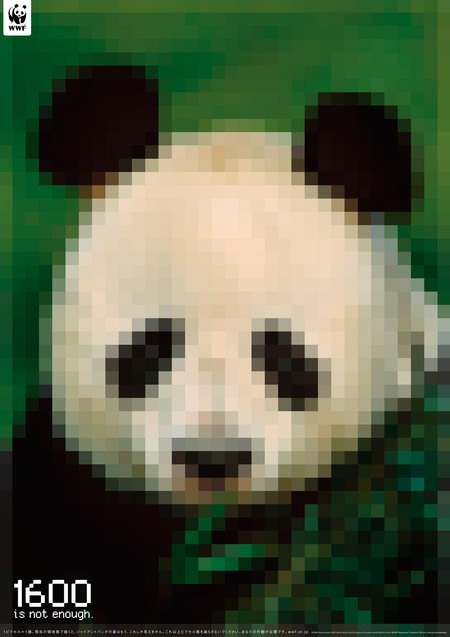
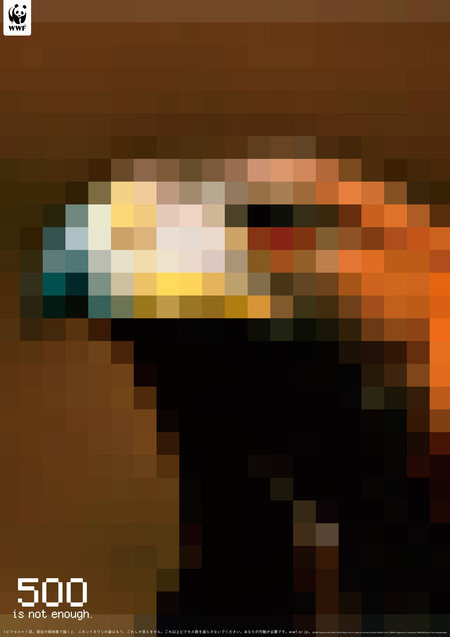
Advertising posters, 2008. One Show. Population by pixel. Agency: HAKUHODO C&D/Tokyo Client: WWF Japan

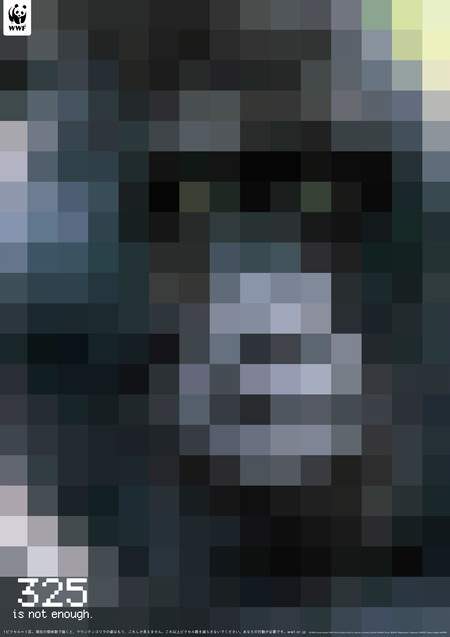
Advertising Posters, 2008, One Show, Population by Pixel Agency: HAKUHODO C&D/Tokyo Client: WWF Japan
In the lower corner of the images, there is also small text that reads «325 is not enough.» This serves as a metaphor, suggesting that 325 pixels are insufficient to recognize the animal in the picture—implying that 325 represents a very small population, which is not enough for the species to survive.
Initially, the viewer feels curiosity about why the image is so blurry. However, after reading the text and the number, that interest shifts to anxiety. 325—that is indeed not enough, and the person understands that.The advertisement captivates through the independent discovery of meaning; no one states the problem directly, names solutions or necessary actions, but only displays a number and a very blurred image. I believe that, following E. Gromova’s psychographic types, this type of advertising is largely aimed at the intelligentsia: an engaging presentation format that compels reflection and the realization of a connection.
Search Engine (2007)
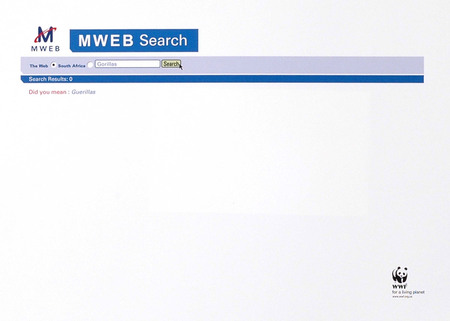
Another soul-stirring example is the Search Engine series by WWF, which portrays a future where animals are so diminished that search engines don’t even look for them—showing their disappearance through the absence of data.
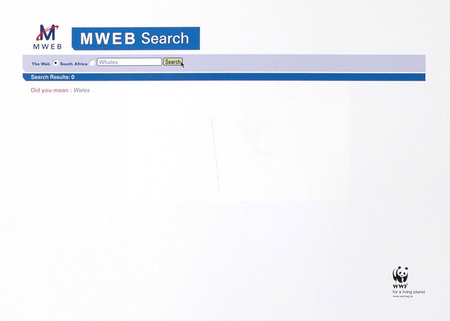
Advertising Posters, 2007, One Show, Search Engine Agency: Ogilvy&Mather/Cape Town Client: WWF
Advertising Posters, 2007, One Show, Search Engine Agency: Ogilvy&Mather/Cape Town Client: WWF
In the images, we see a search engine interface that is familiar to us—and that is precisely what engages the viewer. They see something they are accustomed to, yet they cannot imagine that the system will show nothing after typing «Gorillas» into the search bar.It is by breaking through the things familiar to us that advertising penetrates our daily lives, but under new rules.
The advertisement appeals to the ingrained habit of analyzing information and noticing inconsistencies. By seeing the posters, the viewer constructs frightening scenarios of the future in their own mind.The emotional response stems from personal experiences that probably resonated with everyone. Everyone was searching for something online, and that is what makes the situation personal rather than merely an image.
Gorillas / Tigers / Penguins
In the Gorillas/Tigers/Penguins series, endangered species are literally depicted as ghosts. The silhouettes are still recognizable and discernible, but barely visible.
Advertising Posters, 2010, D&AD Archive WWF, Gorillas/Tigers/Penguins
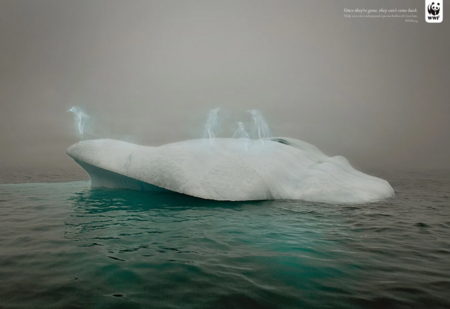
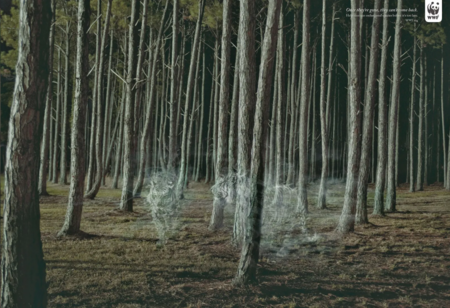
Advertising Posters, 2010, D&AD Archive WWF, Gorillas/Tigers/Penguins
The metaphor on the posters is instantly legible—there is no need to speculate or imagine to understand the subject matter. This image evokes a sense of sadness and loss, as the animals are present yet seem detached from this world. If one considers psychographic profiles, I lean toward the conventionalist here. The advertisement touches upon the desire to preserve the familiar, and disappearance feels like a denial of constancy and stability.
A Comparison of Images of Emptiness
One environmental issue can be presented and conveyed to the consumer in completely different ways, eliciting various feelings and leading to different conclusions.
Population by Pixel operates through scale. The number of pixels is equated to the number of population, and it is through this mechanism that people recognize the situation.
Search Engine appeals to everyday life and the fear of being forgotten; people see a future where even searching proves powerless.
Gorillas/Tigers/Penguins relies on sadness and empathy; the ghostly imagery encourages perceiving extinction as a personal loss.
The Metaphor of Transformation and How Nature Changes Form
Lungs
WWF presents several objects in a single image: healthy trees, a forest, dead stumps, and human lungs.
People are accustomed to perceiving these things separately, and they don’t always remember how closely connected they are. This metaphorical transformation of trees into lungs illustrates that, first and foremost, when we cut down forests, we are harming ourselves.
Poster, 2008, Lungs Agency: TBWA WWF