Concept
The research focuses on the dynamically sublime as presented in Kant’s Critique of Judgment (Sections 23–29). Kant links this experience to the confrontation between humans and a power that transcends their physical capabilities. By recognizing their own vulnerability, individuals simultaneously discover that their rational capacity is not reducible to mere physical existence. The sublime unites the displeasure arising from the limitations of sensory experience with the pleasure gained from realizing the superhuman capacity of humankind. The subject material is the visual world of the album Trench (2018) by Twenty One Pilots, specifically focusing on the music videos for «Jumpsuit, ” „Nico and the Niners, ” and „Levitate.“ The conflict between Clancy and Dema is explored through imagery of control, threat, and resistance: Dema and the bishops represent an overwhelming system, while Banditos and the color yellow symbolize the potential to oppose it. The aim of this work is to investigate the extent to which the visual narrative of Trench allows for interpretation through Kant’s conceptual framework. The core analysis will be based on the official music videos for „Jumpsuit, ” „Nico and the Niners, ” and „Levitate, ” which will be treated as a cohesive narrative. Specific episodes are selected that depict Dema’s space, the bishops, Clancy’s vulnerability, his pursuit and resistance, and the appearance of Banditos and the color yellow. The composition, color, light, movement, and the relationship between the human figure and its environment are analyzed. Additionally, the ending of „Breach“ (2025) is examined to explore the cyclical nature of the conflict and the possibility of the hero’s liberation. The research is structured from theory to analysis. Initially, the distinctions between the beautiful and the sublime, the mathematically sublime and the dynamically sublime, as well as the roles of power, safe contemplation, imagination, and reason, are discussed. Then, the context of Trench is introduced. The analytical section is divided into chapters concerning Dema as an image of oppressive power, Clancy and his physical vulnerability, and Banditos and the color yellow as symbols of resistance. The paper concludes by examining the recurrence of confrontations and the finale of „Breach.“ The primary theoretical source is Kant’s Critique of Judgment, particularly Sections 23–29. To clarify concepts, the article „Kant’s Aesthetics“ from the Stanford Encyclopedia of Philosophy and other scholarly studies on Kantian aesthetics are utilized. The context of Trench is reconstructed using the official music videos, album materials, and group interviews; supplementary publications aid in verifying plot details. The work differentiates between the full…
Navigation
CHAPTER I. DYNAMIC ELEVATION AT THE EDGE

For Kant, the beautiful and the sublime are distinct types of aesthetic judgment. The beautiful is connected to the experience of harmony and the free play between imagination and understanding. The sublime, conversely, is connected to tension: the usual capacities of imagination prove insufficient when faced with something overwhelmingly large or powerful. However, this tension does not end merely in helplessness; it allows one to discover a capacity of reason that is not reducible to sensible perception [1, §§ 23–29; 2, Section 2.7].
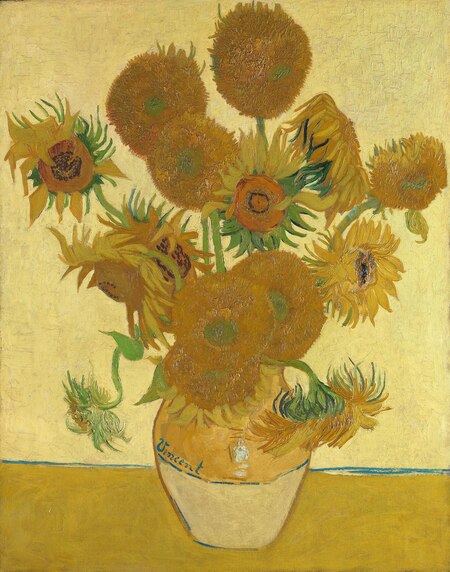
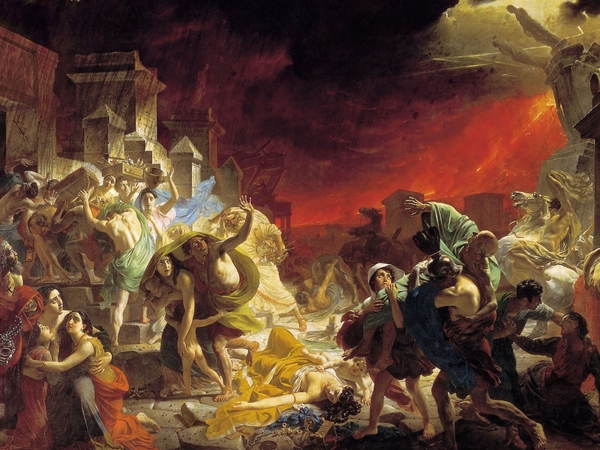
Beautiful: the content of the form (Vincent van Gogh, «Sunflowers,» 1888) / Sublime: confrontation with an overwhelming force (Karl Bryullov, «The Last Day of Pompeii,» 1833)
Kant distinguishes between the mathematically and dynamically sublime. The mathematically sublime relates to magnitude: the imagination cannot grasp something as an absolute whole. The dynamically sublime relates to power: humans contemplate a force capable of physically overwhelming them, yet under certain conditions, it does not possess authority over them in the sense critical to their rational and moral self-consciousness [1, §§ 25–28].
In this study, the focus will be on the dynamically sublime. The mathematically sublime will be used as a contrast—for example, when analyzing the vast landscape in Jumpsuit.
ESO / S. Brunier, Milky Way panorama, 2009
Dynamically Elevated: Power
In $\S$28, Kant defines power as the ability to overcome great obstacles. He calls authority the power that overcomes the resistance of another power. Natural elements can be stronger than a human and physically defeat him. Kant does not deny this. His question, however, is different: does the physical superiority of nature imply that it possesses absolute authority over humanity as a rational being?The dynamically sublime arises when we contemplate nature as a powerful force, yet simultaneously retain the capacity to regard ourselves as beings whose dignity is not determined solely by physical strength [1, $\S$28].
Caspar David Friedrich, «Wanderer Above the Sea of Fog, ” 1818
Kant emphasizes: if a person is genuinely in immediate danger and engaged in rescue, they cannot freely contemplate the event as sublime. Aesthetic judgment requires a distance at which the power can be perceived as threatening, but the observer is not under its direct assault.
Safety does not automatically create the sublime. It merely allows the transition from practical fear and rescue to aesthetic contemplation [1, § 28; 2, section 2.7].
The sublime is connected to «pleasure possible only through displeasure.» Initially, a person experiences the limitations of imagination or physical helplessness. Then, they discover that the rational faculty is not limited by sensory and physical vulnerability. Therefore, the experience has a dual nature: repulsion and attraction, displeasure and pleasure. Kant compares the movement of the soul in the sublime to a fluctuation between being repelled from an object and being drawn toward it [1, § 27; 2, Section 2.7].
Kant insists: the sublime does not reside in nature itself, but in the subject’s mind. A mountain, the sea, or a storm can provide a catalyst for an experience, but they do not possess sublimity as an objective quality. Strictly speaking, nature can only be called «dynamically sublime» in a limited sense—as nature that is perceived by us through the concept of power [1, §§ 23, 28; 2, Section 2.7].
This distinction is crucial for the entire study: the Devas, the Nikas, and the bishops will not be referred to as «sublime objects.» Instead, the analysis will examine how their depiction organizes a similar confrontation with power for the viewer.
Kant primarily examines the sublime through examples from nature. Therefore, applying his theory to a music video requires a qualification. There is a debate in contemporary philosophical literature: Uygar Abaci argues that Kant correctly limits the sublime to nature, while Robert R. Clewis defends the possibility of an artistic sublime [3; 4].
This study does not resolve the debate definitively. It uses Kant as an analytical model to investigate the extent to which a visual work can replicate the structure of the experience described in § 28.
CHAPTER II. THE TRENCH WORLD: SPACE, CHARACTERS, SIGNS
Trench — the 2018 album by Twenty One Pilots. Along with the music videos, it forms a cohesive fictional world where the story is told not only through lyrics but also through space, costumes, color, recurring objects, and characters. For this research, three music videos are especially important: «Jumpsuit,» «Nico and the Niners,» and «Levitate.» They constitute an interconnected visual trilogy; the publication about «Jumpsuit» also describes it as a continuation of the previous video, and the material on the three videos labels «Levitate» as the concluding part of the trilogy [9–11; 14; 17].
In the official retrospective video I Am Clancy, Dema is described as a circular concrete city situated on the green continent of Trench. Its residents are forbidden from leaving its boundaries; Clancy himself refers to himself as both a citizen of the city and a fugitive. This contrast between the enclosed city and the open natural space forms a vital foundation for the visual world [7].
City of Dema, overhead view twenty one pilots — Nico And The Niners (Official Video). Director Andrew Donoho, 2018
According to Clancy’s story in I Am Clancy, nine bishops rule Demy. Their power rests on the religious system of Vailism, which links self-destruction to achieving paradise. The same story explains the bishops' ability to «possess» dead bodies for a limited time. For visual research, the most important point is that the bishops are not presented merely as individual villains, but as carriers of a stable system of control [7].
Bishops (Episcopal), in the center — Twenty One Pilots — Nico And The Niners (Official Video). Directed by Andrew Donoho, 2018
In a 2018 interview with Rob Forbes, Tyler Joseph explains that the yellow details are necessary for the Banditos to recognize each other in the green natural environment. According to him, the bishops cannot distinguish that color. Therefore, the yellow in Trench is not just a general symbol of hope—it has a specific function within the narrative: to signal among themselves while remaining unnoticed by the bishops [13].
Yellow petals that Banditos throws at Clancy twenty one pilots — Jumpsuit (Official Video). Director Andrew Donoho, 2018
Yellow Elements in Banditos' Clothing twenty one pilots — Levitate (Official Video). Directed by Andrew Donoho, 2018
The core of the study consists of three Trench-era clips: Jumpsuit (2018), Nico and the Niners (2018), and Levitate (2018). Heavydirtysoul (2017) is included additionally because the visual motif of the car from this clip reappears in Jumpsuit. I Am Clancy (2024) is used as a retrospective authorial commentary on the narrative, and City Walls from the Breach (2025) album serves as an epilogue, allowing for an examination of the motif of repetition [7; 8–12].