Navigation Menu
1. Research Concept
2. From Luxury to Symbol of Love: The Genesis of the Diamond Tradition. Late 19th Century — 1950s
3. The Diamond as an Essential Engagement Attribute: Forming the Romantic Ideal. 1950s–1990s
4. From Tradition to Reinterpretation: The Diamond in Contemporary Advertising. 2000–2026
5. Conclusion
6. Bibliography
7. Visual Material Sources
Research Concept
The diamond ring today is almost synonymous with engagement. Show it in a romantic film, an advertisement, or a photograph, and no explanation is needed—the viewer understands that it is a proposal of love. Yet, for centuries, engagement jewelry looked completely different, and precious stones long remained the privilege of the wealthy. So why did the diamond ring, out of everything that could be given at such a moment, transform into the enduring symbol of love and a future marriage?
This association has a history, and it is closely linked to jewelry advertising. It all began in the late 19th century when Tiffany & Co. introduced the Tiffany Setting, which lifted the diamond above the ring’s bezel, making the stone the centerpiece of the design. However, one recognizable design was not enough to explain why buying such a ring gradually became an expected part of an engagement. Much of this was shaped by 20th-century advertising, particularly the partnership between the diamond mining company De Beers and the American agency N. W. Ayer, which started in 1938. The advertising spoke not only about the material value of the diamond but also about fidelity, constancy, and the seriousness of romantic relationships. Then, in 1947, copywriter Frances Gerety invented the slogan «A Diamond Is Forever, ” and it became one of the most famous advertising statements of the 20th century.
But the story of the diamond engagement is not limited to one company and one slogan. In different decades, brands appealed to buyers in various ways: some emphasized the beauty and quality of the jewelry, others presented the ring as proof of love, and a third group built narratives around the proposal moment itself. Advertisements featured happy brides, in love couples, close-ups of hands with rings, and promises of a shared future. Over time, this coalesced into a set of recognizable images, which buyers were encouraged to use to envision the perfect engagement.
It is particularly interesting to observe how the placement of the diamond changed within the advertisement. In some ads, it served as a standalone object that the viewer needed to examine and appreciate; in others, it became part of a romantic scene, and at times, it almost vanished behind the characters' emotions. Concurrently, the advertising arguments evolved: the stone’s characteristics were juxtaposed with promises of happiness, and its value could be presented as an indicator of sincere intentions. Such shifts allow us to view advertising not merely as a means of promoting jewelry, but as one of the tools shaping perceptions of love, marriage, and romantic gestures.
Global and international experience are instructive. For instance, the widespread popularity of diamond engagement rings in Japan occurred significantly later than in the United States, and it was accompanied by advertising that linked such jewelry with a modern lifestyle. This example is particularly relevant for research, as it allows us to see how a tradition perceived in one culture as commonplace can be promoted in another as a new model for romantic relationships.
The Goal of This Study — is to trace how the advertising of various jewelry brands shaped, solidified, and subsequently reinterpreted the connection between the diamond and engagement. The primary focus is on the visual elements of advertising communication: composition, character portrayals, methods of showcasing jewelry, the interplay between image and text, romantic narratives, and recurring symbols. It is important to determine which techniques were used to create the emotional value of the diamond and how those techniques evolved depending on time, cultural context, and the nature of the brand being advertised.
The research spans from the late 19th century to 2026. Early jewelry advertising is examined as historical context to understand the role the diamond held before the advent of large-scale advertising campaigns. The central part focuses on the 20th century, when the concept of the diamond engagement ring as an essential engagement symbol became widespread. Contemporary campaigns allow us to trace the subsequent trajectory of this association: some brands continue to appeal to classic notions of romantic love, while others encourage viewing the diamond as a piece of jewelry not necessarily tied to marriage or relationships.The primary methodology will be a historical-comparative analysis of advertising materials. The study will examine magazine ads, promotional posters, catalogs, photographs, and video campaigns from De Beers, Tiffany & Co., Cartier, ArtCarved, Keepsake, Kay Jewelers, Jared, Zales, and other jewelry brands. Comparing examples from different decades will reveal changes in the visual language of advertising and determine which imagery has endured over a long period.
The study is based on the hypothesis that the mass perception of the engagement ring as a symbol of commitment was shaped not only by the properties of the gemstone itself or existing jewelry traditions. A significant influence came from years of advertising communication, which consistently linked the diamond to specific emotions, actions, and life events. Analyzing specific campaigns will help to understand how a commercial image acquired lasting cultural significance and why the diamond ring remains one of the most recognizable symbols of a marriage proposal even decades later.
From Luxury to a Symbol of Love: The Genesis of the Diamond Tradition. Late 19th Century — 1950s
For centuries, a ring served as a symbol of marriage intention long before the diamond became the established engagement stone. One of the most famous early mentions dates back to 1477: Archduke Maximilian of Austria presented Maria of Burgundy with a diamond ring. However, such adornments remained part of aristocratic culture for a long time, and most people did not require purchasing a costly stone for an engagement at all.In the 19th century, things gradually began to shift. Diamond mining, jewelry manufacturing, and trade developed, and diamond jewelry became more accessible to affluent buyers beyond just the aristocracy. Yet, even then, the diamond remained only one option for an engagement ring. Its value was placed on its rarity, the quality of its cut, and the social standing of the person who could afford such a purchase.
A significant step toward the engagement ring design we know today was taken in 1886 with the introduction of the Tiffany Setting. The Tiffany & Co. jewelry house offered a setting with six prongs that lifted the diamond above the metal band. The light gained greater freedom as it passed through the stone, and the stone itself became the focal point of the piece. Alongside the heavy settings of the time, this new design barely distracted from the diamond.
However, several more decades passed between the emergence of the recognizable design and the diamond becoming the mandatory symbol of engagement.
Tiffany & Co. «Tiffany® Setting, ” 1886. Contemporary still life photography of an engagement ring featuring a six-prong diamond setting.
Tiffany & Co. Advertisement for engagement and wedding rings. Magazine advertisement, 1905.
Let’s consider the Tiffany & Co. advertisement from Munsey’s Magazine in 1902. It lacks a romantic narrative, a happy bride, or any guidance for the buyer on how deeply he should love his future wife. They simply offer him a selection of appropriate jewelry—and that’s it; no prepared script for romantic behavior is provided.
This advertisement pairs well with mid-20th-century advertising. The product is similar, but the promotion strategy is vastly different. At the turn of the century, simply announcing that diamond rings were for sale was enough. Later, advertisements increasingly explained the emotions the jewelry should convey and why it should be given specifically during a proposal.
During the Great Depression in the 1930s, the demand for diamonds sharply declined. To win back consumers, De Beers partnered with the American advertising agency N. W. Ayer & Son in 1938, and within a year, a massive campaign emerged where the emphasis shifted from the stone’s material value to its romantic significance.
The advertising spoke differently to men and women. For men, a diamond was a testament to success and serious intent; for women, it was a symbol of love and a future marriage.
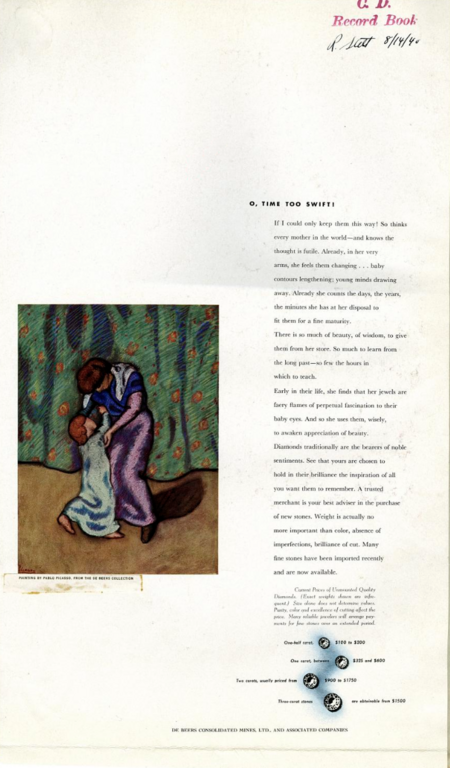
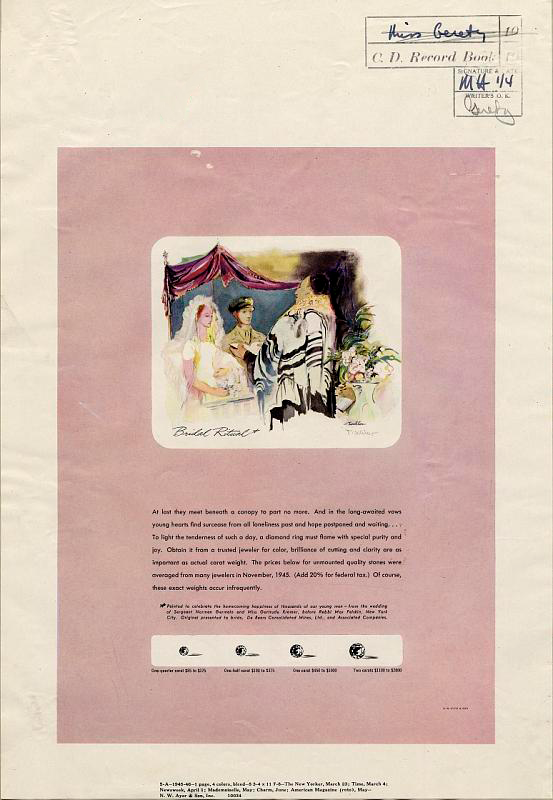
De Beers. «O Time Too Swift, ” 1940. Advertisement reproducing a painting by Pablo Picasso. | De Beers. „Bridal Ritual, ” 1945. Advertisement featuring an illustration by Victor Tichseler.
One of the agency’s signature approaches was the integration of fine art. The painted compositions were accompanied by short texts on love, time, and memory. Through art, De Beers could communicate about diamonds using the language of family, time, and human connection. The gem became associated not only with the owner’s wealth but also with moments people wished to preserve in memory. Both advertisements are part of a single strategy, although the plots differ. The viewer is first prompted to respond to the image, and only then to connect it to the product. This approach is even more evident in De Beers' subsequent advertisements.
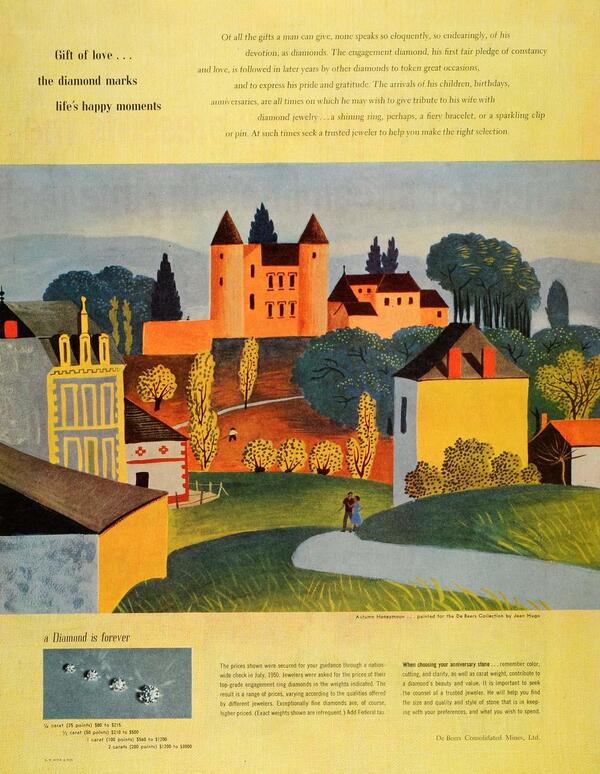
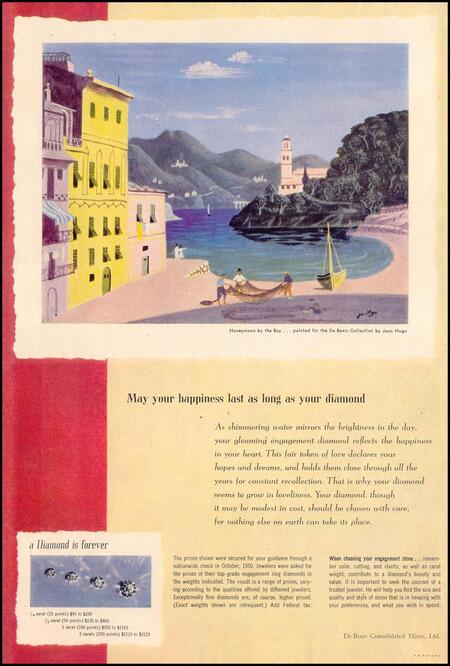
De Beers. Advertisements featuring illustrations by Jean Hugo (from left to right): «Autumn Honeymoon, ” 1950; „Honeymoon by the Bay, ” c. 1950–1951.
In the advertisements for «De Beers Autumn Honeymoon» and «Honeymoon by the Bay» from the early 1950s, illustrations by Jean Hugues were used. These featured romantic landscapes tied to travel and shared memories. The couples almost become lost among the architecture and nature, but without them, the landscape would be just a landscape—it is they who transform it into a story of a shared journey.There are no scenes of a marriage proposal here; the focus is on what happens after the wedding. The buyer is shown not the moment of acquiring the ring, but the happy memories that will later be associated with it.The concept in Honeymoon by the Bay is complemented by the phrase, «May your happiness last as long as your diamond»: may happiness last as long as the diamond. Thus, De Beers links the durability of the stone with the longevity of love, gradually training people to view the diamond as a symbol of enduring relationships.
In 1947, copywriter Francis Gifford of the N. W. Ayer agency came up with the slogan «A Diamond Is Forever”—“A Diamond is Forever.» The phrase is short, but it continues what De Beers had been saying in previous campaigns: a diamond should be a reminder of a love that lasts a lifetime.
The slogan changed the meaning of the message. Previously, the customer was told about the stone’s quality, cut, and size; now, its durability was compared to the constancy of romantic feelings.
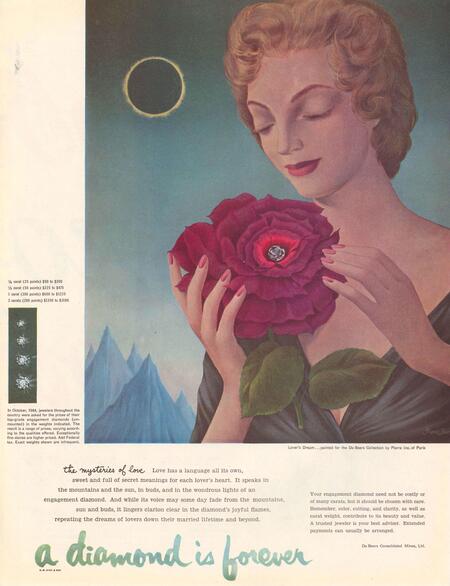
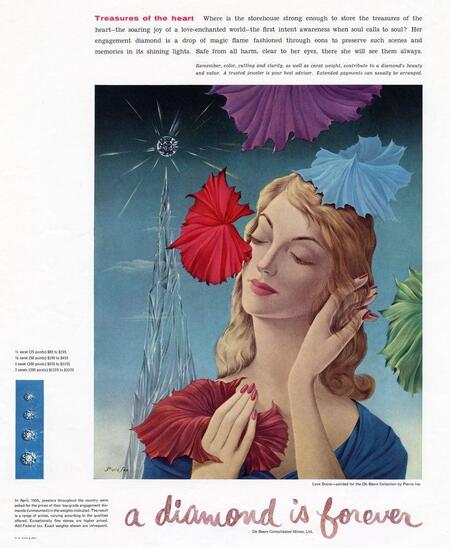
De Beers. «The Mysteries of Love.» Advertisement with an illustration by Pierre Ino, «Lover’s Dream, ” no earlier than October 1954. | De Beers. „Treasures of the Heart, ” 1955. Advertisement with an illustration by Pierre Ino, „Love Scene.“
In the 1954 and 1955 advertisements, De Beers utilizes images of young women, lush flowers, and small, brilliant diamonds. In both cases, the stone is set within an imaginary composition and is not shown as a standalone piece of jewelry. The slogan, «A Diamond Is Forever, ” is displayed prominently at the bottom of both advertisements, framing this contrast as a promise of eternal love.
There are no grooms, wedding ceremonies, or even engagement rings in these visuals. The diamond is presented as a symbol of emotion, and its meaning is not tied to any single event.
Keepsake Diamond Rings. Advertisement, 1946.
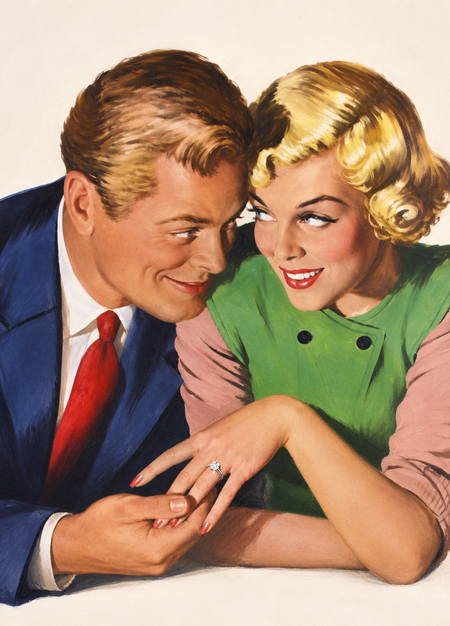
While De Beers was constructing the romantic image of the diamond, ring manufacturers promoted the product more directly—they displayed finished jewelry. A good example is the 1946 Keepsake Diamond Rings advertisement. It features a close-up of a kissing couple surrounded by flowers, with several engagement rings, model names, and prices displayed above the characters. The buyer can immediately view the assortment, compare the models, and learn the prices. Yet, the ring selection takes place alongside the romantic couple, and even the basic product information is read within the context of love and future marriage: the emotional narrative and the assortment work in tandem here.
Keepsake Diamond Rings. «The Proud Look… it’s a Keepsake! , ” 1948. Advertisement.
In the 1948 Keepsake advertisement, the imagery is different: a proud bride displays a ring. The woman is smiling, and the man stands behind her, embracing her. Below the illustration are several models of engagement and wedding rings.The main difference from the previous advertisement is that the ring is now part of the heroine’s gesture. She is not just happy by her loved one’s side; she is showing the jewelry to others. The engagement becomes associated with a specific social gesture, and receiving the ring transforms into an event one wants to share. Meanwhile, the text continues to emphasize the quality of the diamonds and the reliability of the manufacturer, giving the Keepsake buyer two reasons at once: the emotional value of the jewelry and confidence in its specifications.
Keepsake Diamond Rings. Advertisements (left to right): «Darling, it’s a Keepsake!», 1948; «A Keepsake… because I love you», 1949; «Merry Christmas, Darling… it’s a Keepsake», 1949; «For the happiest day of all», 1950.
This is also noticeable in other Keepsake advertisements from the late 1940s. The illustrations depict men kissing their loved ones' hands, examining gifted rings, or embracing future brides. Each piece of jewelry becomes an occasion for a romantic gesture, and the characters' reactions take up more space than the product itself. Furthermore, the situations where the diamond appears evolve: while there are several reasons to purchase a Keepsake, they all revolve around the relationship between a man and a woman.
ArtCarved. «For the loveliest bride of 1950, ” 1950. An advertisement featuring Elizabeth Taylor and Don Taylor dressed as characters from the film „Father of the Bride.“