«…Advertisers attempted to translate the key elements of this discourse into semiotic markers…»
— Robert Goldman, Debora Heath, Sharon Smith. «Commodity Feminism, ” 1991 [7]
Concept
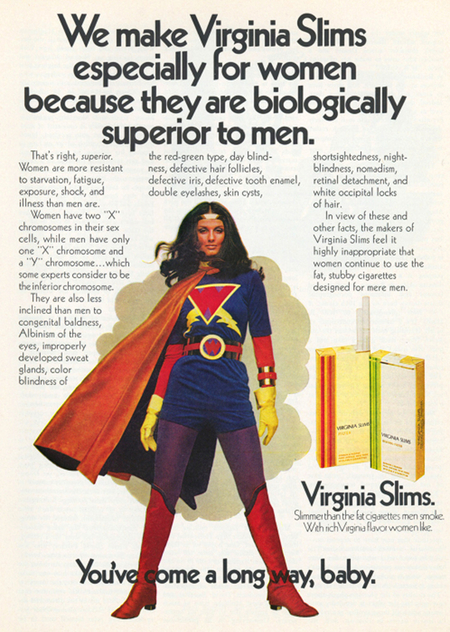
The idea for this topic came to me from an old advertisement for Virginia Slims cigarettes. On the left, there is a small, faded photograph: a woman from the early century is hiding to smoke. On the right, a modern model stands full-length in bright clothing and looks directly at me. Beneath them is the phrase, «You’ve come a long way, doll.» What struck me was that the advertisement says nothing about the tobacco itself. Instead, it tells a story about how women became freer, positioning the pack of cigarettes as the final punctuation mark in that story—as if the purchase itself were the last step toward liberation. This made me curious: when and how did advertising learn to speak like that?
The topic seems important to me also because this technique has not disappeared. Today, brands of clothing, cosmetics, and sporting goods constantly speak about strength, confidence, and the right to be oneself. Therefore, it is useful to return to one of the first instances where the language of female emancipation became the entire language of advertising, rather than just a discrete joke in a slogan.
Key question: At what point did the idea of female liberation transform into a marketing tool, and how is this evident in the images themselves?
I suggest the turning point was 1968 and the Virginia Slims campaign created by Leo Burnett for Philip Morris. Advertising had previously employed the theme of female independence, but here it became the central focus of the brand for years to come. The campaign portrayed liberation as a completed past: the struggle belonged to the black-and-white era, and now all that remained was to choose «your» cigarette. In my view, the subsequent decades show how this language migrated from tobacco advertising into cosmetics, perfumes, and sports, while becoming increasingly personal. If in 1968 it was about all women collectively («you’ve come a long way» together), by the 1990s, a single heroine and her personal choice came to the forefront: «I am worth this, ” „find your voice.“ Freedom shifted from a universal political demand to a personal mood that could be supported by a purchase.The foundation of the visual analysis consists of print ad spreads and television commercials for Virginia Slims from 1968–1979. I selected pieces where recurring techniques are clearly visible: the division between „then“ and „now, ” the model’s pose and gaze, her clothing, and the placement of the slogan and packaging. To check if this logic was general, I included advertisements for other women’s products released around the same time and in the following decades: L’Oréal hair color (1971), Revlon’s Charlie perfume (1973) and Enjoli (1978), a Nike sports campaign (1995), and later Virginia Slims slogans from the 1990s. As background, I briefly feature the „Torches of Freedom“ campaign from 1929, because without it, it is unclear where the pairing of „smoking—freedom“ in cigarette advertising originated. Chronologically, the work concludes at the turn of the 2000s, when a specific term for such advertising emerged and it began to be openly debated.
The final outcome of this work must be an answer to the question posed by the theme itself: did such advertising help women, or did it merely sell their own struggle back to them?
The Cigarette as a «Torch of Freedom»
The idea that smoking makes a woman free emerged forty years before Virginia Slims. But back then, it was a one-time promotion, not an entire brand.
Saulwort and House. Portrait of Lola Montes. Daguerreotype, circa 1851.
The dancer is dressed as a well-bred lady, but the cigarette in her hand betrays a rebel spirit. In the 19th century, a smoking woman was considered almost indecent [3]. It is this very prohibition that advertising later transforms into an advantage: if it is forbidden, then smoking becomes an act of defiance.
Lucky Strike cigarette advertisement with the slogan «Reach for Lucky instead of sweets.» American Tobacco Company, 1929.
There is no discussion of rights yet, but there is already a link drawn between smoking and slenderness. The cigarette is proposed as a dessert substitute. This motif will return forty years later in the very name Virginia Slims, meaning «slender.»
Participants in the Easter parade on Fifth Avenue with cigarettes. New York, 1929. Press photograph.
Participants of the Easter parade on Fifth Avenue with cigarettes. New York, 1929. Press photograph.
The campaign was conceived by publicist Edward Bernays at the request of Lucky Strike. The hired young women smoked directly in front of photographers, and newspapers dubbed their cigarettes «torches of freedom» [3; 4]. For me, this is the first point on the line: the word «freedom» is already attached to a product, but only for a day.
Brand Launch: «You’ve come a long way, kid» (1968–1969)
Virginia Slims appeared in 1968 as a cigarette brand specifically designed for women. It was one of the first commercially successful examples of this positioning: women’s cigarettes existed before, but Virginia Slims made the idea of female independence the core of an entire advertising campaign.
Leo Burnett for Philip Morris. Virginia Slims cigarette advertisement. 1968.
One of the first advertisements. At the top is an old photograph and a note about how in 1915, Mrs. Cynthia Robinson was caught smoking in the cellar, and her husband sent her to her room like a child. At the bottom, the model is in a bright red dress against a plain white background with the inscription, «Now everything is different. Now there is a thin cigarette just for women.» The formula that would last almost twenty years is visible right here.
Walter Landor. Virginia Slims Cigarette Packaging. 1968.
The white, long packet with colored stripes on the side looks more like a perfume bottle or powder compact than a tobacco product. The packaging design already shifts the cigarette into a category of women’s accessories, and the packet will subsequently appear in almost every advertisement alongside a model.
Leo Burnett for Philip Morris. Virginia Slims cigarette advertisement «Nolan was right.» 1969.
Leo Burnett for Philip Morris. Virginia Slims cigarette advertisement: «Before your skirts reach your knees…». 1980.
In the 1969 advertisement, there was a woodcut at the top featuring suffragettes and a male quote claiming that women were not rational enough to vote. At the bottom was a model in a white coat with the caption: first you gained the right to vote, and now you have your own cigarette. The slogan already contained the word «little darling»: in 1968, the phrase about a «long road» was part of the text, and in 1969 it became the slogan [13]. Next to it, for comparison, is the 1980 advertisement. At the top, a woman from the 1920s takes a cigarette out from under her garter, and at the bottom, a smiling model in a very short dress with her hand on her hip. Eleven years passed, but the premise remained the same: previously, smoking had to be done in secret; now, there was no need to hide. The only thing demonstrating freedom now is not the right to vote, but the length of the skirt.
Leo Burnett for Philip Morris. A frame from a Virginia Slims television commercial. Late 1960s.
The Virginia Slims television commercials were essentially print advertisements set in motion. Initially, actors dressed in early 20th-century attire appeared on screen, playing a short, humorous scene: a woman secretly smoking, being caught, her husband becoming angry. The visuals were deliberately stylized to look «vintage, ” like silent film. Then, the scene abruptly shifted, and a modern model in fashionable clothes walked out to an upbeat song. The music repeated the slogan: you’ve come a long way; now you have your own cigarette. I find it important that the past in these commercials always feels comedic. The restrictions and punishments that women faced are transformed into a lighthearted comedy that is easy to laugh at and forget. The struggle is portrayed not as a long, arduous effort by many people, but as a funny episode that has long since concluded. The viewer doesn’t need to think about anything—it’s all in the past; all she has to do is enjoy herself and choose a cigarette. These commercials didn’t last long; in 1971, cigarette advertising was removed from television in the United States, forcing the brand to seek other platforms [17].
«Then» and «Now»: How 1970s Advertising Worked
Рекламы Virginia Slims начала 1970-х: как в них соединяются прошлое и настоящее.
Leo Burnett for Philip Morris. Virginia Slims cigarette advertisement: «Men used to tease women who smoked in public.» 1970.
This is typical Virginia Slims advertising from the early 1970s. The headline references the past: previously, men used to mock women who smoked in public. Like other ads in this series, the past is depicted in a small, black-and-white image, while the present is shown in a large, colorful photograph of a model [10]. If you examine such a spread closely, you can see how precisely everything is calculated. The past occupies a small portion of the page; it is dim and resembles a clipping from an old newspaper. The present takes up almost all the space—it is bright and clean. The eye is first drawn to the humorous story, then moves to the beautiful woman, and finally encounters the slogan and the pack. The result is a short story with a happy ending, and that ending is the purchase itself. Furthermore, the «old» picture is not a document but a staged scene with actors, artificially aged to appear authentic. The story of women here is transformed into mere decoration. Another detail is that these ads speak about the right to smoke, but almost never about the right to work, to earn equal pay, or to control their own money—even though this was precisely what the women’s movement of that era was fighting for.
Leo Burnett for Philip Morris. Virginia Slims Menthol cigarette advertisement. 1971.